Understanding Artificial General Intelligence
Introduction to AGI
The Next Frontier
Most artificial intelligence you encounter today is a specialist. An AI can master chess, recommend your next movie, or translate languages, but it can't do all three. Each one is an expert in its own narrow domain. But what if an AI could learn and reason across many different fields, just like a human can? That's the core idea behind Artificial General Intelligence, or AGI.
AGI
noun
A type of artificial intelligence that possesses the ability to understand, learn, and apply its intelligence to solve any problem that a human being can. It's not limited to a specific task.
AGI is often called “strong AI” or “full AI.” It represents a system with cognitive abilities that are functionally equivalent to a human's. It could learn to write a symphony, then switch gears to discover a new scientific principle, and then learn to bake a cake, all using the same underlying intelligence. This is a stark contrast to the AI we currently have.
Specialists vs. Generalists
The AI systems of today are examples of Artificial Narrow Intelligence (ANI), or “weak AI.” Think of ANI as a highly specialized tool. A calculator is brilliant at arithmetic but can't write a poem. A GPS is an expert at navigation but can't diagnose an illness. ANI systems are incredibly powerful and useful, but their intelligence is confined to the specific task they were designed for.
ANI is a master of one trade. AGI would be a master of all trades, and could even invent new ones.
The key difference is flexibility and generality. An ANI system that plays Go can't use its knowledge to understand the stock market. An AGI, on the other hand, could draw on its general understanding of patterns, strategy, and logic to tackle both challenges. It learns how to learn.
| Feature | Artificial Narrow Intelligence (ANI) | Artificial General Intelligence (AGI) |
|---|---|---|
| Scope | Limited to a single, specific task | Can handle any intellectual task a human can |
| Learning | Trained on a specific dataset for one job | Learns and adapts across various domains |
| Flexibility | Inflexible; cannot perform outside its programming | Highly flexible and adaptable |
| Example | Image recognition software, Siri, AlphaGo | A hypothetical human-like robot or consciousness |
A Long-Held Dream
The concept of AGI isn't new. It has been the implicit goal of artificial intelligence since the field's inception in the 1950s. Early pioneers of AI weren't just trying to make machines that could calculate faster; they dreamed of creating machines that could think in the same general, adaptable way humans do. Alan Turing's famous "imitation game," now known as the Turing Test, was an early attempt to define a standard for a machine with general intelligence.
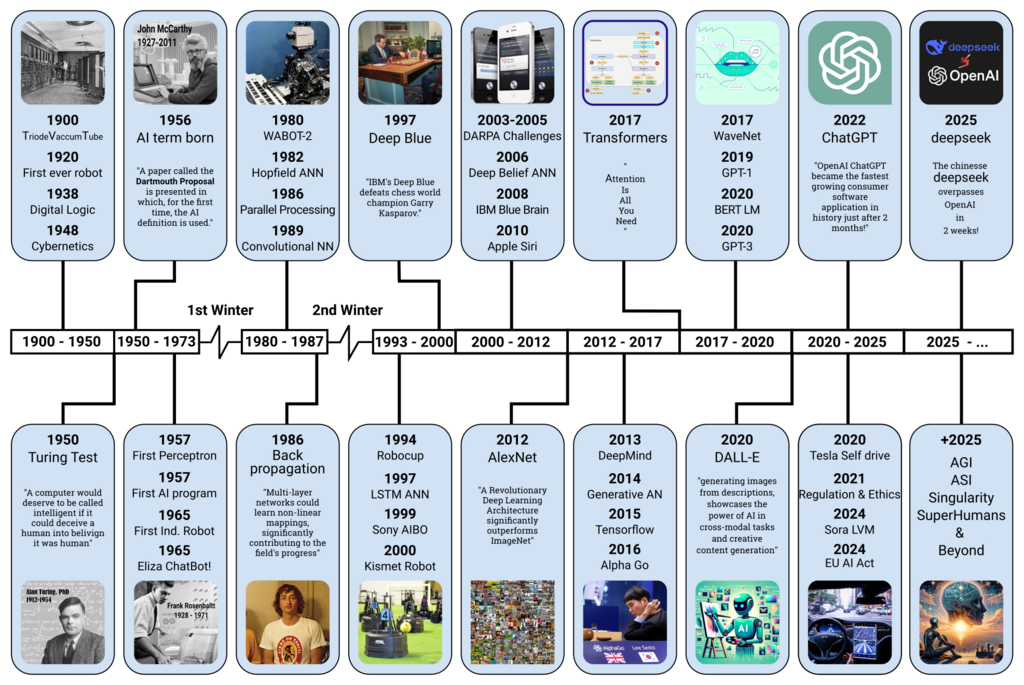
For decades, AGI remained more in the realm of science fiction than science fact. But as ANI systems have become more sophisticated, the conversation around AGI has intensified. It is seen by many as the ultimate destination for AI research—the point where we create a true intellectual partner to humanity.
Artificial intelligence (AI) is a broad field of computer science and engineering that focuses on developing computers capable of performing activities that normally require human intelligence, such as learning, problem-solving, decision-making, and natural language processing.
The significance of achieving AGI would be immense. A system with general human-level intelligence (or greater) could potentially solve some of the world's most complex and pressing problems, from curing diseases to addressing climate change. It represents a fundamental shift in what's possible, moving from creating tools that perform tasks to creating partners that can solve problems.
Now, let's test your understanding of these core concepts.
What is the primary characteristic that distinguishes Artificial General Intelligence (AGI) from the AI we commonly use today?
An AI system designed specifically to master the game of chess is an example of:
While true AGI remains a goal for the future, understanding its definition and how it differs from the AI of today is the first step in appreciating the incredible journey of artificial intelligence.