Understanding Angus Bull Genetics and EPDs
Introduction to Cattle Genetics
The Blueprint in Every Cell
Every animal, including an Angus bull, has an instruction manual inside each of its cells. This manual is called DNA, or deoxyribonucleic acid. It's a long, spiral-shaped molecule that contains all the information needed to build and operate the animal.
Think of DNA as a massive library. This library is organized into volumes called chromosomes. Cattle have 30 pairs of these chromosomes. One set of 30 comes from the sire (father), and the other set of 30 comes from the dam (mother).
Within these volumes, the individual instructions are called genes. Each gene is a specific segment of DNA that codes for a particular trait, like coat color, horn status, or muscle development.
Gene
noun
A distinct sequence of nucleotides forming part of a chromosome, the order of which determines the order of monomers in a polypeptide or nucleic acid molecule which a cell (or virus) may synthesize.
For any given gene, an animal inherits two copies, one from each parent. These different versions of a gene are called alleles. For example, the gene for coat color in Angus cattle has an allele for black and an allele for red.
The specific combination of alleles an animal has is its genotype. What we actually see—the physical expression of those genes, like a black coat—is called its phenotype. The genotype is the recipe, and the phenotype is the finished cake.
Passing Traits to the Next Generation
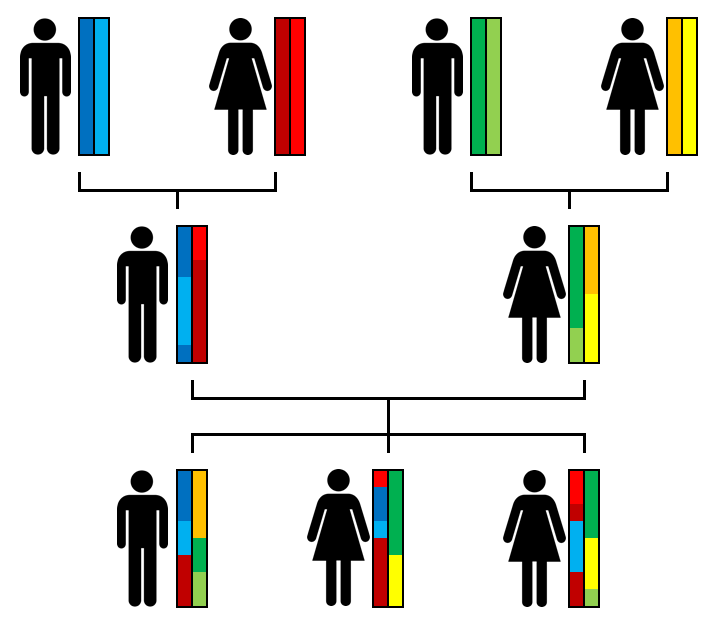
When a bull and a cow reproduce, each contributes one chromosome from each of their 30 pairs to their calf. This means the calf gets a random half of its DNA from its sire and the other half from its dam.
How these alleles interact determines the calf's traits. Some alleles are dominant, while others are recessive. A dominant allele will express its trait even if only one copy is present. A recessive allele needs two copies to be expressed.
In Angus cattle, the allele for a black coat (let's call it 'B') is dominant over the allele for a red coat ('b'). This means a bull with one black allele and one red allele (Bb) will be black. For a calf to be red, it must inherit a red allele from both parents (bb).
An animal with two identical alleles for a trait (like BB or bb) is called homozygous for that trait. If it has two different alleles (like Bb), it's heterozygous. A black bull could be homozygous (BB) or heterozygous (Bb), but you couldn't tell just by looking at it. Its genotype holds the key.
The Source of Variation
If calves are just combinations of their parents' genes, why is there so much variety in a herd? This genetic variation is the lifeblood of any breeding program, and it comes from two main sources.
The first is genetic recombination. During the formation of sperm and egg cells, the chromosomes from the animal's parents get shuffled. Segments of one chromosome can swap with segments of its pair. This creates brand new combinations of alleles to be passed on, ensuring that no two offspring (except identical twins) are exactly alike.
The second source is mutation. Occasionally, a random error occurs when DNA is copied. This creates a brand new allele. While many mutations have no effect or are harmful, some can introduce beneficial new traits into a population. This variation is what allows breeders to select for desirable characteristics, like faster growth, better meat quality, or higher milk yield.
Understanding these basic principles is the first step in making informed breeding decisions. By knowing how traits are inherited and where variation comes from, a producer can begin to select animals that will improve their herd for generations to come.
What is the term for the observable, physical characteristics of an animal, such as its coat color or size?
In Angus cattle, the allele for a black coat (B) is dominant over the allele for a red coat (b). What is the phenotype of a bull with the genotype 'Bb'?