Understanding and Improving Bone Density
Bone Structure
The Blueprint of Bone
Your skeleton is far more than just a rigid frame. Think of bones as living, dynamic organs that are constantly working. They give your body its shape, create a protective shield for vital organs, and anchor the muscles that allow you to move.
The skeletal system provides the framework that supports the body, maintains its shape, and protects what's inside.
A Look Inside
If you could slice a bone in half, you'd see it's made of several distinct layers, each with a specific job. Let's peel them back one by one, starting from the outside.
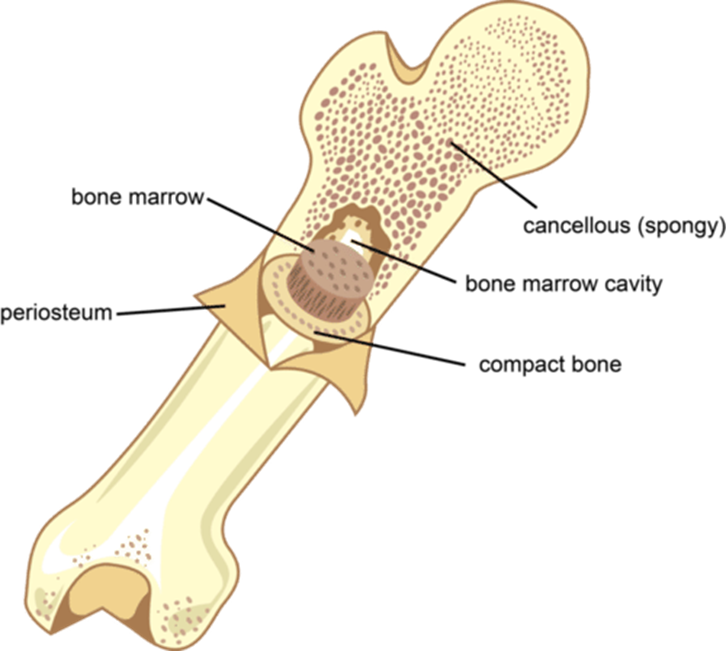
The outer surface is covered by a thin, dense membrane.
Periosteum
noun
A dense layer of vascular connective tissue enveloping the bones except at the surfaces of the joints.
This tough outer layer, the periosteum, is filled with nerves and blood vessels. It’s crucial for nourishing and repairing bone tissue.
Beneath it lies the compact bone. This is the hard, dense, and smooth layer that you probably picture when you think of a skeleton. It provides most of the bone's strength and support.
Deeper still is the spongy bone, also known as cancellous bone. Despite its name, it's very strong. Its porous, honeycomb-like structure helps absorb shock and makes bones lighter without sacrificing strength. You'll find it at the ends of long bones and in the middle of others.
At the very center of many bones is the bone marrow. This is a jelly-like substance that fills the cavities. There are two types: red marrow, which is responsible for producing our blood cells, and yellow marrow, which is mostly fat.
Built for the Job
Not all bones are shaped the same way, because they don't all do the same job. Anatomists generally classify them into four main categories based on their form.
| Type | Description | Examples |
|---|---|---|
| Long Bones | Longer than they are wide, with a shaft and two ends. They act as levers. | Femur (thigh bone), Humerus (upper arm bone), Phalanges (finger bones) |
| Short Bones | Roughly cube-shaped. They provide stability and support with little movement. | Carpals (wrist bones), Tarsals (ankle bones) |
| Flat Bones | Thin, flattened, and often curved. They serve as protective shields for organs. | Cranial bones (skull), Sternum (breastbone), Ribs |
| Irregular Bones | Have complex shapes that don't fit into the other categories. | Vertebrae (spinal bones), Pelvic bones, Facial bones |
This variety in shape and size allows the skeletal system to perform its many functions efficiently, from the fine movements of your fingers to the powerful strides of your legs.
What is the primary function of red bone marrow?
If you were to view a cross-section of a long bone from the outside in, what is the correct sequence of layers?