Understanding AI Language Models
Introduction to Artificial Intelligence
What Is Artificial Intelligence?
Artificial intelligence is the science of making machines that can think or act like humans. The core idea is to build systems that can perform tasks that typically require human intelligence, like learning from experience, solving problems, understanding language, and recognizing patterns.
At its core, Artificial Intelligence refers to the simulation of human intelligence in machines programmed to think, learn, and problem-solve.
Think of it this way: when you learn to ride a bike, you don't follow a rigid set of instructions. You try, you fall, you adjust, and eventually, you figure it out. AI systems, particularly a subset called machine learning, operate on a similar principle. They are given vast amounts of data, and they learn to identify patterns and make decisions on their own, improving with more experience.
Artificial Intelligence
noun
A wide-ranging branch of computer science concerned with building smart machines capable of performing tasks that typically require human intelligence.
This ability to learn and adapt is what makes AI so powerful. It's not about creating robots with human emotions, like in the movies. Instead, it's about creating practical tools that can handle complex tasks efficiently and at a scale humans can't.
A Brief History of AI
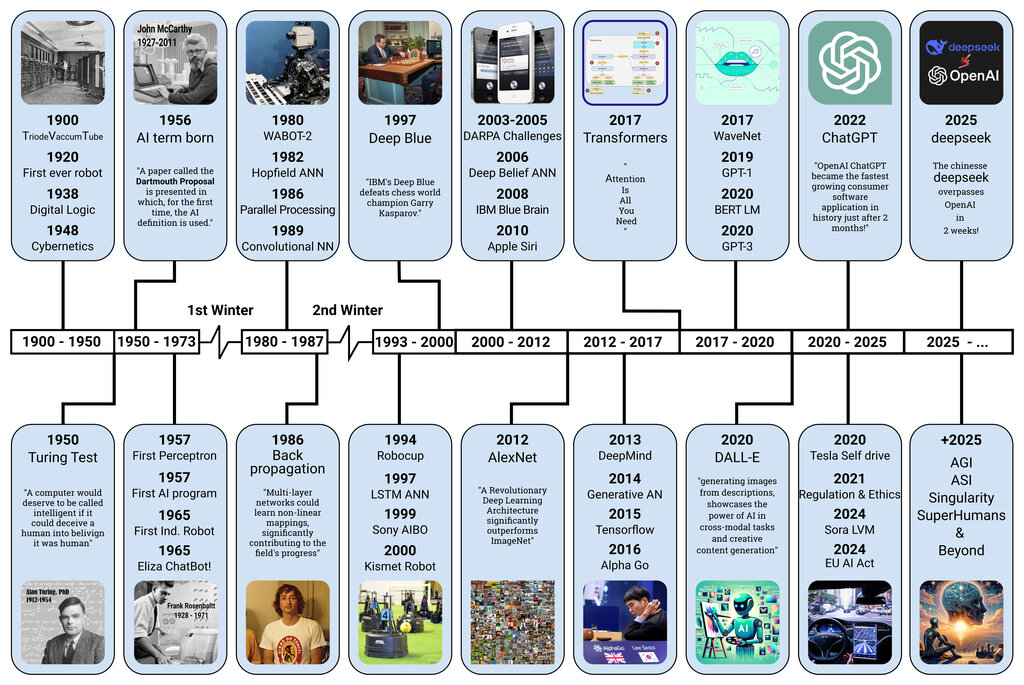
The dream of creating intelligent machines has been around for centuries, but the formal field of AI research began in the 1950s. A pivotal moment was the Dartmouth Workshop in 1956, where the term "artificial intelligence" was officially coined. Early researchers were incredibly optimistic, believing that a machine as intelligent as a human being was just a few decades away.
However, progress was slower than expected. The complexity of creating true intelligence led to periods known as "AI winters," when funding dried up and public interest waned. But the research never stopped.
Key milestones kept the field moving forward. In 1997, IBM's Deep Blue chess computer defeated world champion Garry Kasparov, a major symbolic victory. More recently, the explosion of available data and massive increases in computing power have fueled a new era of rapid advancement. This has allowed for the development of sophisticated models that can understand language, generate images, and even write code.
AI in Everyday Life
AI isn't just a futuristic concept; it's already a part of our daily lives. When you ask a voice assistant for the weather, get a movie recommendation on Netflix, or use a navigation app to avoid traffic, you're using AI. These tools learn your preferences and use real-time data to provide helpful, personalized experiences.
Beyond personal convenience, AI is transforming major industries. It helps doctors diagnose diseases from medical scans, enables banks to detect fraudulent transactions in real time, and allows farmers to monitor crop health to improve yields.
| Industry | AI Application |
|---|---|
| Healthcare | Analyzing medical images to detect cancer |
| Finance | Approving loans and detecting fraud |
| Transportation | Developing self-driving cars and optimizing traffic flow |
| Entertainment | Recommending songs, movies, and shows |
| Manufacturing | Using robots for assembly and quality control |
The main goal of AI is to create systems that can either replicate or augment human intelligence. This can mean automating repetitive or dangerous tasks, like inspecting infrastructure with drones. It can also mean helping us solve complex problems that are beyond human cognitive limits, such as modeling climate change or discovering new medicines.
Ultimately, the objective is to build tools that can perceive their environment, reason about challenges, and take actions to achieve specific goals, making our world more efficient, safer, and more connected.
Ready to check your understanding?
What is the fundamental goal of artificial intelligence?
The analogy of learning to ride a bike is used to explain how AI systems, particularly machine learning, operate. What key principle does this illustrate?
This introduction just scratches the surface of what AI is and what it can do. By understanding its core definition, history, and applications, you have a solid foundation for exploring this transformative technology.