Understanding AI Knowledge Fabrics
Knowledge Representation Basics
How AI Represents Knowledge
For an AI to reason about the world, it needs more than just raw data; it needs knowledge. This has been a central challenge since the early days of AI. Initial approaches, known as symbolic AI, focused on explicitly programming rules and relationships into a system. For example, you might tell a machine: "All humans are mortal" and "Socrates is a human." The AI could then deduce that "Socrates is mortal." While powerful for well-defined problems, this method is brittle and doesn't scale well to the messy, unpredictable real world.
The modern goal is to create systems that can understand the meaning and context behind data without having every rule spelled out. This requires a shift from manually encoding facts to building flexible, interconnected webs of information. The solution lies in representing knowledge in a way that is both human-readable and machine-understandable, allowing different systems to share and reuse information seamlessly. This is the foundation of the knowledge fabric.
The Building Blocks of Meaning
To make data machine-understandable, we need to give it structure and context. This is where ontologies and semantic principles come into play. An ontology is a formal model that defines a set of concepts within a domain and the relationships between them. It's like a dictionary and a rulebook combined, providing a shared vocabulary for AI systems.
This formal modeling is the core idea behind the Semantic Web, a vision for a web of data that can be processed directly by machines. To achieve this, several key technologies were developed. The most important are the Resource Description Framework (RDF) and the Web Ontology Language (OWL).
| Technology | Purpose | Analogy |
|---|---|---|
| RDF | Describes resources using simple statements | A simple sentence (Subject-Predicate-Object) |
| OWL | Adds a rich vocabulary and rules to RDF data | A grammar book that defines complex sentence structures |
provides a simple, flexible framework for describing things using statements called "triples," in the form of subject-predicate-object. For example: (Paris) - (is the capital of) - (France). OWL builds on top of RDF, allowing for more complex relationships and rules, such as stating that a capital city must be located within the country it governs. Together, they allow us to build rich, machine-readable models of knowledge.
From Encoding to Understanding
The shift from explicit, hard-coded rules to these flexible, semantic models is profound. Instead of a single, monolithic knowledge base, we can now create a decentralized web of interconnected data. Different systems can share and contribute to this web because they all speak the common language of RDF and OWL.
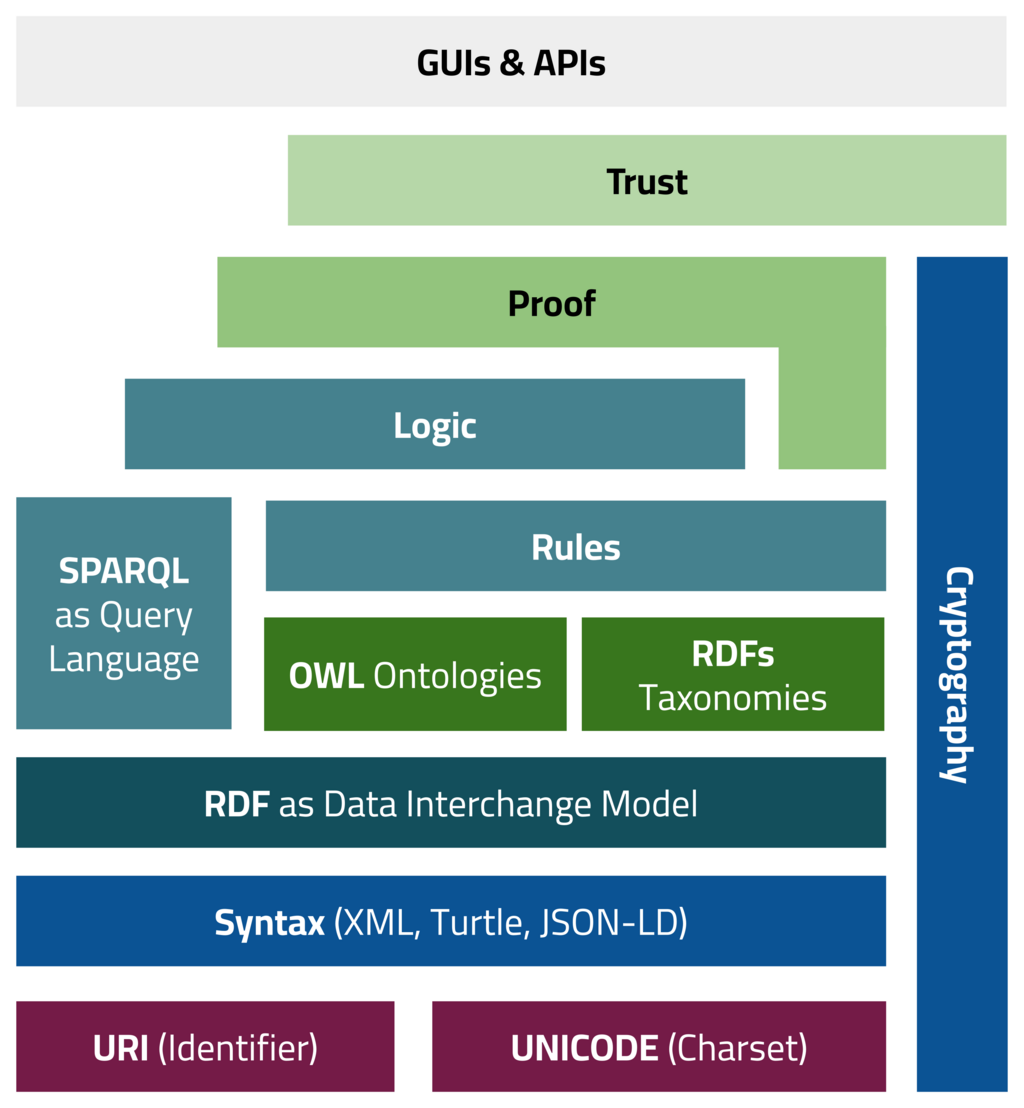
This approach turns data into a dynamic, interoperable resource. It enables AI applications to discover new connections, infer unstated facts, and integrate information from diverse sources. This is the essence of a knowledge fabric: not just storing data, but creating an environment where knowledge can be woven together, understood, and put to use. These foundational principles are what make that possible.
Let's review these core concepts.
What is the primary limitation of early symbolic AI approaches, where knowledge is encoded as explicit rules?
In the context of AI and the Semantic Web, what is an ontology?