Understanding AI and Your Digital Assistant
Introduction to Artificial Intelligence
What Is Artificial Intelligence?
At its heart, artificial intelligence is about making machines smart. It's a field of computer science dedicated to creating systems that can perform tasks that normally require human intelligence. This includes things like learning from experience, understanding language, recognizing objects, solving problems, and making decisions.
Artificial Intelligence
noun
The theory and development of computer systems able to perform tasks that normally require human intelligence.
Think of it this way: instead of programming a computer with a rigid set of instructions for every possible scenario, AI allows a machine to figure things out on its own. It’s not about creating a robot that feels emotions, but about building tools that can perceive their environment, reason about it, and take actions to achieve specific goals.
A Brief History of AI
The dream of intelligent machines has been around for centuries, but the actual scientific field is relatively young. The term "artificial intelligence" was first coined at a workshop at Dartmouth College in 1956. Early researchers were incredibly optimistic, believing that a machine as intelligent as a human being was just a few decades away.
Progress wasn't always a straight line. The field went through periods of excitement followed by "AI winters," when funding dried up and public interest faded due to overly ambitious promises. However, the last couple of decades have seen an explosion in AI development, largely thanks to two things: the availability of massive amounts of data and the development of much more powerful computers.

The Two Main Types of AI
When people talk about AI, they are usually referring to one of two broad categories. It's important to understand the difference between the AI we have today and the AI we see in science fiction.
Artificial Narrow Intelligence (ANI): This is AI that is specialized for one particular task. It can be incredibly good at that single task, often surpassing human ability. All the AI we use today falls into this category.
Artificial General Intelligence (AGI): This is a hypothetical type of AI that possesses the ability to understand, learn, and apply its intelligence to solve any problem, much like a human being. AGI does not yet exist.
Every AI application you interact with, from the spam filter in your email to your phone's voice assistant or a navigation app, is a form of Narrow AI. It's excellent at its job but can't operate outside its specific programming. An AI that can beat the world champion at chess cannot drive a car or recommend a movie.
AI's Core Concepts
So how do we make machines intelligent? It comes down to a few key ideas. While the field is vast, most modern AI is built on the concept of machine learning.
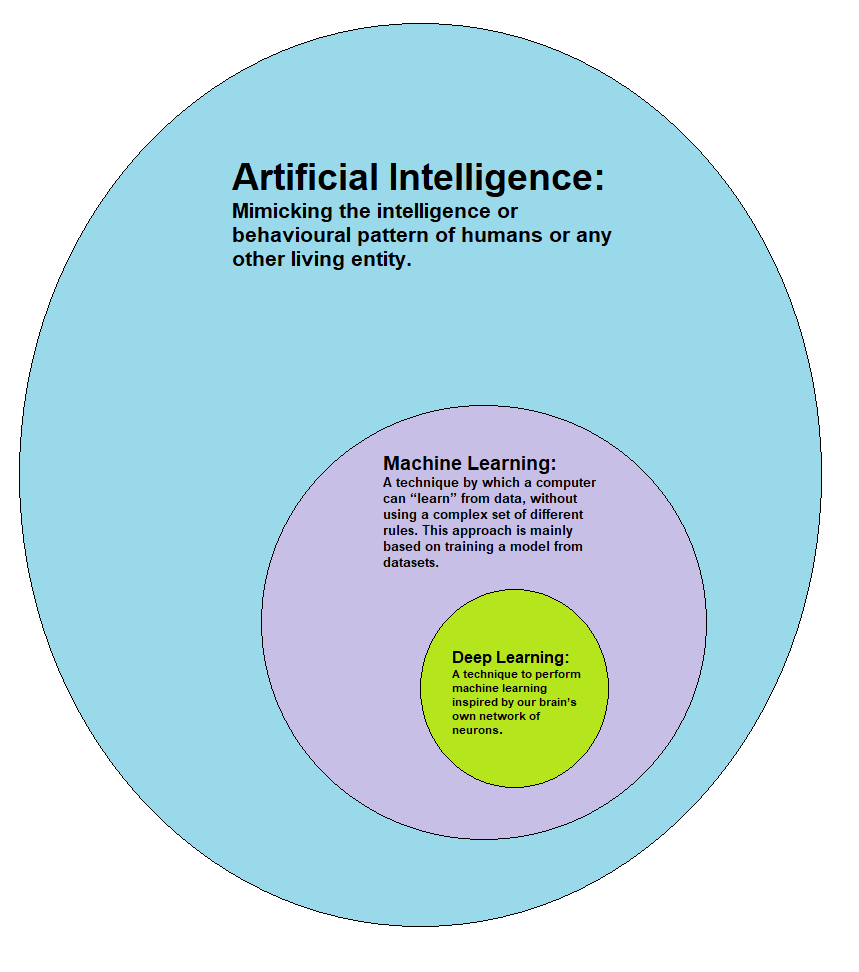
Machine Learning (ML) is a subset of AI where systems learn directly from data without being explicitly programmed. Instead of writing rules, developers feed the system huge amounts of data and let it identify patterns and make predictions on its own. For example, a spam filter learns to identify junk mail by analyzing millions of emails that have been labeled as "spam" or "not spam."
Neural Networks are a type of machine learning model inspired by the structure of the human brain. They are made up of interconnected layers of nodes, or "neurons," that process information. Deep Learning is simply the use of very large neural networks with many layers, which allows them to learn incredibly complex patterns from data. This is the technology behind self-driving cars and image recognition.
Natural Language Processing (NLP) is a branch of AI that gives computers the ability to understand, interpret, and generate human language. It's what allows you to talk to your smart speaker, use translation apps, and see chatbots answer customer service questions.
AI in the Real World
Artificial intelligence is no longer just a futuristic concept; it's a practical tool that is reshaping industries across the globe. Its applications are diverse and growing every day.
| Industry | Application of AI |
|---|---|
| Healthcare | Analyzing medical images like X-rays and MRIs to detect diseases earlier, predicting patient outcomes, and discovering new drugs. |
| Finance | Detecting fraudulent transactions, automating trading, and providing personalized financial advice through robo-advisors. |
| Retail | Recommending products to shoppers, managing inventory, and optimizing supply chains to ensure products are in the right place at the right time. |
| Transportation | Powering self-driving cars, optimizing traffic flow in cities, and creating more efficient delivery routes for logistics companies. |
| Entertainment | Creating personalized playlists on music streaming services, recommending movies and shows, and even assisting in the creation of visual effects for films. |
This is just the beginning of understanding what AI is and what it can do. By grasping these core ideas, you have a solid foundation for exploring the more advanced concepts that are driving this technological revolution.