Understanding AI Agents
Introduction to AI Agents
What Is an AI Agent?
Think about a robot vacuum cleaner. It navigates your home, senses dirt, avoids obstacles, and returns to its dock to recharge. It operates on its own to achieve a goal: a clean floor. In the world of artificial intelligence, this vacuum cleaner is a simple example of an agent.
An AI agent is a system that can perceive its environment through sensors, process this information, and act upon the environment through actuators to achieve specific goals.
Let's break that down.
- Environment: This is the world the agent operates in. For the robot vacuum, it's your living room. For a stock-trading AI, it's the financial market.
- Sensors: These are the tools the agent uses to perceive its environment. The vacuum has bump sensors, infrared sensors to detect walls, and dirt sensors. A self-driving car has cameras, radar, and LiDAR.
- Actuators: These are the parts the agent uses to take action. The vacuum's actuators are its wheels, brushes, and suction motor. A self-driving car's actuators are the steering wheel, accelerator, and brakes.
This perception-action loop is the fundamental basis of how AI agents work. They observe, decide, and act, all in service of a goal. This simple model applies to everything from a smart thermostat adjusting the temperature to a complex AI managing an entire city's power grid.
The Core Traits of an Agent
Not every program is an agent. What sets agents apart are a few key characteristics that enable them to operate intelligently and effectively. These traits exist on a spectrum, with simpler agents showing basic versions and more advanced agents exhibiting them to a high degree.
Autonomy
noun
The ability to operate without direct, constant human intervention. An autonomous agent can make its own decisions to achieve its goals based on its perceptions.
Next is reactivity. This is the ability to perceive the environment and respond to changes in a timely fashion. A reactive agent doesn't just follow a script; it adapts. When a self-driving car's sensors detect a pedestrian stepping into the road, its reactive nature makes it hit the brakes immediately.
Then there's proactivity. This is the opposite of just reacting. Proactive agents take initiative rather than waiting for something to happen. They are goal-driven. Your email's spam filter is a great example. It doesn't wait for you to label junk mail; it proactively identifies and files away suspicious messages to keep your inbox clean.
Finally, many advanced agents have social ability. This means they can communicate and cooperate with other agents (and even humans) to achieve a common goal. In a modern automated warehouse, multiple robotic agents coordinate their paths to retrieve items and avoid collisions, working together far more efficiently than they could alone.
A Quick Look Back
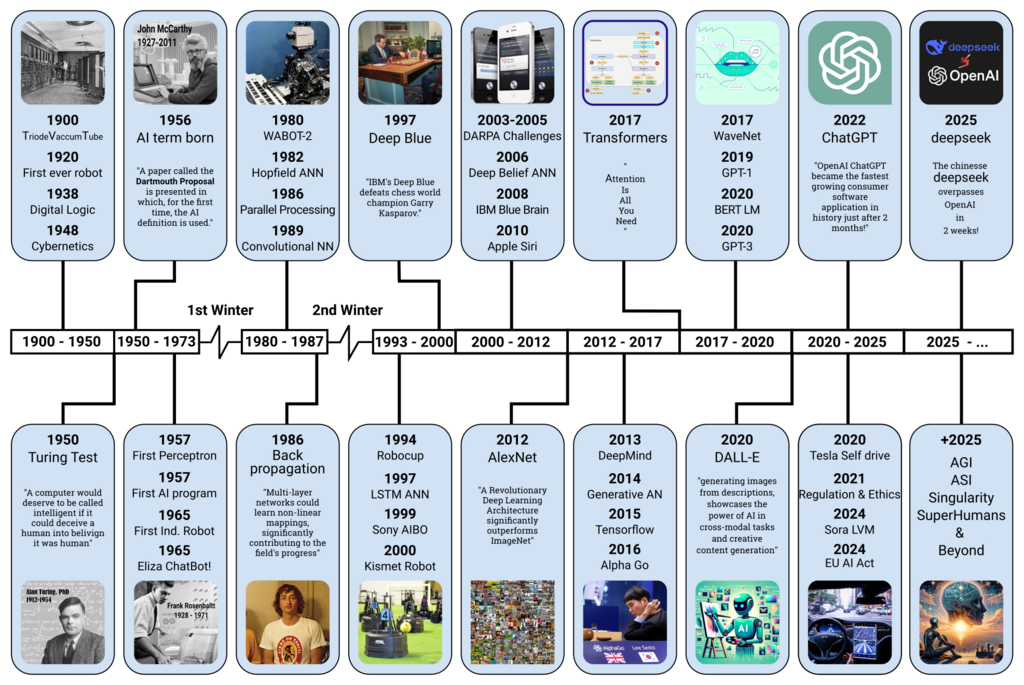
The idea of agents isn't new. It has roots in the earliest days of AI and computer science, dating back to the 1940s and 50s. Early thinkers in fields like cybernetics explored the concepts of feedback loops and goal-oriented systems, which are central to how agents work.
However, for a long time, AI research focused on creating large, monolithic systems designed to be masters of a single task, like playing chess. Over time, many researchers realized that breaking down complex problems and assigning them to smaller, cooperating agents could be a more powerful and flexible approach.
This shift led to the rise of multi-agent systems (MAS) and the formalization of agent-based AI in the 1980s and 90s. The internet's growth also played a huge role, creating a vast, dynamic environment perfect for software agents to navigate and perform tasks, from search engine crawlers to e-commerce bots.
Why Agents Matter
Agents provide a powerful framework for building complex AI systems. By thinking in terms of autonomous, goal-driven entities, we can design solutions for problems that are too large, dynamic, or distributed for a single, centralized program to handle.
From personal assistants on our phones to the algorithms that manage logistics for global shipping, AI agents are already a fundamental part of our technological landscape. They represent a key step toward creating more capable and independent artificial intelligence that can tackle real-world challenges.
Ready to check your understanding? Take this quick quiz to see what you've learned about AI agents.
A robot vacuum cleaner has wheels to move, brushes to sweep, and a motor for suction. In the context of an AI agent, what are these components collectively known as?
An AI agent's ability to take initiative to achieve its goals, rather than simply responding to its surroundings, is known as ______.
Understanding the basic concept of an agent is the first step in exploring the vast and exciting world of artificial intelligence.