Understanding AI Agents
Introduction to AI Agents
What Is an AI Agent?
At its core, an Artificial Intelligence (AI) agent is anything that can view its environment through sensors and act upon that environment through actuators. Think of it as an autonomous entity that perceives, thinks, and acts.
agent
noun
An entity that perceives its environment and acts upon it.
This is a broad definition. A simple thermostat is an agent. It senses the room's temperature (perception) and turns the furnace on or off (action). A self-driving car is also an agent. It senses traffic, road signs, and pedestrians (perception) and controls the steering, acceleration, and braking (action). The key difference is the complexity of their decision-making.
An agent's job is to take in information and perform the best possible action in a given situation. This leads us to some fundamental principles that define how these agents operate.
Core Principles of Agents
Not all agents are created equal. Their intelligence and usefulness are defined by a few key characteristics.
Autonomy: An agent is autonomous if its actions are based on its own experience and knowledge, rather than being hard-coded by a programmer for every possible scenario. A truly autonomous agent can adapt to new situations.
Reactivity: An agent must be able to react to changes in its environment in a timely manner. A self-driving car that doesn't react quickly to a pedestrian stepping onto the road isn't very useful, or safe.
Proactiveness: Good agents don't just react; they take initiative. They have goals and work towards them. A smart assistant that only answers direct questions is reactive. One that reminds you to leave for a meeting because of traffic is being proactive.
Social Ability: In many cases, agents need to interact with other agents or with humans. This could be a team of robots coordinating to build a car or a chatbot communicating with a customer. This interaction requires a form of communication and cooperation.
The most important principle is rationality. A rational agent is one that, for any sequence of perceptions, performs the action that is expected to maximize its performance measure, given the evidence provided by the perception sequence and whatever built-in knowledge the agent has.
In simpler terms, a rational agent always tries to do the "right thing." The "right thing" is defined by a performance measure that tells us how successful the agent is. For a vacuum-cleaning agent, the performance measure might be the amount of dirt cleaned up in an hour. For a self-driving car, it might be reaching the destination safely and quickly.
Types of AI Agents
Agents can be categorized based on how they make decisions. They range from very simple to incredibly complex.
1. Simple Reflex Agents
These are the most basic agents. They make decisions based only on the current situation, ignoring past history. They operate on a simple "condition-action" rule: if this happens, do that. A smart light that turns on when it senses motion is a simple reflex agent.
Simple reflex agents are fast but have limited intelligence. They can't function well if the environment is only partially observable, meaning their sensors don't give them the full picture.
2. Model-Based Reflex Agents
To handle partial observability, an agent needs to maintain some internal state to track the parts of the world it can't see. This internal state is a "model" of the world. A model-based agent updates this model based on how the world evolves and how its own actions affect the world. For example, a self-driving car needs to remember there's a truck in the next lane even when it's in a blind spot.
3. Goal-Based Agents
Knowing about the current state of the environment isn't always enough. Sometimes, the agent needs a goal. Goal-based agents use goal information to choose among possible actions. For instance, if you're at a crossroads, your decision of whether to turn left or right depends on your destination. The agent can consider sequences of actions that will lead to its goal, which allows for planning.
4. Utility-Based Agents
Sometimes having a goal isn't enough either. There might be many ways to achieve a goal, some better than others. A utility-based agent tries to maximize its own "utility," which is a measure of happiness or satisfaction. If a trip-planning agent has a goal of getting you to the airport, a utility function can help it decide between a faster but more expensive route and a cheaper but slower one, based on your preferences.
This allows for more nuanced decision-making in complex situations where there are trade-offs between different outcomes.
5. Learning Agents
A key hallmark of intelligence is the ability to learn. A learning agent can operate in unknown environments and become more competent over time. It has two main parts: a "learning element" that makes improvements, and a "performance element" that selects external actions (essentially, the agent itself). The learning element uses feedback on how the agent is doing and determines how the performance element should be modified to do better in the future.
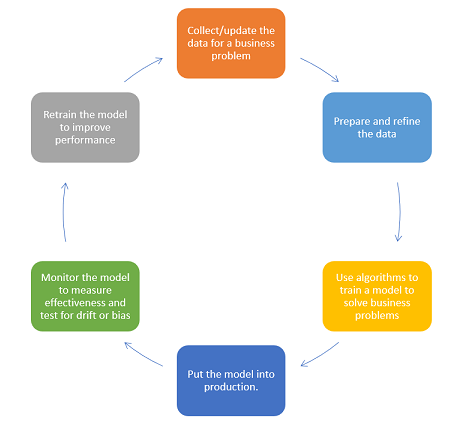
These agent types build upon each other, from simple reactions to complex, goal-oriented, and adaptive behavior. Understanding these fundamental structures is the first step in exploring the world of artificial intelligence.