Understanding a Core Concept
Introduction to the Topic
What Is Artificial Intelligence?
Artificial Intelligence, or AI, is about creating machines that can think, learn, and solve problems like humans. It's not just one thing, but a vast field of computer science. The goal is to build systems that can perform tasks that normally require human intelligence. This includes everything from understanding language and recognizing images to making decisions and even creating art.
Think of it as the science of making computers smart. The scope ranges from the voice assistant on your phone to complex systems that can help doctors diagnose diseases.
Algorithm
noun
A process or set of rules to be followed in calculations or other problem-solving operations, especially by a computer.
AI isn't a single technology. It's an umbrella term that covers many different approaches and techniques. One of the most important is machine learning, where systems learn patterns from large amounts of data instead of being explicitly programmed for a task.
A Quick Trip Through Time
The dream of intelligent machines isn't new; it has roots in ancient myths. But the scientific journey began in the mid-20th century. The term "Artificial Intelligence" was first coined at a conference at Dartmouth College in 1956, which is widely considered the birthplace of AI as a field.
The early years were filled with excitement and bold predictions. Researchers developed programs that could solve algebra problems and play checkers. However, progress slowed in the 1970s and 80s due to limitations in computer power and data availability, periods known as "AI winters."
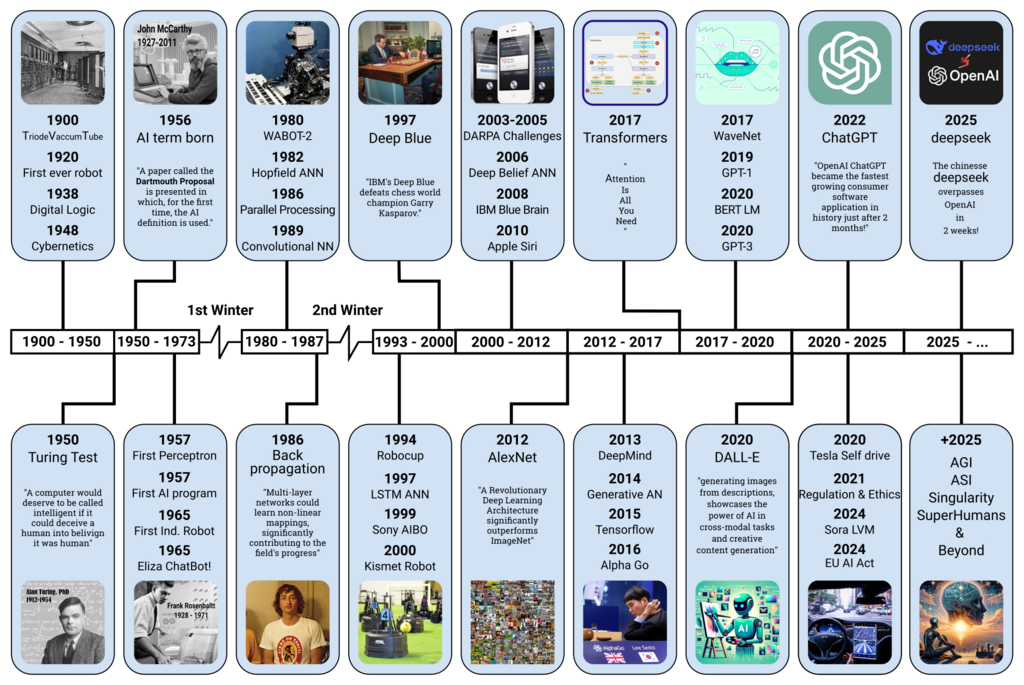
The last couple of decades have seen an explosion in AI development. This boom is fueled by two key factors: the availability of massive datasets (thanks to the internet) and the development of powerful, faster computers. These advances have made it possible to train more complex AI models, leading to the breakthroughs we see today.
AI in Your Daily Life
You might not always notice it, but AI is already all around us. It works behind the scenes to make many everyday technologies smarter and more useful.
| Application | How AI is Used |
|---|---|
| Navigation Apps | Calculates the fastest route by analyzing real-time traffic data. |
| Streaming Services | Recommends movies and shows based on your viewing history. |
| Filters out spam and suggests replies to messages. | |
| Online Shopping | Shows you personalized product recommendations. |
| Smart Assistants | Understands your voice commands to play music or answer questions. |
Beyond these conveniences, AI is also transforming major industries. In healthcare, it helps analyze medical images to detect diseases earlier. In finance, it identifies fraudulent transactions. And in transportation, it's the core technology behind self-driving cars. These examples show how AI is not just a futuristic concept but a practical tool with significant real-world impact.
Let's check your understanding of these core ideas.
What is the fundamental goal of Artificial Intelligence?
Which statement best describes the relationship between Artificial Intelligence (AI) and Machine Learning (ML)?