Uncovering Charmagne History and Impact
Etymological Foundations
The Germanic Root
The journey of the name Charmagne begins not in France, but in the forests of ancient Germania. Its first component, 'Char-', is a direct descendant of the Old High German word karl, meaning "free man." This wasn't just any man, but one who was not a serf or a slave—a person of standing in their community. The name was common among the Franks, a collection of Germanic tribes who would later give their name to France.
As the Franks rose to power, so did the name. It evolved into the Latinized Carolus, which eventually became the familiar name Charles. The core meaning, however, remained tied to this idea of a strong, independent man.
The Latin Addition
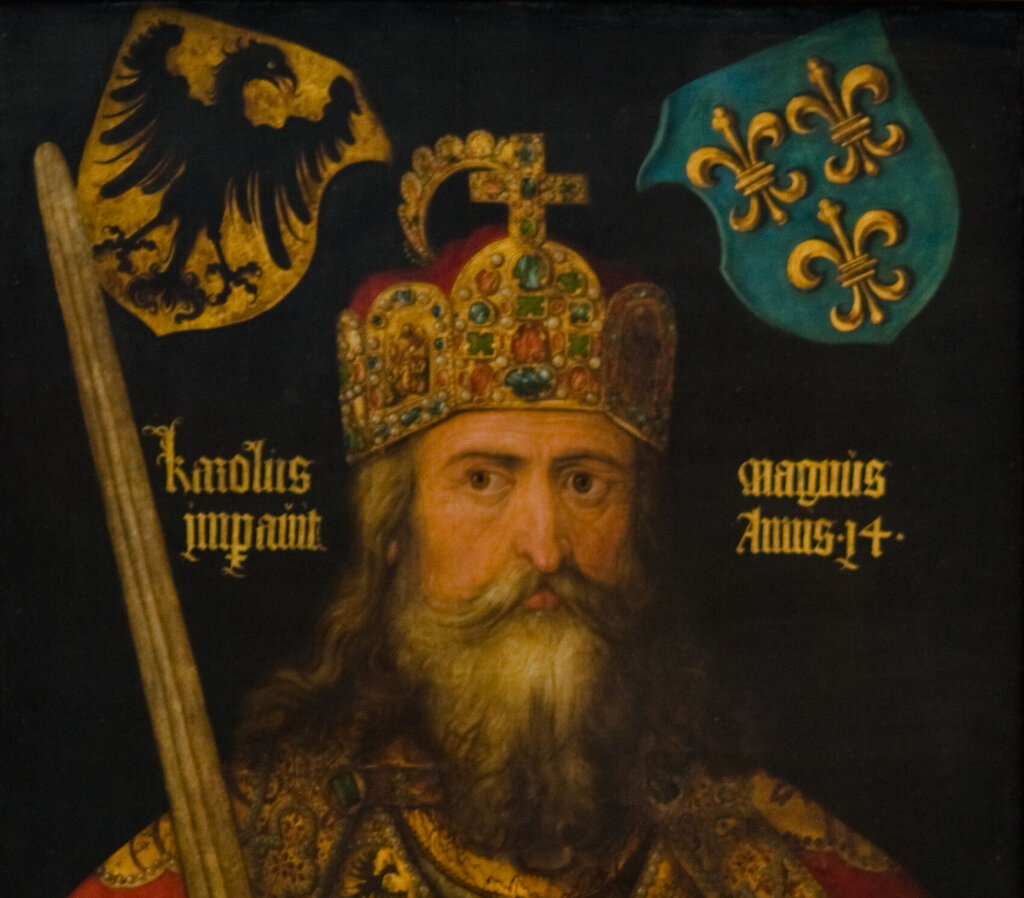
The second half of the name, '-magne', comes directly from the Latin adjective magnus, which simply means "great." This suffix wasn’t a common part of Germanic names. It was a special addition, an honorific, for one man in particular: Charles the Great, or as he was known in Old French, Charlemagne.
The popularity of the name in continental Europe was due to the fame of Charles the Great (742-814), commonly known as Charlemagne, a king of the Franks who came to rule over most of Europe.
By fusing the Germanic karl with the Latin magnus, the name Charlemagne created a powerful new construction. It combined the Germanic ideal of a free man with the Roman concept of greatness, reflecting his status as the ruler who revived the idea of empire in Western Europe.
From Masculine to Feminine
The transformation from the masculine Charlemagne to the feminine Charmagne is a story of phonetic and morphological shifts over centuries. The original Frankish name Karloman (man-Karl) shows the early structure, but it was Charlemagne's fame that cemented the name in the language of ., a dialect that heavily influenced modern French and English.
In medieval French, creating feminine versions of masculine names was common. While sometimes this was done by adding a suffix like '-e' or '-ette', other times the name's sound was softened. The hard 'g' sound in Charlemagne (shaar-luh-MAYN-yuh) softened and eventually dropped, leading to a more fluid pronunciation. The spelling shifted to reflect this, resulting in Charmagne.
This makes Charmagne a fascinating example in the field of .. Unlike names that are simply feminine versions of a masculine counterpart (like Christine from Christian), Charmagne carries the full weight of its historical, honorific origin. It structurally combines the ideas of sovereignty (karl) and greatness (magne) into a single, distinct identity.
Let's review what you've learned about the name's unique history.
What is the original meaning of the 'Char-' component of the name Charmagne?
The name Charlemagne is a fusion of which two linguistic and cultural traditions?
Understanding a name's journey through different languages and cultures reveals a rich history hidden in plain sight.