Unconventional Mathematical Applications
Knot Theory in DNA
Knots in Your DNA
The DNA in a single human cell, if stretched out, would be about two metres long. Yet, it all fits inside a nucleus just a few micrometres across. This incredible feat of compression is achieved by coiling the DNA strand upon itself, again and again. But this coiling creates a problem: just like a tangled phone cord or garden hose, DNA can become knotted and snarled.
These topological challenges are not just a messy inconvenience. During crucial processes like DNA replication or transcription, the two strands of the double helix must be separated. This unwinding can introduce severe overwinding, or 'supercoiling', in adjacent regions. If left unchecked, these tangles would grind cellular machinery to a halt. Biology's solution is found in a branch of mathematics called topology, which studies properties of shapes that are preserved under continuous deformation, like stretching or twisting, but not tearing.
A Topological Toolkit
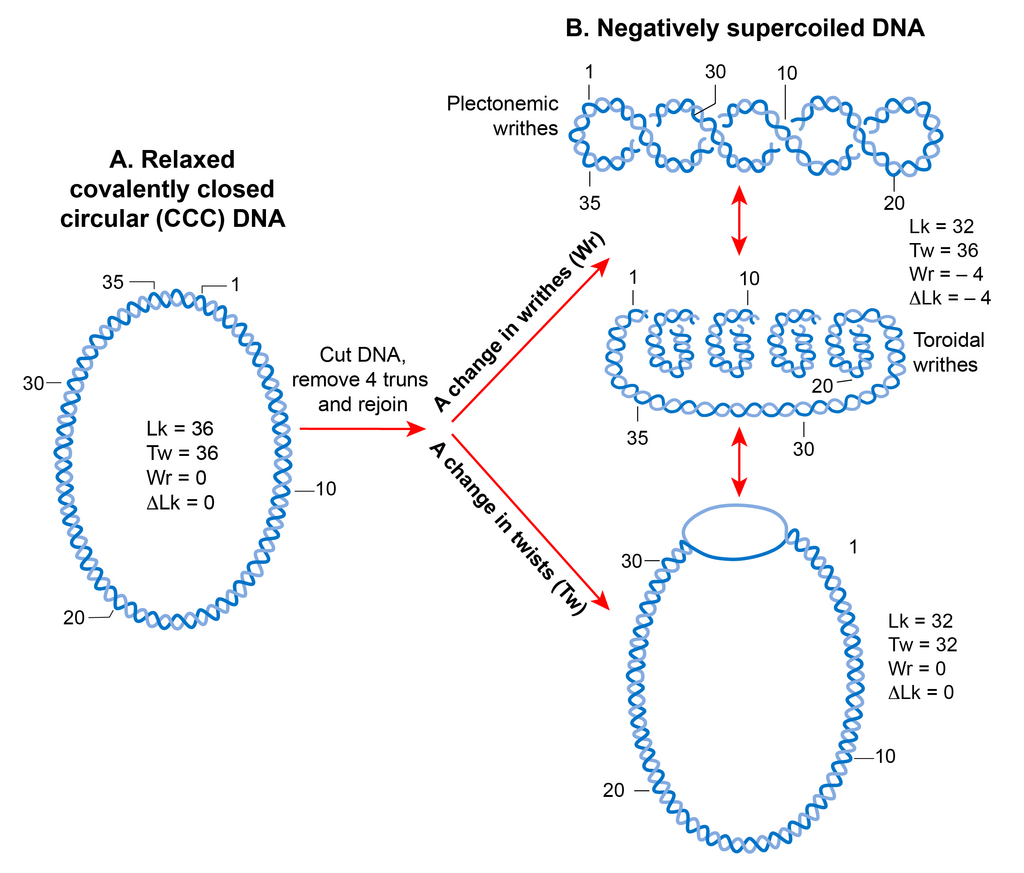
To quantify the knottedness of DNA, molecular biologists use a topological invariant called the linking number (Lk). It's a whole number that describes how many times one strand of the DNA double helix winds around the other. For a closed loop of DNA, this number cannot change without breaking one of the strands. It's a fundamental property of the DNA's topology.
The linking number is the sum of two other geometric properties: 'twist' (Tw) and 'writhe' (Wr).
Imagine a rubber band made of two intertwined strands. The twist is the number of times the strands coil around each other. The writhe is the number of times the entire rubber band coils up and crosses over itself. Changes in twist and writhe can cancel each other out, keeping the linking number constant. For instance, unwinding the helix (decreasing Tw) will cause the DNA to contort in space (increasing Wr) to compensate.
The Cell's Unknotting Machine
Cells manage this topological stress using a remarkable class of enzymes called topoisomerases and recombinases. These proteins act as biological topologists, changing the linking number of DNA. They perform a seemingly magical trick: they cut one or both DNA strands, allow another segment to pass through the break, and then perfectly reseal the cut. This strand-passage mechanism allows them to unknot, untangle, and relax supercoiled DNA.
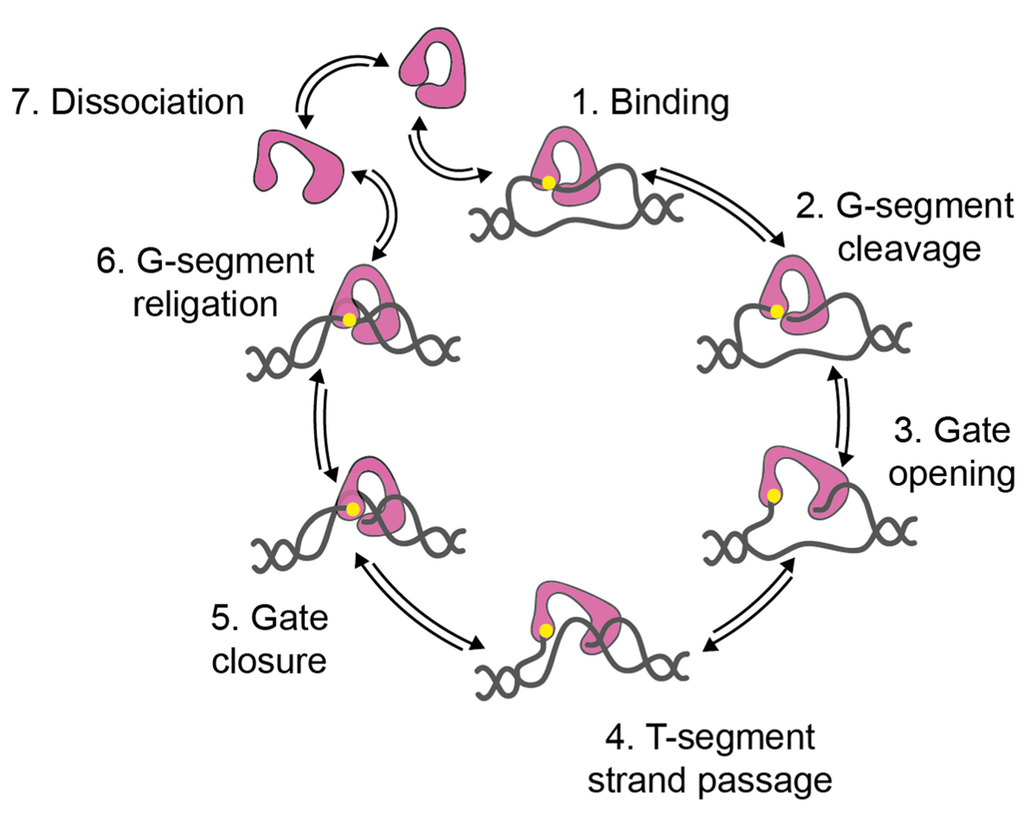
There are different types of topoisomerases. Type I enzymes cut a single strand, while Type II enzymes cut both strands of the double helix. This allows them to perform more complex topological transformations, like passing one whole DNA duplex through another. This is essential for separating the intertwined daughter chromosomes after DNA replication is complete.
Recombination as Knot Tying
Topology isn't just for untangling messes. It's also used to purposefully rearrange the genome. Site-specific recombination is a process where enzymes cut and paste DNA at specific locations. This can invert a gene, delete a segment, or insert new DNA. To understand how enzymes do this without creating a tangled mess, scientists use the Tangle Model to describe the local action of the recombinase enzymes.
In this model, the enzyme operates on a small, localized section of DNA—the tangle. By swapping the strands within this tangle, the enzyme can change the overall knot type of the entire DNA loop. It can tie a simple loop into a trefoil knot, or untie a complex knot into a simple loop. This process is fundamental to how viruses like bacteriophage lambda integrate their DNA into a host's chromosome and is a key mechanism for generating genetic diversity.
By viewing DNA through the lens of topology, we gain a deeper appreciation for the elegant solutions evolution has found for managing and manipulating our genetic blueprint. It's a world where enzymes are mathematicians, and the secrets of life are written not just in a sequence of letters, but in twists, writhes, and knots.
Now, let's test your understanding of these topological concepts.
Why is the extreme coiling of DNA inside a cell nucleus a potential problem?
The linking number (Lk) of a closed loop of DNA is defined by the equation . If a cellular process unwinds a section of the helix, decreasing the twist (Tw), what is the most likely immediate consequence for the DNA molecule if the linking number remains constant?