TV Advertising Campaign Strategy
Buying Models Comparison
Choosing Your Buying Strategy
When buying TV advertising, advertisers face a fundamental choice: negotiate directly with broadcasters or use automated, data-driven platforms. This decision isn't just about technology; it's a strategic choice between control and flexibility, guarantees and opportunities. Each model serves different campaign goals, budgets, and appetites for risk.
The traditional method is the direct buy, built on relationships and manual negotiations. This approach has long dominated TV ad sales, especially for premium, high-stakes inventory. It operates primarily in two cycles: the and the scatter market.
During the Upfronts, major brands commit to large, season-long ad packages months in advance to secure spots in the most anticipated shows. The scatter market is for inventory that wasn't sold during the Upfronts, or for advertisers who need more flexibility. It operates closer to the air date, with prices fluctuating based on supply and demand. Think of it as booking a flight a year in advance versus a week before.
Direct buys offer placement certainty. If you pay for a spot during the championship game, your ad is guaranteed to run. This brand safety and control over context is why it remains the standard for massive product launches or major brand campaigns.
The Rise of Programmatic TV
The alternative is programmatic buying, which automates the purchase of ad space. While it's most common in Connected TV (CTV), it's also making inroads into traditional linear TV. Instead of negotiating for a block of ads on a specific show, advertisers often bid on individual ad impressions for specific audience segments, regardless of what they're watching.
The engine behind much of programmatic is (RTB). When a user opens a streaming app and an ad break arrives, an ad opportunity is broadcast to a digital marketplace. Advertisers’ automated systems evaluate the opportunity in milliseconds based on audience data and place a bid. The highest bidder wins, and their ad is served instantly. The entire auction is over in the time it takes the page to load.
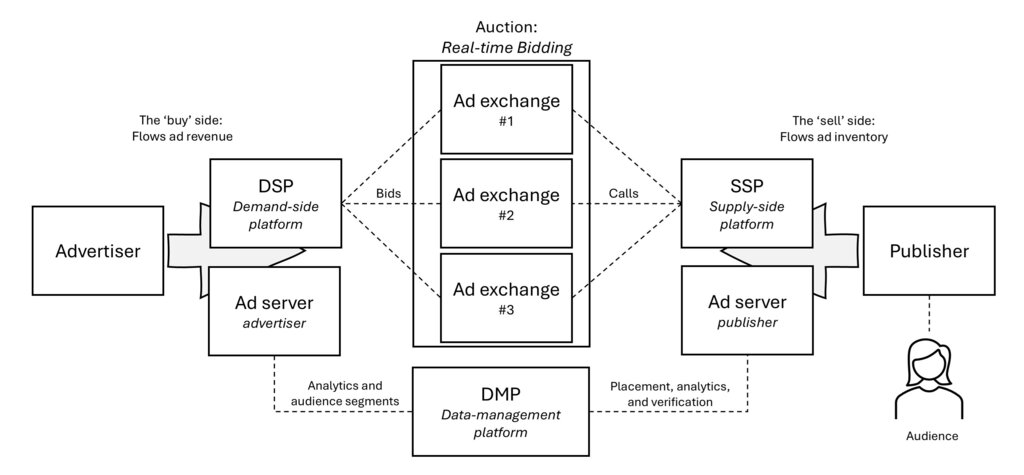
This model offers incredible flexibility. Campaigns can be optimised on the fly, shifting budget to better-performing audience segments or creative. It lowers the barrier to entry, as advertisers don't need massive upfront commitments. The focus shifts from buying a slot on a show that a target demographic might watch to buying a slot shown directly to a member of that demographic.
Comparing the Models
However, not all programmatic buying is a wide-open auction. It exists on a spectrum from private, guaranteed deals to open auctions. This allows buyers to blend the certainty of direct deals with the efficiency of automation. Understanding these nuances is key to choosing the right strategy.
| Feature | Direct Buy | Programmatic Direct | Open Exchange (RTB) |
|---|---|---|---|
| Process | Manual negotiation | Automated, pre-agreed deal | Real-time auction |
| Inventory | Guaranteed, premium | Guaranteed | Non-guaranteed |
| Pricing | Fixed, high CPM | Fixed CPM | Variable, auction-based |
| Targeting | Broad (show, time) | Audience & content | Granular (user-level data) |
| Flexibility | Low (locked in) | Moderate (some changes) | High (real-time changes) |
| Best For | Major brand launches | Consistent presence in premium content | Performance & retargeting |
So, which model should you choose? It depends entirely on your goals.
For a car company launching a new flagship model, a direct buy in the final of a major football tournament offers unparalleled reach and impact. The guarantee is worth the high price and lack of flexibility.
For an e-commerce brand wanting to retarget users who abandoned their shopping carts, a programmatic campaign on CTV is far more efficient. They can target just those specific users across a wide range of apps, paying only for the impressions that matter most and adjusting their bids based on performance.
Programmatic CTV puts advertisers in control, with the flexibility to pivot, optimize, and scale on demand.
Ultimately, many modern media plans blend these approaches. An advertiser might use the Upfronts to secure a baseline of high-value inventory for brand awareness, while simultaneously running programmatic campaigns to drive specific actions and reach niche audiences with greater efficiency. The choice is no longer 'either/or' but 'how much of each'.