Tugboat Piping Systems Explained
Introduction to Fluid Dynamics
The Stuff of Flow
At its core, a piping system is all about moving fluids—liquids or gases—from one place to another. But not all fluids are the same. To understand how they behave inside a pipe, we first need to look at two of their most important properties: density and viscosity.
Density
noun
The amount of mass packed into a given volume.
Think of a suitcase. If you pack it with feathers, it’s light. If you pack the same suitcase with bricks, it’s heavy. The suitcase's volume hasn't changed, but the mass inside has. The brick-filled suitcase is denser. In a tugboat, you might deal with fresh water, salt water, fuel oil, and lubricating oil. Each has a different density, which affects how much energy it takes to pump them.
Viscosity
noun
A fluid's resistance to flow. It's a measure of its internal friction.
Viscosity is basically a fluid's 'thickness'. Imagine pouring water and then pouring honey. The water flows freely, while the honey moves slowly. The honey has a higher viscosity. This property is critical in piping systems. A high-viscosity fluid like heavy oil requires more powerful pumps to move it through pipes compared to a low-viscosity fluid like water, because there's more internal friction to overcome.
Under Pressure
Pressure is the force a fluid exerts on the surfaces it touches, distributed over an area. When a fluid is sitting still in a tank, its weight creates pressure that pushes on the bottom and sides of the tank. This is called hydrostatic pressure.
This formula tells us something simple but important: the deeper you go, the greater the pressure. This is because there's more fluid stacked on top, and all that weight adds up. The pressure at the bottom of a deep fuel tank on a tugboat is much higher than at the top.
Going with the Flow
When we get fluids moving, we talk about flow rate and velocity. The flow rate, often denoted as , tells us how much volume of fluid passes a certain point in a pipe per unit of time (e.g., gallons per minute). Velocity, on the other hand, is just how fast the fluid is moving (e.g., feet per second).
An interesting thing happens inside a pipe. The fluid doesn't all move at the same speed. The fluid touching the pipe's inner walls is slowed down by friction, so it moves the slowest. The fluid in the very center of the pipe, farthest from the walls, moves the fastest. This variation in speed across the pipe's diameter is called the velocity profile.
The shape of this profile depends on the type of flow.
Smooth or Chaotic?
Fluid flow generally falls into one of two categories: laminar or turbulent.
Laminar flow is smooth, orderly, and predictable. The fluid moves in parallel layers, like cars staying perfectly in their lanes on a highway. This usually happens at low velocities or with highly viscous fluids.
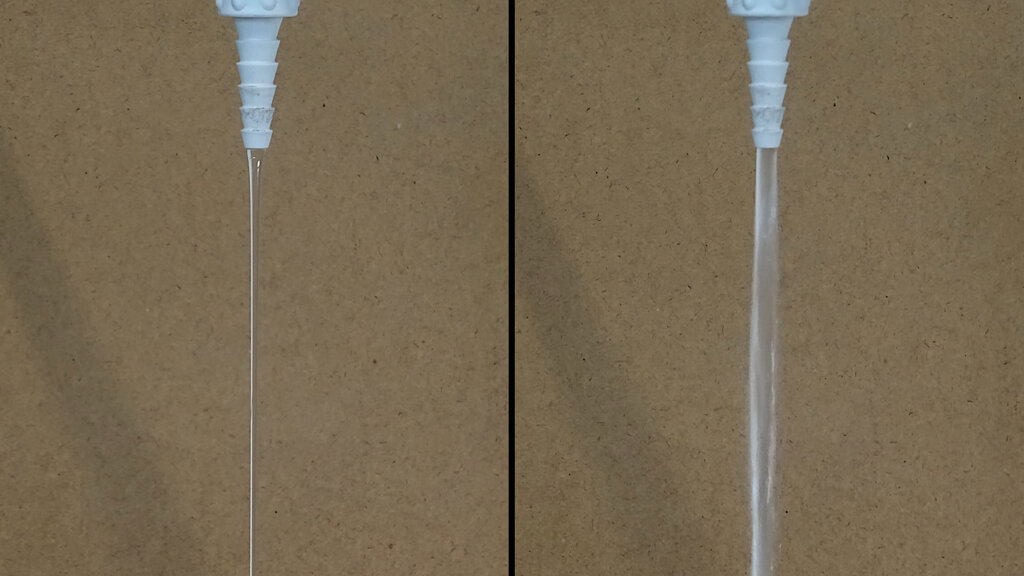
Turbulent flow is chaotic and irregular. The fluid swirls in eddies and vortices, with its velocity changing constantly at any given point. This happens at higher velocities or with less viscous fluids. Most flow in industrial piping systems, including on a tugboat, is turbulent.
Turbulent flow creates more friction against the pipe walls than laminar flow. This means more energy is lost, and the pump has to work harder to maintain the same flow rate. Understanding whether the flow will be laminar or turbulent is key to designing an efficient piping system.
Bernoulli's Principle
One of the most fundamental concepts in fluid dynamics is Bernoulli's principle. It describes the relationship between a fluid's speed, pressure, and potential energy. In simple terms, for a fluid flowing horizontally, where the speed is high, the pressure is low, and where the speed is low, the pressure is high.
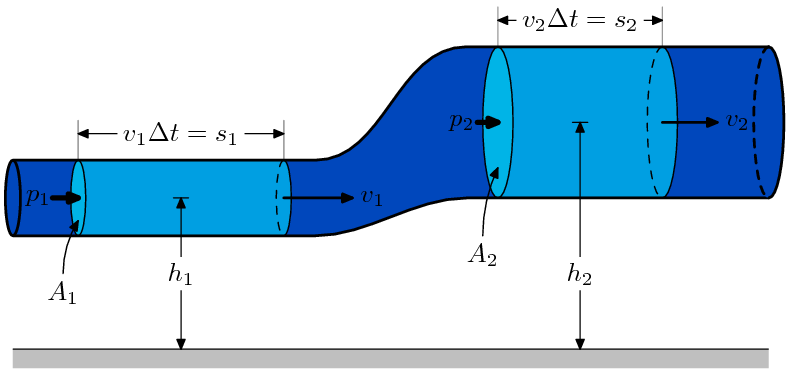
Imagine a fluid flowing through a pipe that narrows in the middle. To get the same amount of fluid through the narrower section in the same amount of time, the fluid has to speed up. According to Bernoulli's principle, this increase in speed comes with a decrease in pressure.
This principle is a simplified version of the law of conservation of energy applied to fluids. The total energy of the fluid, which is a combination of its pressure energy, kinetic energy (from motion), and potential energy (from height), remains constant along its path.
This equation shows that if one term goes up, another must come down to keep the total constant. If velocity () increases, pressure () must decrease, assuming the height () stays the same.
Ready to check your understanding?
Which of the following properties best describes a fluid's 'thickness' or resistance to flow?
In a tall, stationary fuel tank, the hydrostatic pressure is greatest at the very bottom.
These principles form the bedrock of understanding how any fluid system works, from the simple pipes in your home to the complex network keeping a tugboat running.