Truth Versus Deception
Introduction to Epistemology
How Do You Know?
It seems like a simple question. How do you know your name? How do you know that the sky is blue? How do you know that 1 + 1 = 2? You just... do. But what does it actually mean to know something? This question is the starting point for a field of philosophy called epistemology.
Defined narrowly, epistemology is the study of knowledge and justified belief.
Epistemology doesn't just ask what we know; it asks how we know. It's the process of examining our knowledge under a microscope. It tackles big questions: What is the difference between believing something and knowing it? What counts as good evidence? Can we ever be truly certain about anything?
A Recipe for Knowledge
For thousands of years, philosophers have tried to create a clear definition of knowledge. The most famous and enduring of these is the idea that knowledge is a Justified True Belief (JTB). This definition breaks knowledge down into three essential ingredients.
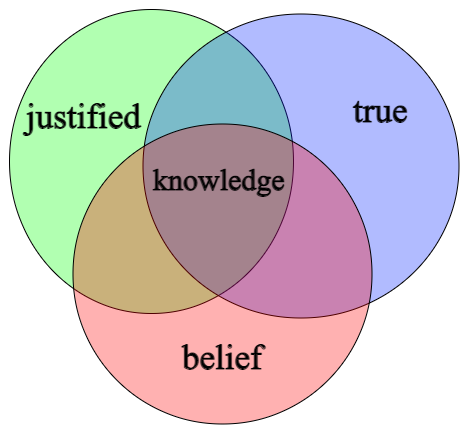
Let's look at each ingredient:
-
Belief: You must actually believe the statement to be true. If you don't believe that Paris is the capital of France, you can't know it.
-
Truth: The statement must be objectively true. Your belief has to match reality. Believing with all your heart that the moon is made of cheese doesn't make it so.
-
Justification: You need a good reason for your belief. It can't be a lucky guess. If you believe a specific horse will win a race simply because you like its name, and it happens to win, you didn't know it would win. You just got lucky.
Imagine you see dark clouds gathering and hear a distant rumble. You form the belief that it's going to rain. It does, in fact, rain (Truth). Your justification is the evidence of the clouds and thunder. According to the JTB model, you knew it was going to rain.
Cracks in the Foundation
The JTB model seems solid, but philosophers are excellent at finding problems. Two major challenges have pushed thinkers to question this classic definition: the problem of certainty and skepticism.
skepticism
noun
A philosophical attitude of doubting claims to knowledge, questioning whether true certainty is possible.
Skepticism takes the 'justification' ingredient and puts it under extreme pressure. A skeptic might ask, how can you be absolutely certain your justification is foolproof? You believe you are reading this on a screen right now. Your justification is that you can see and touch it. But could you be dreaming? Could you be part of an elaborate simulation?
While these scenarios seem far-fetched, they highlight the problem of certainty. Is it possible for our senses to deceive us? Yes. Have our memories ever been wrong? Absolutely. If our tools for justification are flawed, can we ever be 100% certain about anything we claim to know about the outside world?
This is a core challenge in epistemology. It forces us to think critically about the foundations of our beliefs and the limits of human knowledge. It's not about concluding that we know nothing, but about understanding the difference between a reasonable belief and an unshakable certainty.
Ready to test your understanding of these foundational ideas?