Truss Analysis Applied Mechanics
Truss Basics
From Particles to Structures
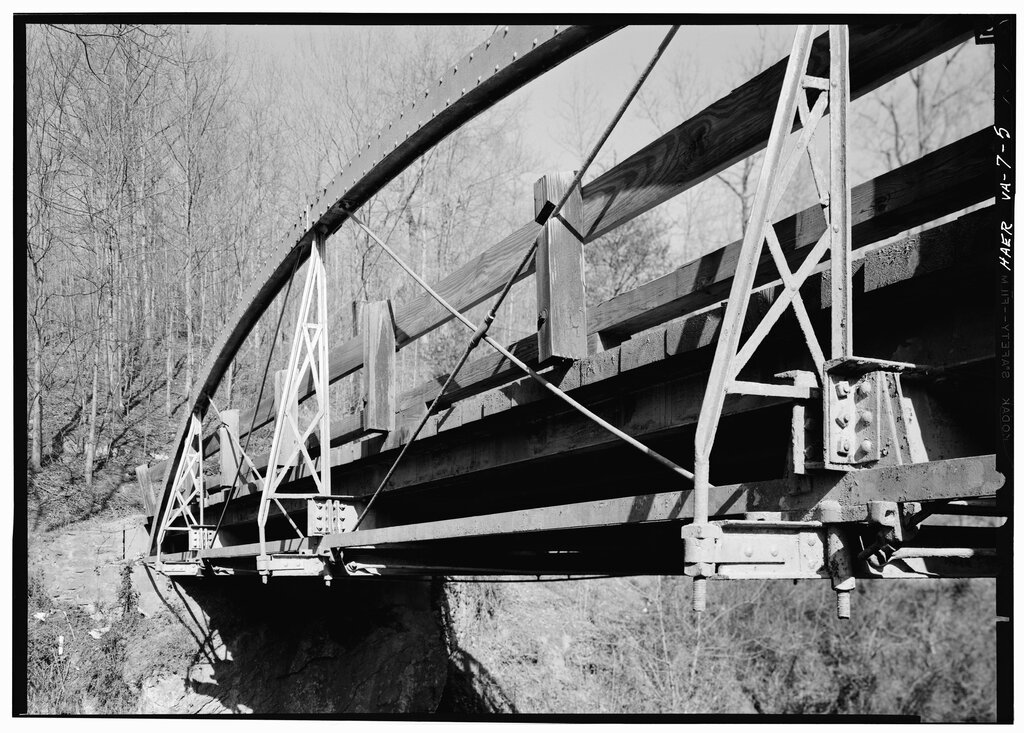
You're already familiar with Newton's laws and how to ensure a single particle is in equilibrium. Now, let's connect multiple particles together to build something useful. This is the basic idea behind a truss. A truss is a structure made of straight, slender members connected at their ends. Think of bridges, roof supports, and crane arms. Their strength comes not from the bulk of their material, but from their geometric arrangement.
To make the analysis of these structures manageable, we rely on a few key assumptions. First, we assume all members are connected by frictionless pins, what we call the pin-joint assumption This is a crucial idealisation. It means the joints allow for free rotation and cannot transfer moments. Second, we assume that all external forces, including loads and supports, are applied only at these joints. Taken together, these assumptions lead to a powerful conclusion: every member in the truss is a two-force member.
A two-force member is a body that is subjected to forces at only two points. For it to be in equilibrium, the forces must be equal, opposite, and act along the line connecting the two points.
This simplifies things immensely. Instead of dealing with complex bending and shear forces within a member, we only need to worry about one thing: is the member being pulled apart or pushed together? This is the fundamental concept of tension and compression.
Tension is a pulling force. Imagine stretching a rubber band. The band is in tension.
Compression is a pushing force. Imagine squeezing a spring. The spring is in compression.
Every member in a simple truss will be in either tension or compression. Our goal in truss analysis is to calculate the magnitude of these internal forces.
Is the Truss Solvable?
Before we can analyse a truss, we need to know if it's 'statically determinate'. This is a fancy way of asking: do we have enough equations of equilibrium to solve for all the unknown forces? For a 2D truss, we can use a simple formula to check.
The right side of the equation, , represents the total number of equilibrium equations we can write. Since each of the joints must be in equilibrium, we get two equations for each joint ( and ). The left side, , represents the total number of unknowns we need to find: the internal force in each of the members and the external support reactions. When the unknowns equal the equations, the structure is statically determinate. A common setup for a stable 2D truss involves a pin support (2 reaction forces) and a roller support (1 reaction force), giving . If we substitute this into our equation, we get the more common form for checking determinacy in such trusses: , or m = 2j - 3
Let's apply this. For a simple triangular truss:
- Number of joints,
- Number of members,
Plugging this into the formula: . The truss is statically determinate.
| Condition | Truss State | Description |
|---|---|---|
| Unstable | Not enough members to form a rigid structure. It will collapse under load. | |
| Statically Determinate | The ideal case. We can find all forces using equilibrium equations alone. | |
| Statically Indeterminate | There are redundant members. It's stable, but we can't solve it with statics alone. |
This framework provides the essential starting point for analysing any truss. By confirming a truss is statically determinate, we ensure that we have a solvable problem. The next step, which we'll cover later, is to use methods like the Method of Joints or Method of Sections to find the specific tension or compression force in each member.