True Speech to Speech AI
Introduction to Speech-to-Speech AI
From Your Voice to Theirs
Speech-to-speech AI is a technology that listens to spoken words and responds with synthesized speech, often in real time. Think of it as a digital interpreter. It doesn't just understand what you say; it can translate it, rephrase it, or even mimic your voice, and then speak the result out loud. This ability to handle a conversation from spoken start to spoken finish opens up a world of possibilities.
The goal is to create a seamless audio conversation, whether it's with another person speaking a different language or directly with an AI assistant.
This technology is becoming increasingly important. It powers real-time translation apps that break down language barriers during travel or international business calls. It’s the magic behind voice cloning, which can preserve a person's voice for those who might lose their ability to speak. It also drives accessibility tools, giving a voice to those who communicate non-verbally.
The Three-Step Process
So, how does a machine listen to a voice and produce another one in response? The process can be broken down into three main stages. First, the AI has to hear and understand the words. Then, it needs to process their meaning. Finally, it has to generate new speech.
Let's look at each stage.
1. Speech Recognition: Often called Automatic Speech Recognition (ASR), this is the system's "ear." Its only job is to listen to the sound waves of your voice and convert them into written text. It’s like a highly-trained stenographer typing out everything it hears.
2. Natural Language Processing (NLP): This is the "brain" of the operation. Once the words are in text form, NLP algorithms work to understand their meaning, context, and intent. If the goal is translation, this is where the system translates the text from the source language to the target language. If you're talking to a voice assistant, this is where it figures out what you're asking it to do.
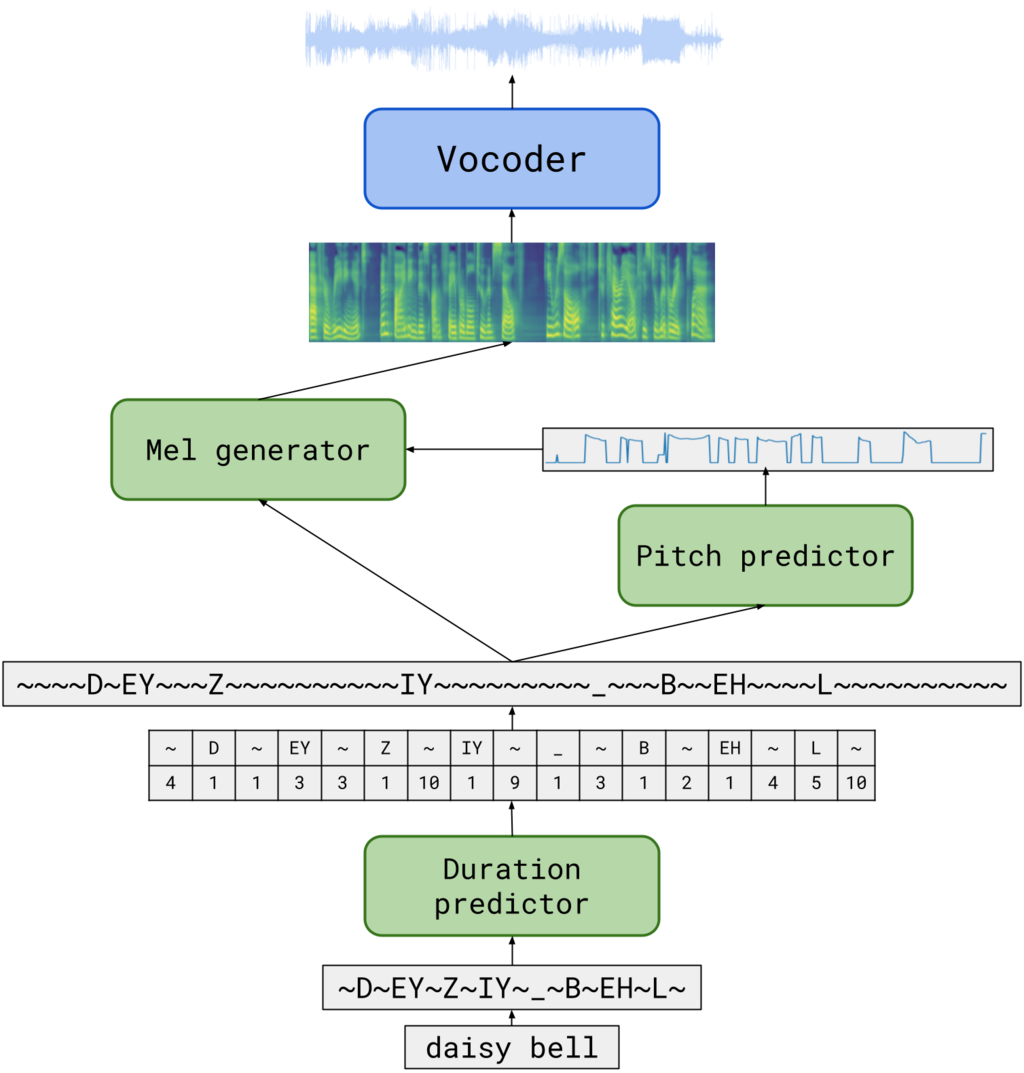
3. Speech Synthesis: Finally, this is the AI’s "mouth." Also known as Text-to-Speech (TTS), this component takes the processed text and turns it back into audible, human-like speech. Modern systems can generate voices that are remarkably natural, with realistic intonation and emotion.
End-to-end speech-in speech-out dialogue systems are emerging as a powerful alternative to traditional ASR-LLM-TTS pipelines, generating more natural, expressive responses with significantly lower latency.
Together, these three components create a pipeline that can transform one person's speech into another's, all within a fraction of a second.
Time to check your understanding of these core ideas.
What is the correct sequence of stages in a typical speech-to-speech AI pipeline?
Which component is considered the "brain" of the operation, responsible for understanding the meaning and context of words?
By understanding this basic flow, you can appreciate the complex but elegant process that allows machines to participate in a conversation.