TRIZ for Business Problem Solving
Introduction to TRIZ
Solving Problems Systematically
Imagine trying to solve a complex engineering problem. A common approach is brainstorming: gather a group, throw ideas at a whiteboard, and hope for a breakthrough. This can work, but it's often unstructured and relies heavily on luck and individual creativity. What if there was a more systematic way to innovate?
In the mid-20th century, Soviet inventor and science fiction author Genrich Altshuller proposed just that. While working in a patent office, he reviewed tens of thousands of patents. He wasn't just looking at the inventions themselves, but at the problems they solved. He noticed something profound: the same fundamental problems appeared again and again across different industries, and the most inventive solutions shared common patterns. Altshuller hypothesized that innovation wasn't a random act of genius, but a process that could be learned and repeated.
This insight led to the development of TRIZ, a Russian acronym that stands for the "Theory of Inventive Problem Solving."
TRIZ
noun
A problem-solving, analysis, and forecasting tool derived from the study of patterns of invention in the global patent literature.
TRIZ is built on the idea that by understanding the patterns of past inventions, we can systematically generate solutions for current problems. Instead of starting from a blank slate, you use a structured framework to guide your thinking.
The Core Concepts
At the heart of TRIZ are a few key concepts. The most fundamental is the idea of contradictions. Altshuller found that inventive problems almost always involve a conflict between two parameters. For example, you might want a car's engine to be more powerful, but increasing power usually increases fuel consumption. You want to improve one thing (power) without worsening another (fuel economy). This is a technical contradiction.
A physical contradiction is when an object or system has opposite, contradictory requirements. For instance, a coffee cup needs to be hot on the inside (to keep the coffee warm) but cool on the outside (so you can hold it).
TRIZ doesn't settle for a trade-off or a compromise. It pushes you to find a solution that eliminates the contradiction entirely. To do this, Altshuller distilled the patterns from his patent research into 40 Inventive Principles. These are generic strategies for solving contradictions. For the hot/cool coffee cup, one principle might be "Segmentation" (using multiple layers, like a double-walled mug) or "Asymmetry" (adding a handle).
Another core idea is Ideality. This is the concept of a perfect system that delivers its benefits without any costs or harms. While a truly ideal system is usually impossible, striving for it helps focus the problem-solving process. You ask: What is the ultimate function I want to achieve, and how can I get there with the fewest possible negative consequences?
A Different Way of Thinking
Traditional problem-solving often involves a direct, sometimes chaotic, path from a problem to a potential solution. It relies on personal experience and trial-and-error.
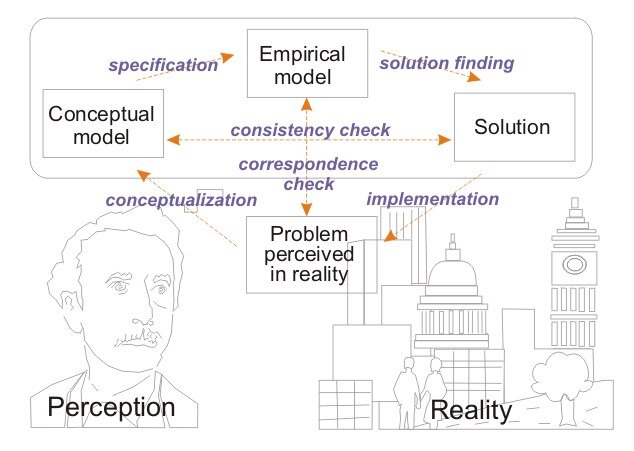
TRIZ takes a different route. It forces you to generalize your specific problem into an abstract, universal problem. Then, you find a known, abstract solution (like one of the 40 Principles) and adapt it back to your specific situation. This detour through abstraction is what makes TRIZ so powerful—it connects your unique challenge to a vast database of proven inventive solutions.
| Feature | Traditional Brainstorming | TRIZ |
|---|---|---|
| Starting Point | Blank slate, psychological inertia | Knowledge base of inventive patterns |
| Process | Unstructured, random idea generation | Systematic, algorithmic approach |
| Goal | Generate many ideas, hope for a good one | Eliminate contradictions, move toward ideality |
| Reliance | Experience of the group, creativity | Universal principles of invention |
By providing a structured path, TRIZ helps overcome psychological inertia—the tendency to stick to familiar ways of thinking. It guides you toward solutions that you might never have considered with unstructured brainstorming.
This systematic approach has made TRIZ a valuable tool in fields ranging from engineering and product development to business management and process improvement.