Trigonometry Essentials
Right Triangle Basics
Meet the Right Triangle
Triangles come in many shapes and sizes, but one special type forms the foundation of trigonometry: the right triangle. What makes it special is one of its three angles. A right triangle is any triangle that contains a perfect 90-degree angle, just like the corner of a square or a book.
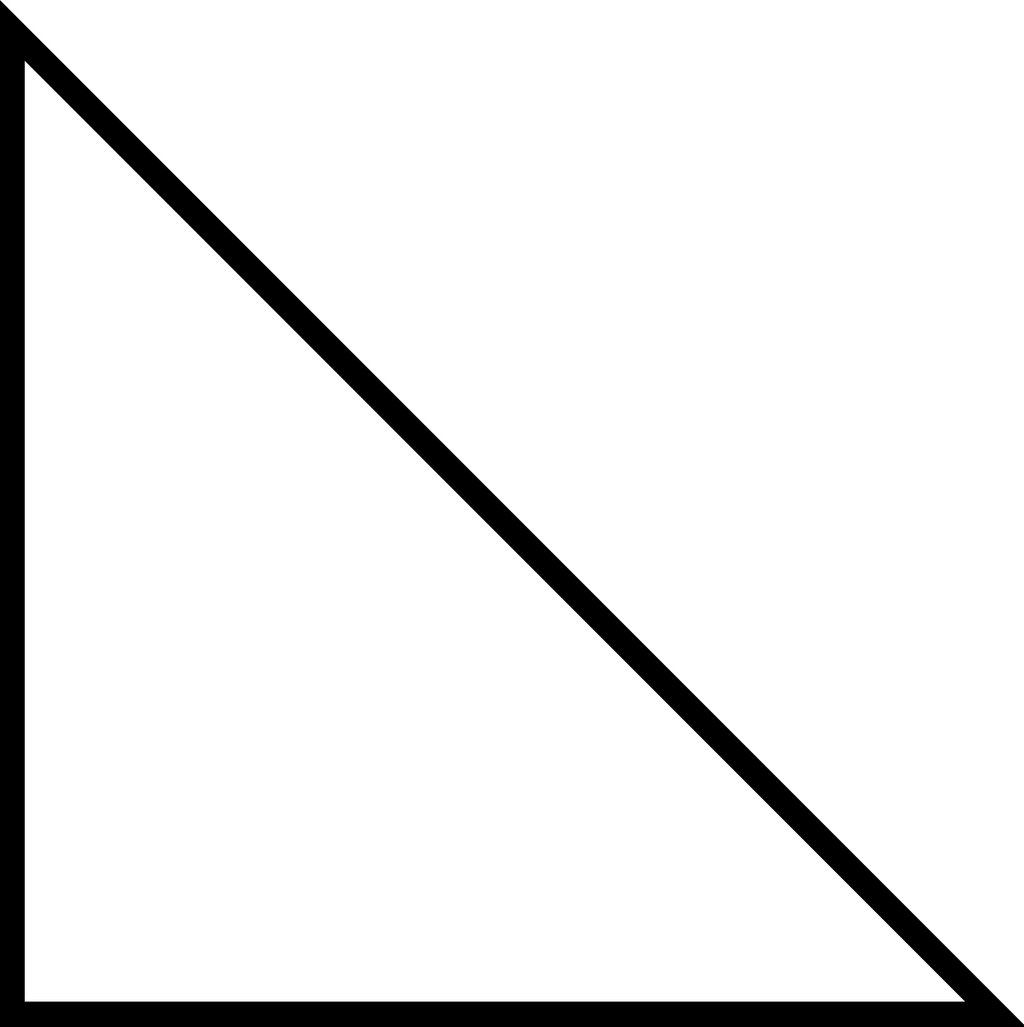
This single 90-degree angle gives the triangle unique properties and predictable relationships between its sides. Because of this, we have special names for each of the three sides. Understanding these names is the first step to mastering trigonometry.
Naming the Sides
Every right triangle has one side that is always the longest. It's the side directly across from the 90-degree angle.
hypotenuse
noun
The longest side of a right triangle, opposite the right angle.
The other two sides are called the legs. Their names, however, depend on which of the other two angles we are focusing on. These two angles are always acute, meaning they are less than 90 degrees.
From the perspective of a chosen acute angle (often labeled with the Greek letter theta, ), the two legs are called:
- Opposite: The side directly across from the angle .
- Adjacent: The side next to the angle that is not the hypotenuse.
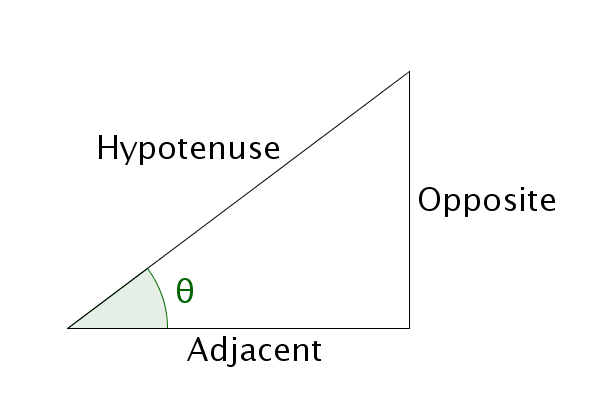
The hypotenuse is always the hypotenuse. But the opposite and adjacent sides can swap, depending on which acute angle you're looking from.
The Pythagorean Theorem
Ancient mathematicians discovered a remarkable relationship between the lengths of the three sides of any right triangle. This rule, known as the Pythagorean theorem, is one of the most fundamental concepts in all of geometry. It allows us to find the length of a missing side if we know the lengths of the other two.
In this formula, and are the lengths of the two legs of the right triangle, and is the length of the hypotenuse. The theorem states that if you square the lengths of the two legs and add them together, you get the square of the length of the hypotenuse.
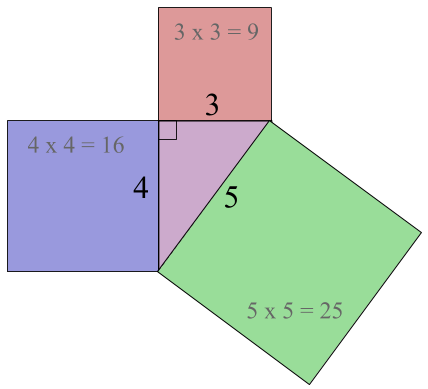
Let's try an example. Imagine a right triangle with one leg of length 3 units and another of length 4 units. We want to find the length of the hypotenuse, .
First, we plug the known values into the theorem:
Next, we calculate the squares:
Now, we add the numbers together:
Finally, to find , we take the square root of 25. The square root of 25 is 5. So, the hypotenuse is 5 units long.
This theorem also works in reverse. If you know the hypotenuse and one leg, you can find the other leg. For instance, if the hypotenuse is 13 and one leg is 5, how long is the other leg?
The missing leg is 12 units long. The Pythagorean theorem is a powerful tool for working with right triangles, and it's essential for the trigonometry to come.
Time to check your understanding.
What is the defining characteristic of a right triangle?
In a right triangle, the side directly across from the 90-degree angle is always the longest side.