Trigonometry Essentials
Right Triangle Basics
Meet the Right Triangle
A triangle is a shape with three sides and three angles. A right triangle is a special kind of triangle that has one angle measuring exactly 90 degrees, like the corner of a square or a book. This 90-degree angle is called a right angle.
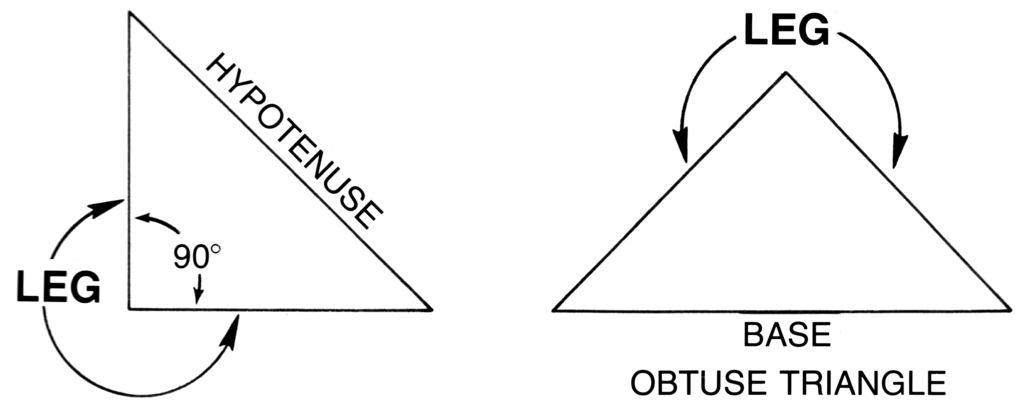
The two sides that form the right angle are called the legs. The third side, which is always the longest and is found opposite the right angle, is called the hypotenuse. Knowing these names is the first step to understanding the relationships within the triangle.
The Pythagorean Theorem
Over 2,000 years ago, Greek mathematicians discovered a special relationship between the sides of a right triangle. This relationship, known as the Pythagorean theorem, is a fundamental rule in geometry.
The theorem states that if you square the lengths of the two legs and add them together, the sum will equal the square of the length of the hypotenuse.
If we call the legs a and b and the hypotenuse c, we can write this relationship as a simple formula.
This formula allows you to find the length of any side of a right triangle if you know the lengths of the other two sides. Let's look at a classic example: a triangle with legs of length 3 and 4.
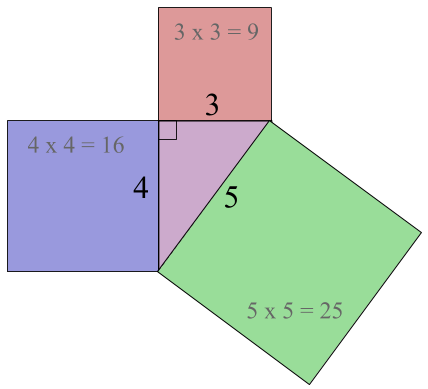
Using the theorem, we can find the length of the hypotenuse:
The hypotenuse is 5 units long. This 3-4-5 combination is a well-known example of a right triangle.
Naming Sides From an Angle's View
While the hypotenuse is always the hypotenuse, the legs have other names that depend on your point of view. Specifically, their names change depending on which of the two smaller angles (the acute angles) you are looking from.
Let's pick one of the acute angles and call it (theta).
- The opposite side is the leg directly across from the angle .
- The adjacent side is the leg next to the angle that is not the hypotenuse.
These labels are crucial. If you switch to the other acute angle, the side that was opposite is now adjacent, and the side that was adjacent is now opposite. The hypotenuse, however, always stays the same.
Mastering these three concepts—the definition of a right triangle, the Pythagorean theorem, and how to identify the sides relative to an angle—provides the foundation for everything else in trigonometry.
Ready to test your knowledge? Let's see what you've learned.
What is the defining characteristic of a right triangle?
In a right triangle, the side opposite the right angle is always the longest side and is called the ______.
With these basics down, you're ready to explore how angles and side lengths are connected.