Trigonometry Essentials
Right Triangle Basics
What Makes a Triangle Right?
A right triangle is any triangle that has one angle measuring exactly 90 degrees. This special angle is called a right angle, and it's often marked with a small square in the corner. Because the three angles in any triangle always add up to 180 degrees, the other two angles in a right triangle must be acute, meaning they are both less than 90 degrees.
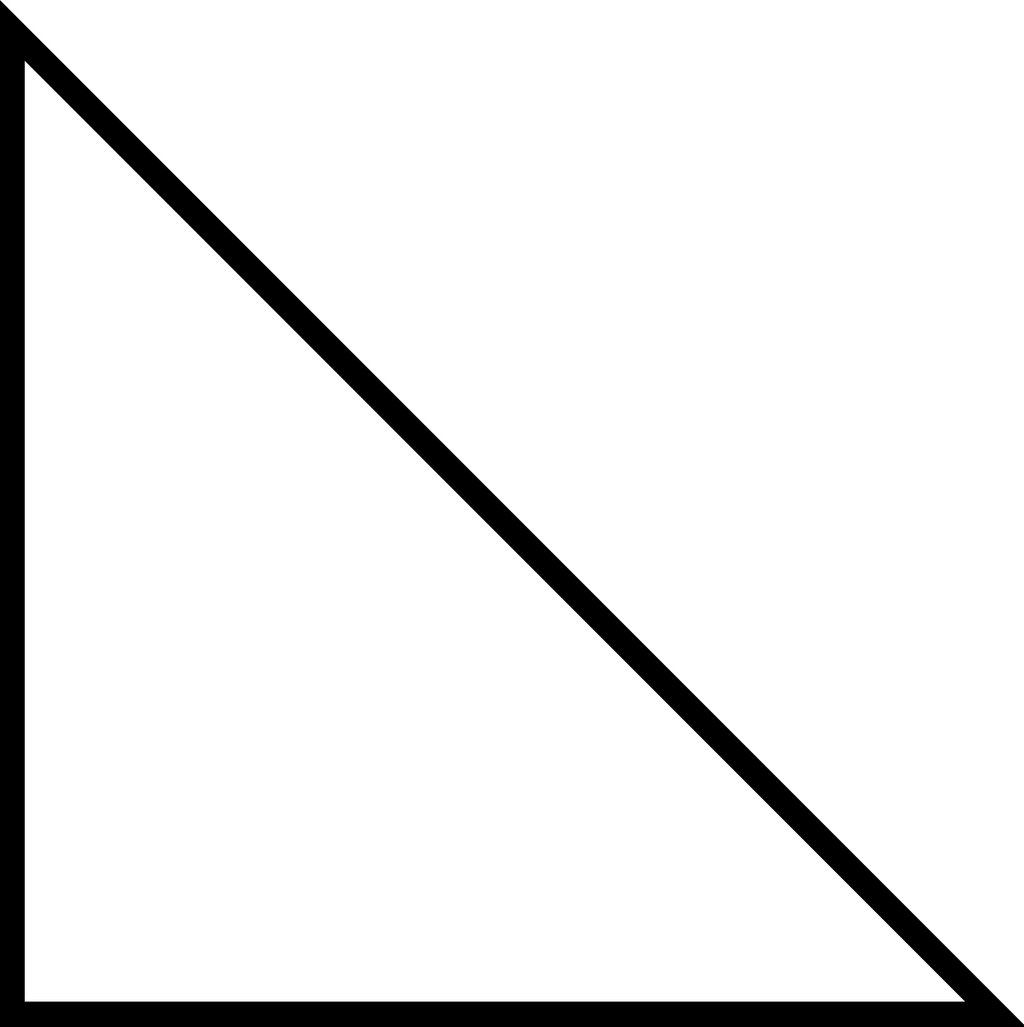
These triangles are a cornerstone of geometry and are found everywhere, from the structure of buildings to the navigation of ships. Understanding their simple but powerful properties is the first step into the world of trigonometry.
Naming the Sides
Every right triangle has three sides, and each has a specific name. The longest side, which is always across from the right angle, is called the hypotenuse. The other two sides are called legs.
The hypotenuse is always the side opposite the 90-degree angle.
The names of the two legs, however, depend on which of the other two angles you are looking at. From the perspective of a specific acute angle, one leg is "opposite" and the other is "adjacent."
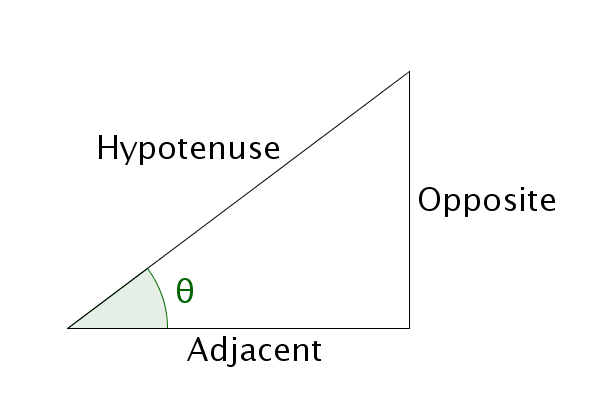
The opposite side is the leg directly across from the angle in question. The adjacent side is the leg right next to the angle, but it's not the hypotenuse.
If you switch to the other acute angle, the labels for the opposite and adjacent sides will swap. The hypotenuse always stays the same.
The Pythagorean Theorem
There's a famous and incredibly useful relationship between the lengths of the three sides of a right triangle. It's called the Pythagorean theorem, named after the ancient Greek mathematician Pythagoras. The theorem states that if you square the lengths of the two legs and add them together, you get the square of the length of the hypotenuse.
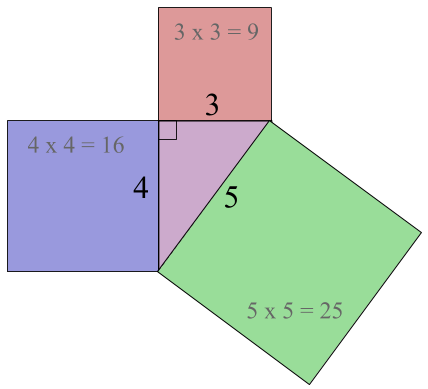
This simple formula allows you to find the length of a third side if you know the lengths of the other two. For example, if a right triangle has legs of length 3 and 4, we can find the hypotenuse:
a² + b² = c²
3² + 4² = c²
9 + 16 = c²
25 = c²
√25 = c
5 = c
So, the hypotenuse has a length of 5. This 3-4-5 combination is a classic example of a "Pythagorean triple," a set of three whole numbers that perfectly fit the theorem.
Let's try one more example. Imagine you have a right triangle where the hypotenuse is 13 units long and one leg is 5 units long. What is the length of the other leg? We'll call the unknown leg 'b'.
a² + b² = c²
5² + b² = 13²
25 + b² = 169
b² = 169 - 25
b² = 144
b = √144
b = 12
The missing leg is 12 units long. As you can see, the Pythagorean theorem is a powerful tool for solving problems involving right triangles.
What is the defining characteristic of a right triangle?
In a right triangle, which side is always the longest?