Trigonometry Essentials
Introduction to Trigonometric Ratios
Sides and Angles
Trigonometry is the study of triangles—specifically, the relationships between their angles and side lengths. Let's start with the right-angled triangle, the foundation for everything we'll cover.
A right-angled triangle has one angle that is exactly 90 degrees. The other two angles are always smaller, or acute. The sides of a right triangle have special names, but their names depend on which acute angle you're looking from.
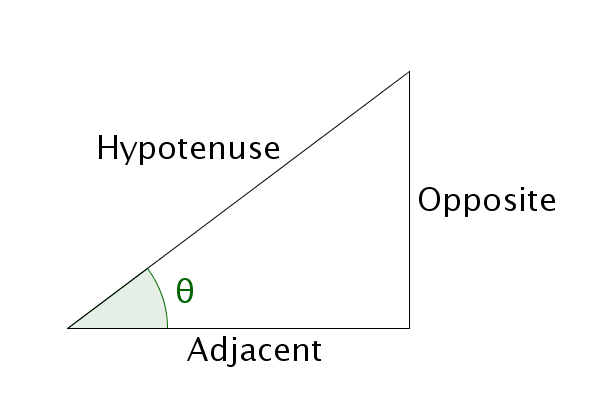
Let's break down these labels:
- Hypotenuse: This is always the longest side, and it's always opposite the right angle. Its name stays the same no matter which acute angle you focus on.
- Opposite: This side is directly across from the angle you're considering (we'll call it θ, the Greek letter theta).
- Adjacent: This side is next to the angle θ, but it's not the hypotenuse.
Notice that if you switch to the other acute angle, the Opposite and Adjacent sides swap roles. The hypotenuse, however, always stays the same.
The Three Basic Ratios
Trigonometry is built on the idea that for any given angle in a right triangle, the ratio of any two side lengths is always the same, no matter how big or small the triangle is. These constant ratios are given special names: sine, cosine, and tangent.
sine
noun
The ratio of the length of the side opposite an angle to the length of the hypotenuse.
cosine
noun
The ratio of the length of the side adjacent to an angle to the length of the hypotenuse.
tangent
noun
The ratio of the length of the side opposite an angle to the length of the adjacent side.
That can be a lot to remember. Luckily, there's a handy mnemonic to help.
SOH CAH TOA
Sine is Opposite over Hypotenuse. Cosine is Adjacent over Hypotenuse. Tangent is Opposite over Adjacent.
Putting It to Work
Let's see how this works with a real triangle. Consider a right triangle with side lengths 3, 4, and 5. The longest side, 5, is the hypotenuse.
First, let's find the trigonometric ratios for angle α.
From the perspective of angle α:
- The Opposite side is 3.
- The Adjacent side is 4.
- The Hypotenuse is 5.
Now we just plug these values into our definitions.
Simple enough. But what about angle β? The side lengths of the triangle haven't changed, but our perspective has.
From the perspective of angle β:
- The Opposite side is now 4.
- The Adjacent side is now 3.
- The Hypotenuse is still 5.
Let's calculate the ratios for β.
Notice anything interesting? The sine of α is the same as the cosine of β, and the cosine of α is the same as the sine of β. This is not a coincidence, and it's a relationship we'll explore more later.
For now, you've learned the three fundamental building blocks of trigonometry. Let's see if you've got them down.
In a right-angled triangle, which side is always the longest and is located opposite the 90-degree angle?
The mnemonic SOH CAH TOA is used to remember the trigonometric ratios. What does 'CAH' stand for?
These ratios are powerful tools. They allow us to find unknown side lengths or angles in right triangles, a skill that's incredibly useful in fields like engineering, physics, and even video game design.