Trigonometry Essentials
Right Triangle Basics
What Makes a Triangle Right?
A right triangle is simply a triangle that contains one 90-degree angle. This single right angle is its defining feature. Think of the corner of a square or a book – that's a right angle. If a triangle has one of those, it's a right triangle.
The Parts of a Right Triangle
The sides of a right triangle have special names. The two sides that form the right angle are called the legs. The third side, which is always opposite the right angle, is called the hypotenuse. The hypotenuse is always the longest side of a right triangle.
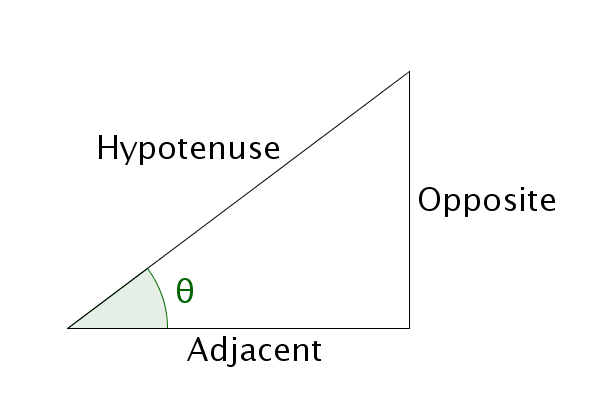
Knowing these parts is key because they are related to each other in a very specific and useful way, discovered by the ancient Greeks.
The Pythagorean Theorem
The Pythagorean theorem is a famous rule that describes the relationship between the lengths of the three sides in any right triangle. It states that if you square the lengths of the two legs and add them together, the total will be equal to the square of the length of the hypotenuse.
The 2,000-year-old theorem established that the sum of the squares of a right triangle’s two shorter sides equals the square of the hypotenuse – the third, longest side opposite the shape’s right angle.
If we call the lengths of the legs 'a' and 'b' and the length of the hypotenuse 'c', the formula looks like this:
Let's try it with a classic example. Imagine a right triangle with legs that are 3 units and 4 units long. We can use the theorem to find the length of the hypotenuse.
So, the hypotenuse is 5 units long. This 3-4-5 triangle is a famous example of a right triangle with whole-number sides.
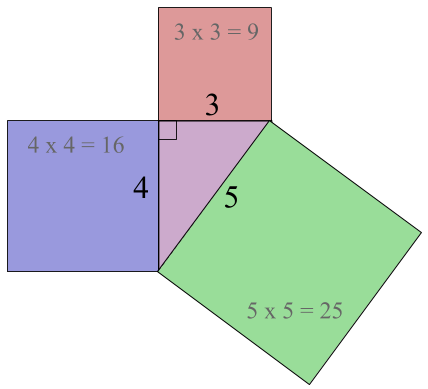
This theorem is incredibly powerful. If you know the lengths of any two sides of a right triangle, you can always find the length of the third side. This simple formula is a cornerstone of geometry and a key building block for understanding more advanced math.