Trigonometric Functions Explained
Right Triangle Basics
The 90-Degree Angle
A triangle has three sides and three angles. A right-angled triangle, or just a right triangle, is a special kind where one of those angles is exactly 90 degrees. This perfect corner is often marked with a small square to show it's a right angle.
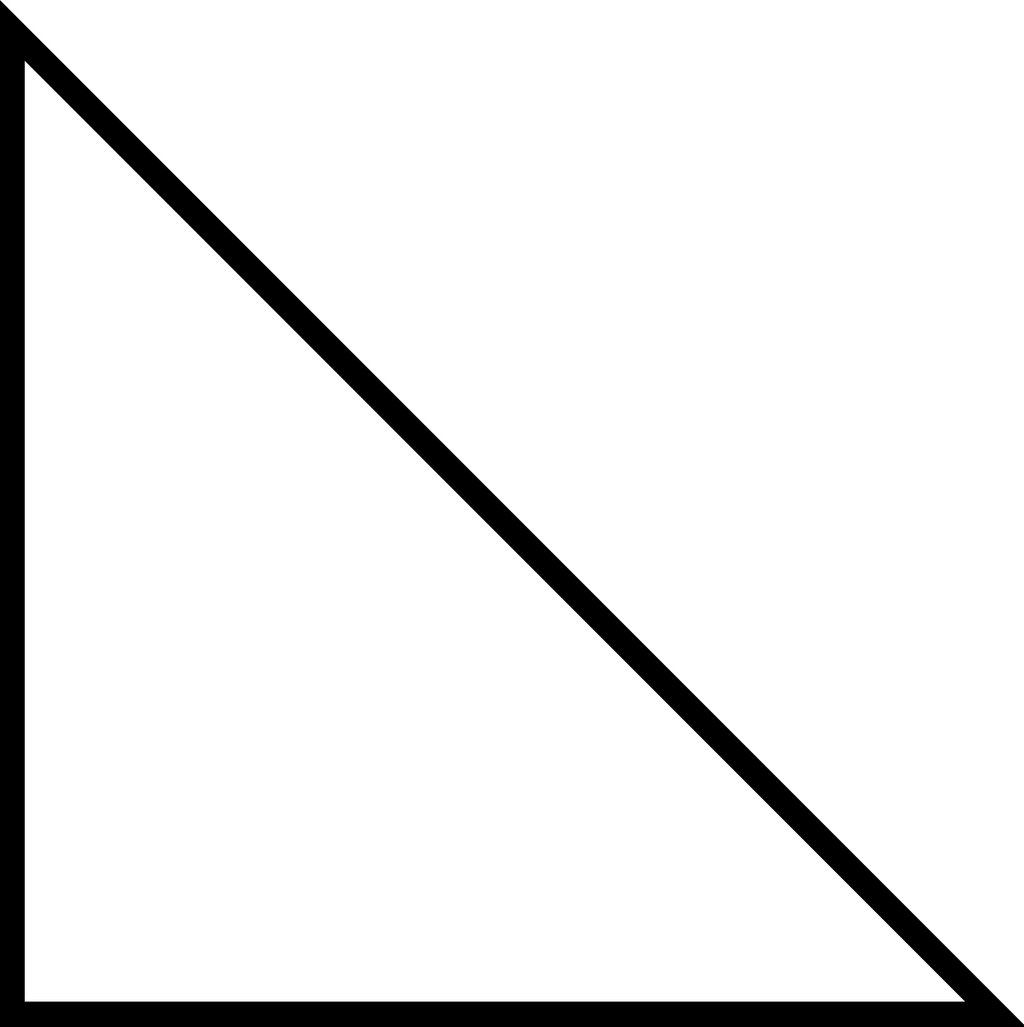
The two sides that form the right angle are called the legs. The third side, which is always the longest, has its own special name.
Naming the Sides
Every side of a right triangle has a name, but it depends on your perspective. Let's pick one of the non-right angles and call it our reference angle. You can think of it as the corner you are "standing" on.
hypotenuse
noun
The side opposite the right angle. It's always the longest side of a right triangle.
The other two sides, the legs, are named relative to the reference angle.
- Opposite: The side directly across from the reference angle.
- Adjacent: The side next to the reference angle that isn't the hypotenuse.
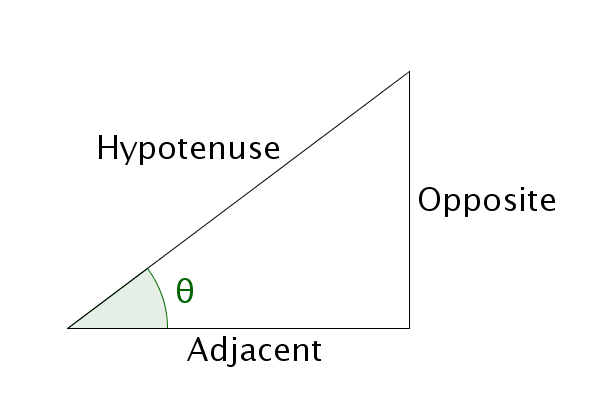
If you switch your reference angle to the other non-right angle, the opposite and adjacent sides swap places. The hypotenuse, however, never changes.
A Famous Relationship
Over 2,500 years ago, Greek mathematicians discovered a special relationship between the sides of a right triangle. This rule, known as the Pythagorean theorem, is a cornerstone of geometry.
The theorem states that if you square the lengths of the two legs and add them together, you get the square of the length of the hypotenuse.
If we call the legs 'a' and 'b' and the hypotenuse 'c', the relationship is written as:
This simple formula is incredibly powerful. If you know the lengths of any two sides of a right triangle, you can always find the length of the third.
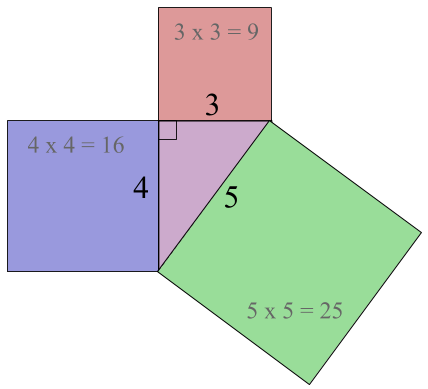
Let's try an example. Imagine a right triangle with legs of length 3 and 4. To find the hypotenuse (c), we can use the theorem.
First, square the lengths of the legs: $3^2 = 9$ $4^2 = 16$
Next, add them together: $9 + 16 = 25$
So, $c^2 = 25$. To find c, we take the square root of 25, which is 5. The hypotenuse is 5 units long.
The same logic works for finding a missing leg. If you know the hypotenuse is 13 and one leg is 12, you can set up the equation:
Subtract 144 from both sides to isolate :
Taking the square root, you'll find that the missing leg, 'a', is 5 units long.
Now let's check your understanding of these core concepts.
In a right-angled triangle, what is the name of the side located directly across from the 90-degree angle?
The Pythagorean theorem is represented by the formula . What does the variable 'c' represent?
Mastering these fundamentals opens the door to understanding the deeper relationships between a triangle's angles and its sides.