Trigonometric Functions Explained
Right Triangle Basics
Anatomy of a Right Triangle
A right triangle is a triangle with one angle that measures exactly 90 degrees. This special corner is usually marked with a small square. The three sides of a right triangle have unique names, but two of them depend on your point of view.
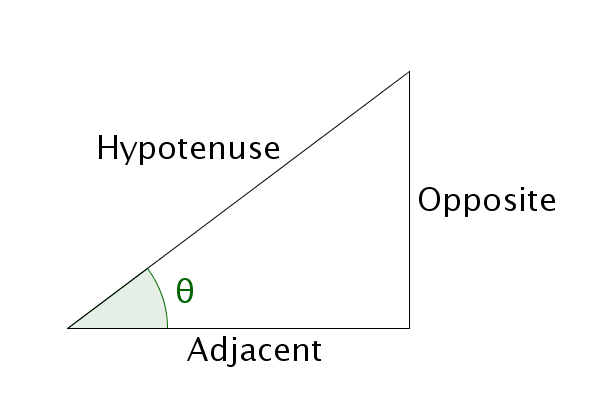
The longest side, always across from the right angle, is called the hypotenuse. It's the one side with a fixed name, no matter which angle you're looking from.
hypotenuse
noun
The longest side of a right-angled triangle, opposite the right angle.
The other two sides are called the legs. Their names, opposite and adjacent, are relative to one of the other two angles (the acute angles).
- The opposite side is the leg directly across from the angle you're considering.
- The adjacent side is the leg next to the angle you're considering, but it's not the hypotenuse.
If you switch your focus from one acute angle to the other, the opposite and adjacent sides swap places.
The Pythagorean Theorem
Ancient mathematicians discovered a remarkable relationship between the sides of a right triangle. This relationship, known as the Pythagorean theorem, is a cornerstone of geometry. It states that the square of the hypotenuse is equal to the sum of the squares of the other two sides (the legs).
In this formula, and are the lengths of the legs, and is the length of the hypotenuse. This simple equation allows you to find the length of any side of a right triangle if you know the lengths of the other two.
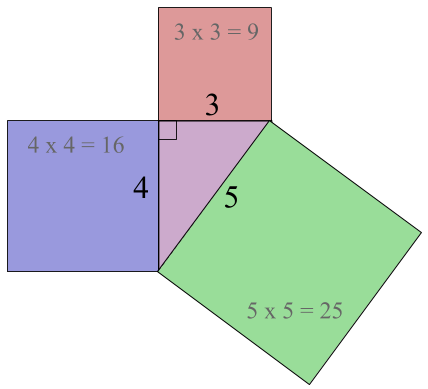
There are many ways to prove this theorem. One of the most intuitive visual proofs involves rearranging four identical right triangles.
Key Properties
Besides the Pythagorean theorem, right triangles have a few other defining characteristics.
First, the two angles that are not the right angle must be acute, meaning they are each less than 90 degrees. This is because the sum of all angles in any triangle must be 180 degrees. Since one angle is 90 degrees, the other two must add up to the remaining 90 degrees (, so ).
Because they must sum to 90 degrees, the two acute angles in a right triangle are always complementary.
Second, the hypotenuse is always the longest side. It's located opposite the largest angle (the 90-degree angle), and in any triangle, the longest side is always opposite the largest angle. The shortest side will always be opposite the smallest angle.
In a right triangle, which side is always located opposite the 90-degree angle?
True or False: The two non-right angles in a right triangle must add up to 90 degrees.
Understanding these fundamentals—the names of the sides and the Pythagorean theorem—is the first step into the much larger world of trigonometry.