Trigonometric Functions Explained
Introduction to Trigonometry
Angles and Coordinates
Trigonometry is the study of the relationship between angles and the side lengths of triangles. While it starts with right triangles, its true power comes from extending these ideas to all angles. To do that, we use a tool called the unit circle.
The unit circle is simply a circle with a radius of 1, centered at the origin (0,0) of a coordinate plane. Every point on this circle can be described by an angle, , and a pair of coordinates, . The angle begins from the positive x-axis and is measured counter-clockwise.
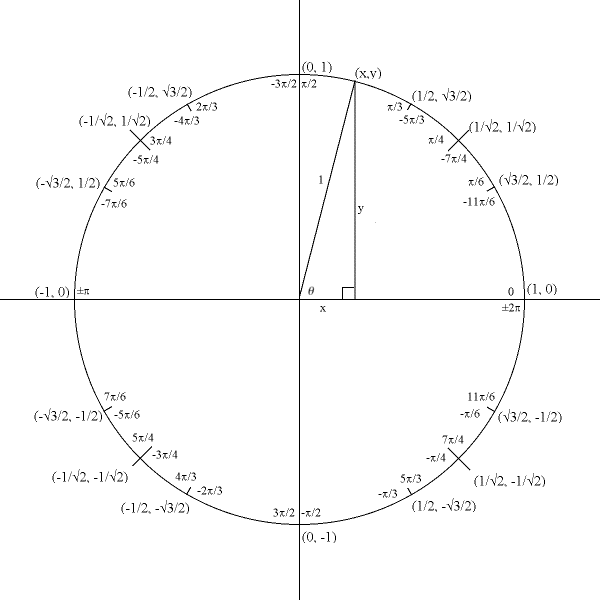
This setup provides a simple, direct way to define the two most fundamental trigonometric functions: sine and cosine. For any angle , the coordinates of the corresponding point on the unit circle are simply .
On the unit circle: • The x-coordinate is the cosine of the angle. • The y-coordinate is the sine of the angle.
Meet the Six Functions
Sine and cosine are the building blocks. The other four trigonometric functions are defined using them. First is the tangent, which is the ratio of sine to cosine. Geometrically, it represents the slope of the line from the origin to the point on the unit circle.
The remaining three functions are the reciprocals of the first three. Cosecant is the reciprocal of sine, secant is the reciprocal of cosine, and cotangent is the reciprocal of tangent.
| Function | Abbreviation | Definition | Reciprocal of |
|---|---|---|---|
| Sine | sin(θ) | y | Cosecant |
| Cosine | cos(θ) | x | Secant |
| Tangent | tan(θ) | y/x | Cotangent |
| Cosecant | csc(θ) | 1/y | Sine |
| Secant | sec(θ) | 1/x | Cosine |
| Cotangent | cot(θ) | x/y | Tangent |
Notice that since tangent, cosecant, secant, and cotangent all have a variable in the denominator, they will be undefined whenever that denominator is zero. For example, is undefined when , which happens at and .
Patterns on the Circle
The unit circle reveals interesting patterns. If you travel once around the circle, an angle of (or radians), you end up exactly where you started. This means the values for sine and cosine repeat every . This repeating nature is called periodicity.
A function is periodic if there's a number such that for all . The smallest such positive number is the period.
For sine and cosine, the period is . For tangent, the pattern repeats more quickly, every . The reciprocal functions share the same period as their base functions.
Trigonometric functions also exhibit symmetry. Consider the angles and . A negative angle is measured clockwise from the positive x-axis. The point for will have the same x-coordinate as but the opposite y-coordinate.
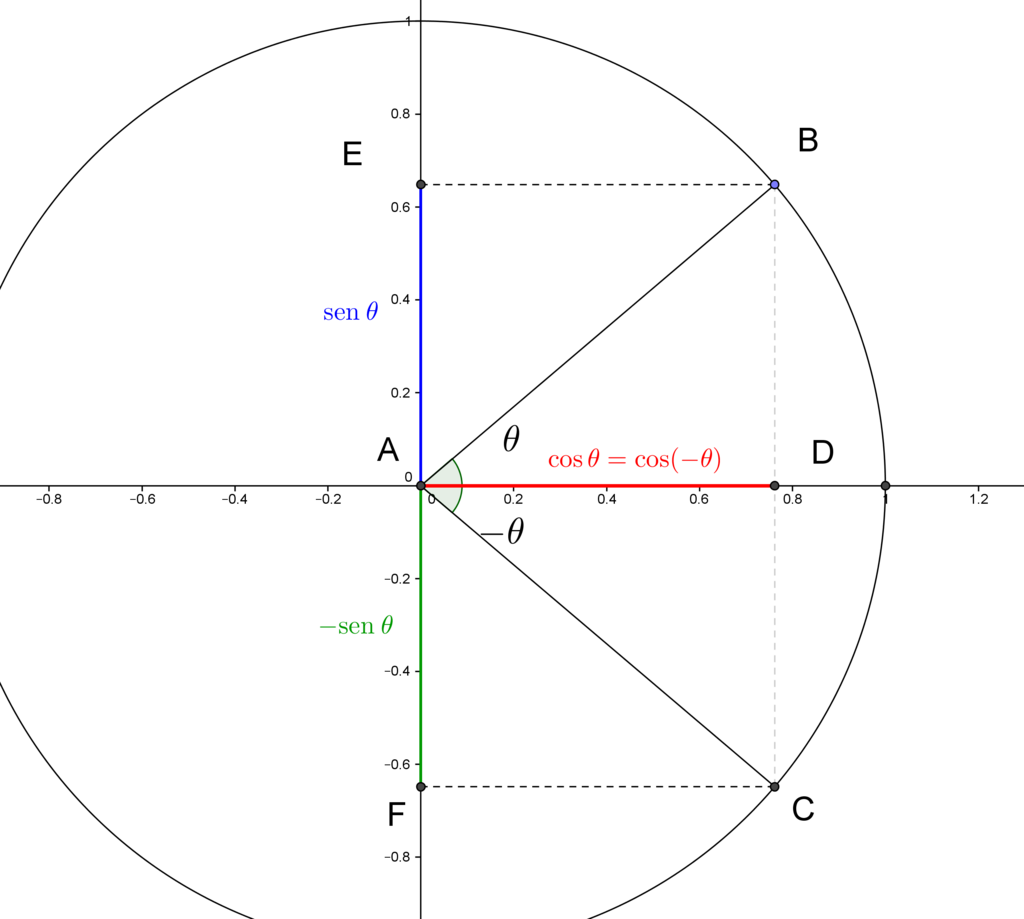
This observation leads to the even and odd properties of these functions. An even function is symmetric across the y-axis, meaning . An odd function is symmetric about the origin, meaning .
From these, we can determine the properties for the other functions. For example, tangent is an odd function because .
| Function | Property |
|---|---|
| Sine | Odd |
| Cosine | Even |
| Tangent | Odd |
| Cosecant | Odd |
| Secant | Even |
| Cotangent | Odd |
Let's check your understanding of these fundamental concepts.
On the unit circle, the coordinates of a point corresponding to an angle are defined as:
The tangent of an angle , denoted as , is defined as the ratio:
These definitions and properties are the foundation of trigonometry. Mastering them opens the door to understanding more complex relationships and applications.