Trigonometric Functions Explained
Introduction to Trigonometry
Angles and Sides
Trigonometry is the study of the relationship between angles and the side lengths of triangles. It's a fundamental part of geometry and has applications everywhere, from building bridges to creating video games. At its heart, it helps us find unknown angles or distances by using what we already know about a shape.
The simplest place to start is with a right-angled triangle. This special triangle, with its dependable 90-degree angle, is the key to unlocking the three basic functions of trigonometry: sine, cosine, and tangent.
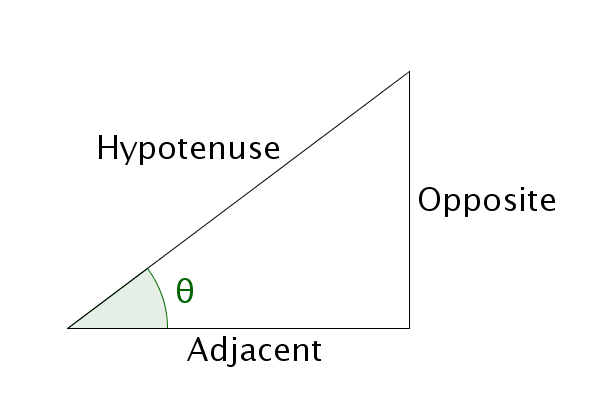
To understand these functions, we first need to name the sides of a right-angled triangle in relation to one of its acute angles (an angle less than 90 degrees), which we'll call (theta).
- Hypotenuse: This is always the longest side, and it's directly opposite the right angle.
- Opposite: This is the side directly across from the angle .
- Adjacent: This is the side next to the angle , but it's not the hypotenuse.
These names are relative. If you choose the other acute angle in the triangle, the 'opposite' and 'adjacent' sides will switch.
Defining the Ratios
Sine, cosine, and tangent are simply ratios of the lengths of two sides of a right-angled triangle. A popular mnemonic to remember them is "SOH CAH TOA".
SOH: Sine = Opposite / Hypotenuse CAH: Cosine = Adjacent / Hypotenuse TOA: Tangent = Opposite / Adjacent
Let's look at a classic 3-4-5 triangle. If the side opposite angle is 3, the adjacent side is 4, and the hypotenuse is 5, the trigonometric ratios for are:
The power of these ratios is that they depend only on the angle, not the size of the triangle. A tiny 3-4-5 triangle and a massive one with sides of 300, 400, and 500 would have the exact same sine, cosine, and tangent values for the corresponding angle.
The Unit Circle
Right-angled triangles are great, but they have a limitation: their angles are always less than 90 degrees. To work with any angle (even negative ones or those larger than 360 degrees), we use the unit circle.
The unit circle is a circle with a radius of 1, centered at the origin (0,0) of a graph. We measure an angle by starting from the positive x-axis and rotating counter-clockwise.
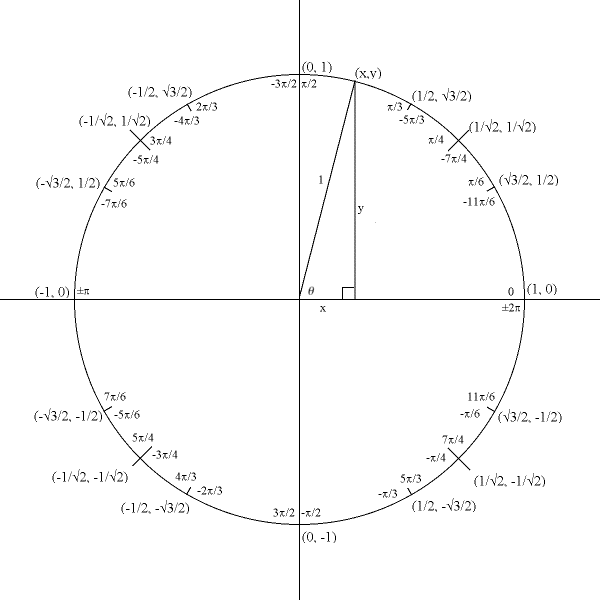
Imagine a point where the angle's terminal side intersects the circle. We can draw a right-angled triangle by dropping a vertical line from this point to the x-axis. In this triangle:
- The hypotenuse is the circle's radius, which is 1.
- The adjacent side has a length equal to the x-coordinate.
- The opposite side has a length equal to the y-coordinate.
Now, let's apply our SOH CAH TOA definitions.
This gives us a more powerful definition: for any angle , its cosine is the x-coordinate and its sine is the y-coordinate of the corresponding point on the unit circle. This works for any angle, because x and y can be positive or negative, depending on the quadrant.
And what about tangent? It's still Opposite / Adjacent, which in this case is .
On the unit circle:
A New Way to Measure Angles
We're used to measuring angles in degrees, with a full circle being 360°. But in trigonometry and higher math, it's often more useful to use radians.
A radian is defined by the arc length of a circle. One radian is the angle created when the arc length is equal to the radius of the circle.
radian
noun
A unit of angle measure based on the radius of a circle.
The circumference of a circle is given by the formula . For the unit circle, where , the circumference is simply . This means a full trip around the circle (360°) covers an arc length of . Therefore:
radians
Dividing both sides by 2 gives us the most common conversion:
radians
From this, we can find other common angles. For example, is half of , so it's radians. And is one-third of , so it's radians. While it might seem strange at first, using radians simplifies many formulas in calculus and physics.
In a right-angled triangle, which trigonometric function is defined as the ratio of the length of the side opposite an angle to the length of the hypotenuse?
Using the unit circle, the coordinates of a point on its circumference corresponding to an angle can be expressed as (cos , sin ).