Triangle Congruence Essentials
Triangle Basics
The Simplest Polygon
A triangle is the simplest polygon you can make. It's a flat, enclosed shape with three straight sides, three corners (called vertices), and three inside angles. Every triangle, no matter its shape or size, has a fundamental property: its three interior angles always add up to 180 degrees. This is a hard and fast rule in geometry.
Classifying by Sides
One way to categorize triangles is by looking at the lengths of their sides. Are they all the same, are two the same, or are they all different? This gives us three distinct types.
Equilateral
adjective
A triangle with three sides of equal length.
Think of it as the most symmetrical type of triangle. All sides are identical, and all angles are identical too.
Isosceles
adjective
A triangle with at least two sides of equal length.
An easy way to remember this is that an isosceles triangle has two sides that are 'in cahoots'—they're the same length. The third side can be shorter or longer.
Scalene
adjective
A triangle with three sides of different lengths.
This is the most general type of triangle. No special treatment here; every side has its own unique length.
Classifying by Angles
Another way to classify triangles is by their largest internal angle. This also gives us three categories.
Acute
adjective
A triangle where all three angles are less than 90 degrees.
These triangles have sharp, pointy corners. No single angle is very wide.
Right
adjective
A triangle with one angle that is exactly 90 degrees.
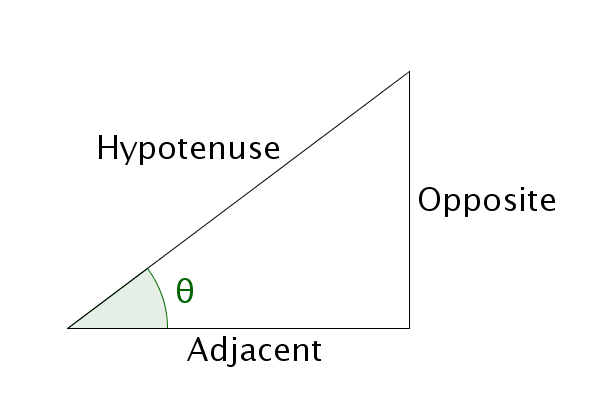
Right triangles are fundamental in trigonometry. They have a perfect square corner. The two sides that form the right angle are called legs, and the longest side, opposite the right angle, is the hypotenuse.
Obtuse
adjective
A triangle with one angle that is greater than 90 degrees.
These triangles have one wide, open angle. Since the total degrees in a triangle is 180, it's impossible to have more than one obtuse angle.
Keep in mind that a triangle can be described by both its sides and angles. For example, you can have a "right isosceles triangle" (a right triangle with two equal sides) or an "obtuse scalene triangle" (an obtuse triangle with no equal sides).
| Classification | By Sides | By Angles |
|---|---|---|
| Three Equal | Equilateral | Not possible |
| Two Equal | Isosceles | Acute, Right, or Obtuse |
| None Equal | Scalene | Acute, Right, or Obtuse |
Understanding these basic types is the first step. With these definitions in hand, you can start exploring more complex ideas in geometry.