Triangle Angle Relationships
Triangle Basics
The Simplest Polygon
Let's start with the basics. A triangle is a flat, closed shape with three straight sides. That's it. It’s the simplest polygon you can make. The points where the sides meet are called vertices (one is a vertex), and the sides themselves are often called edges.
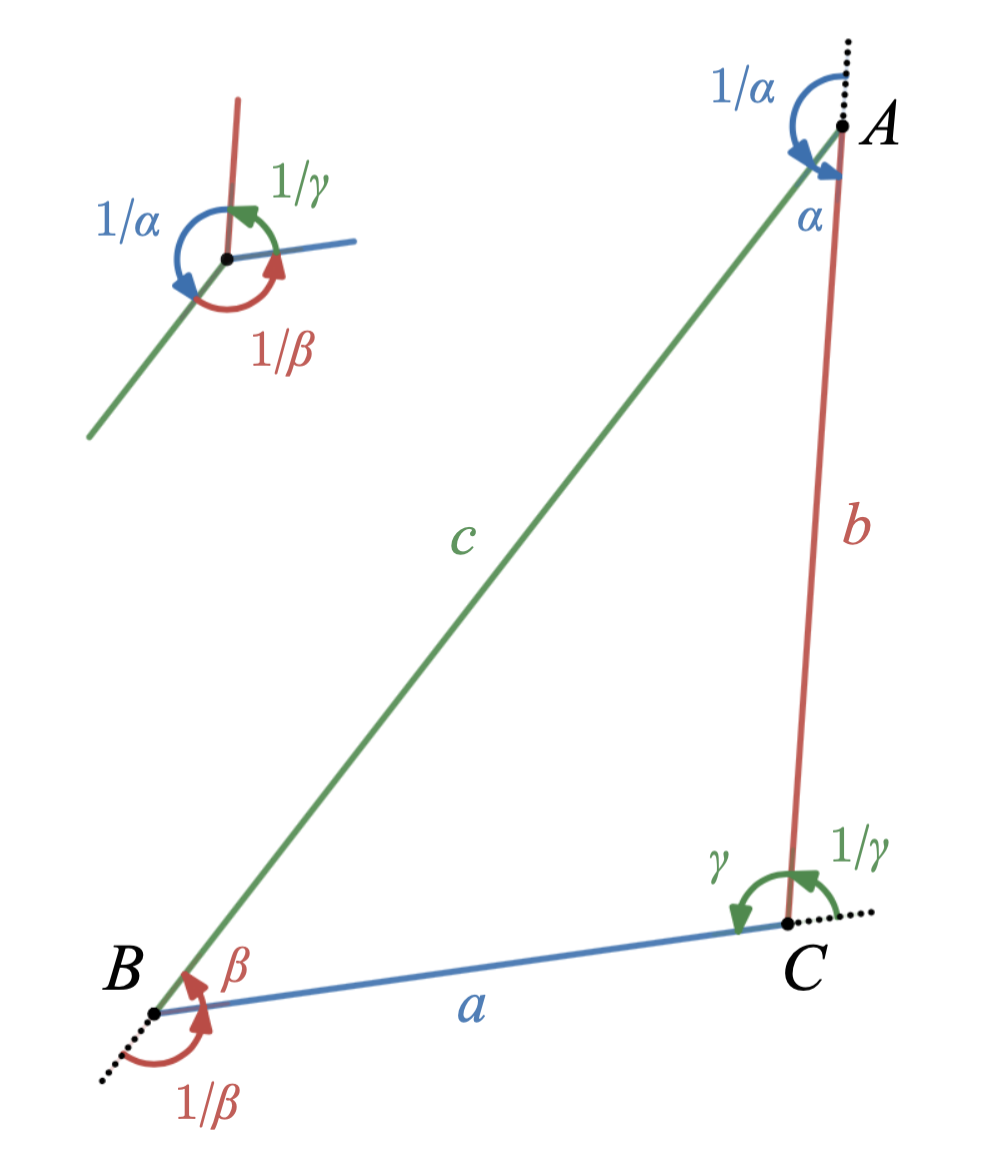
But not all triangles look the same. We can sort them into different categories based on the length of their sides and the size of their angles. Think of it like a first and last name; every triangle has a name from each category.
Naming by Sides
The first way to classify a triangle is by looking at its side lengths. Are they all the same? Are two the same? Or are they all different?
Equilateral
adjective
A triangle with three equal sides. Because the sides are equal, the three angles are also equal.
The name comes from Latin: aequus (equal) and latus (side).
Isosceles
adjective
A triangle with two equal sides. The angles opposite the equal sides are also equal.
This name has Greek roots: isos (equal) and skelos (leg).
Scalene
adjective
A triangle where all three sides have different lengths. Consequently, all three angles are also different.
This word also comes from Greek, skalenos, which means uneven.
Naming by Angles
The second way to classify a triangle is by its largest angle. All triangles have at least two sharp, or acute, angles. The third angle is the deciding factor.
Acute
adjective
A triangle where all three internal angles are less than 90 degrees.
An equilateral triangle is a perfect example of an acute triangle.
Right
adjective
A triangle that has one angle measuring exactly 90 degrees. This angle is often marked with a small square.
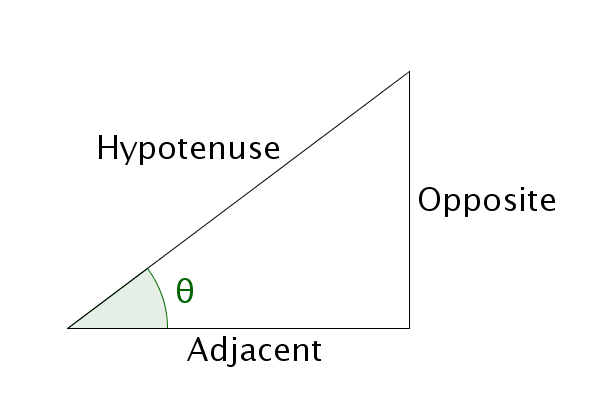
Right triangles have special names for their sides. The two sides that form the right angle are called legs. The longest side, opposite the right angle, is the hypotenuse.
Obtuse
adjective
A triangle with one angle that is greater than 90 degrees.
A triangle can only have one right or one obtuse angle. If it had more, the sides would never meet to form a closed shape!
Combining the Names
Every triangle has two names: one that describes its sides and one that describes its angles. For example, you can have a right isosceles triangle. This triangle has a 90-degree angle and two equal sides.
Or you could have an obtuse scalene triangle. This tells you it has one angle greater than 90 degrees and three sides of different lengths. Learning these classifications is the first step to understanding the geometry of triangles.