Transition Series Ionization Energies
Atomic Structure
The Building Blocks of Everything
At the heart of every atom is a dense core called the nucleus. It's packed with two types of particles: positively charged protons and neutral neutrons. Protons and neutrons are roughly the same size and mass. The number of protons is what defines an element. An atom with one proton is always hydrogen, while an atom with six protons is always carbon.
Whizzing around this nucleus are much smaller, negatively charged particles called electrons. The attraction between the positive protons in the nucleus and the negative electrons keeps the atom together. In a neutral atom, the number of electrons equals the number of protons, balancing the overall charge to zero.
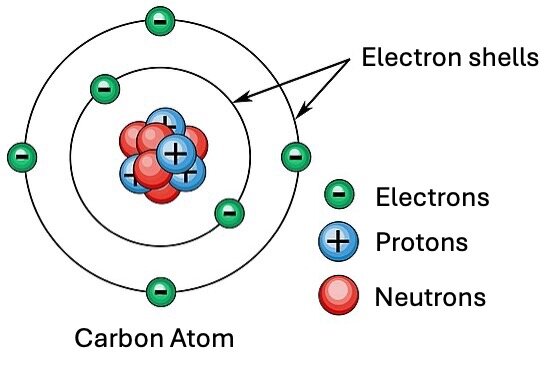
Where Electrons Live
Electrons don't just orbit the nucleus randomly. They exist in specific energy levels called electron shells. Think of these like floors in a building. Electrons on the first floor (the shell closest to the nucleus) have the lowest energy. Those on higher floors have more energy.
Each shell is identified by a principal quantum number, represented by . The first shell is , the second is , and so on. A shell can only hold a limited number of electrons, given by the formula . So, the first shell () can hold electrons, and the second shell () can hold electrons.
But the floors in this building have different types of rooms. These rooms are called subshells.
There are four main types of subshells, designated by the letters s, p, d, and f.
- An s subshell is spherical and contains just one room, or orbital, which can hold up to 2 electrons.
- A p subshell is dumbbell-shaped and has three orbitals, holding a total of 6 electrons.
- A d subshell has five orbitals, holding up to 10 electrons.
- An f subshell has seven orbitals, holding up to 14 electrons.
The first shell () only has an s subshell. The second shell () has s and p subshells. The third shell () has s, p, and d subshells. This pattern continues for higher energy levels.
Filling the Shells
So how do we know which shell and subshell an electron goes into? Electrons fill the available orbitals starting from the lowest energy level and moving up. This is known as the Aufbau principle. The filling order isn't always as simple as finishing one shell before starting the next. For instance, the 4s subshell is actually lower in energy than the 3d subshell, so it gets filled first.
The order of filling is: 1s, 2s, 2p, 3s, 3p, 4s, 3d, 4p, 5s, 4d...
The way electrons are arranged in these shells and subshells is called an atom's electron configuration. This configuration is a shorthand that tells us exactly where all of an atom's electrons are located. It's written by listing the subshells and using a superscript to show the number of electrons in each one.
Let's take carbon as an example. Carbon has six electrons. Following the filling order:
- The first two electrons go into the 1s subshell. Now 1s is full. Configuration: $1s^2$.
- The next two electrons go into the 2s subshell. Now 2s is full. Configuration: $1s^2 2s^2$.
- The remaining two electrons go into the 2p subshell. Configuration: $1s^2 2s^2 2p^2$.
This final notation, $1s^2 2s^2 2p^2$, is the complete electron configuration for carbon. It precisely describes the location of all six of its electrons. Understanding this structure is the first step to figuring out how atoms interact with one another.