Transient Conduction Explained
Heat Transfer Fundamentals
How Heat Moves
Heat is simply energy on the move. It always flows from a warmer object to a cooler one, never the other way around. This transfer can happen in three distinct ways: conduction, convection, and radiation. Often, you'll find more than one of these processes happening at the same time.
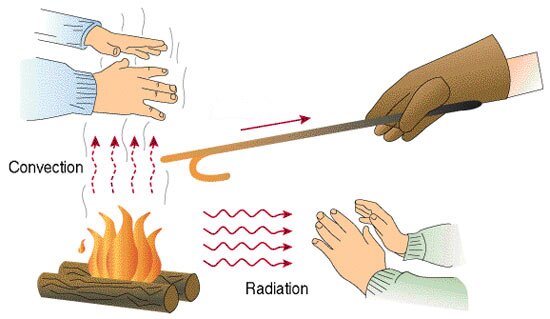
Imagine warming your hands by a campfire. The heat you feel from the glowing embers without touching them is radiation. If you put a metal poker in the fire, its handle eventually gets hot through conduction. The rising hot air you feel if you hold your hands above the flames is convection. Let's look at each of these more closely.
Conduction
Conduction is heat transfer through direct contact. At the atomic level, the particles of the hotter object are vibrating more intensely. When they touch a cooler object, they bump into its particles and transfer some of their energy, causing the cooler particles to vibrate more. This chain reaction continues, passing heat along.
Think of a metal spoon left in a hot cup of soup. The heat travels up the spoon's handle molecule by molecule until it's too hot to touch. This happens without any of the metal itself actually moving from one end of the spoon to the other.
Thermal Conductivity
noun
A measure of a material's ability to conduct heat. Materials with high thermal conductivity transfer heat quickly, while materials with low conductivity transfer it slowly.
The rate of this heat transfer is described by Fourier's Law of Heat Conduction. It tells us that heat flows faster if the temperature difference is larger, the area of contact is bigger, or the material is a better conductor. It also says heat flows slower through thicker materials.
Here, is the rate of heat transfer, is the thermal conductivity of the material, is the cross-sectional area through which heat is flowing, and is the temperature gradient, or how quickly the temperature changes with distance. The negative sign indicates that heat flows from high temperature to low temperature.
Convection
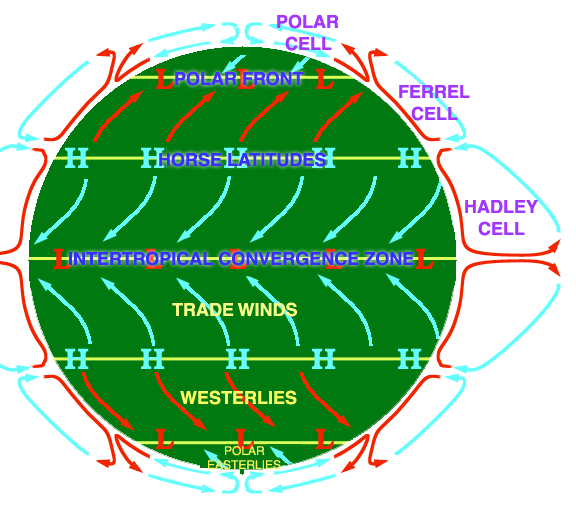
Convection is heat transfer through the movement of fluids, which includes liquids and gases. When a part of a fluid is heated, it usually expands and becomes less dense. Gravity then causes this warmer, less dense fluid to rise, while the cooler, denser fluid sinks to take its place. This creates a continuous circulation called a convection current, which transfers heat.
You see this every time you boil water in a pot. The water at the bottom gets heated by the stove, rises to the top, cools off, and then sinks back down, creating a rolling boil.
The rate of heat transfer by convection is described by Newton's Law of Cooling. This principle states that the rate of heat transfer is proportional to the temperature difference between an object's surface and the surrounding fluid.
In this formula, is the rate of heat transfer, is the surface area of the object, is the object's surface temperature, and is the temperature of the fluid far from the object. The term is the convection heat transfer coefficient, which depends on factors like the fluid's properties and its velocity.
Radiation
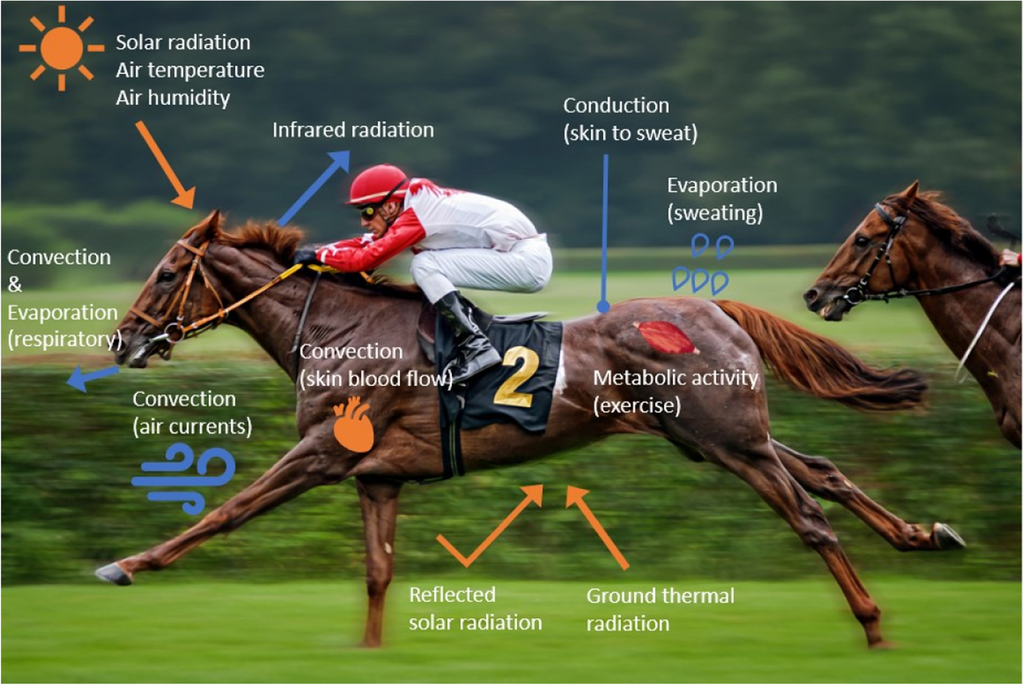
Radiation is the transfer of heat through electromagnetic waves, such as infrared radiation. Unlike conduction and convection, radiation doesn't need a medium to travel through. It can move through the vacuum of space. This is how the Sun's energy reaches Earth.
All objects with a temperature above absolute zero emit thermal radiation. Hotter objects radiate more energy than colder ones. When these waves hit another object, they transfer heat to it.
The Stefan-Boltzmann Law describes the power radiated from a perfect radiator, often called a "black body." It says that the total energy radiated per unit surface area is directly proportional to the fourth power of its absolute temperature.
Here, is the total radiated power, is the surface area, and is the absolute temperature in Kelvin. The symbol (sigma) is the Stefan-Boltzmann constant. For real objects, we add a factor called emissivity (), which is a value between 0 and 1 that describes how well the surface radiates heat compared to a perfect black body.
This is why a dark-colored car gets hotter in the sun than a light-colored one. Dark surfaces have higher emissivity, so they absorb and emit radiation more effectively.
Ready to check your understanding? Let's see how well you've grasped these concepts.
Which method of heat transfer is primarily responsible for the circulation of water in a boiling pot?
The feeling of warmth from the sun on your skin is an example of heat transfer by radiation.
Understanding these three modes of heat transfer is the foundation for analyzing how energy moves in everything from engines and electronics to buildings and planetary systems.