Transformer Models for AI Generation
Introduction to Transformers
Beyond One Word at a Time
For a long time, AI models that worked with language, like Recurrent Neural Networks (RNNs) and their more advanced cousins, LSTMs, read sentences a lot like we do: one word after another, in order. This sequential approach makes sense, but it has two major drawbacks.
First, it creates a memory problem. By the time the model reaches the end of a long paragraph, it might have forgotten crucial details from the beginning. This struggle to connect distant words is known as the difficulty with "long-range dependencies." Second, it's slow. A model has to process the first word before it can move to the second, and so on. It can't just jump into the middle or read everything at once. This makes training these models on huge amounts of text very time-consuming because the process can't be easily parallelized, or broken up to run on multiple processors at the same time.
Transformers solve these problems by abandoning the sequential approach. Instead of reading word-by-word, they process all the words in a sentence simultaneously.
The Power of Self-Attention
The key innovation that allows Transformers to do this is called the self-attention mechanism. It's a way for the model to weigh the importance of every word in a sentence relative to every other word. It lets the model ask, "As I look at this specific word, which other words in this sentence provide the most important context?"
Consider the sentence: "The robot picked up the ball, but it was too heavy." What does "it" refer to? The robot or the ball? For a human, the answer is obviously the ball. Self-attention allows a model to make this connection by linking "it" directly back to "ball," even though several words separate them. The model learns to pay more "attention" to "ball" when processing the word "it".
This ability to directly link words, no matter how far apart, is how Transformers master long-range dependencies. And because the attention scores for all words can be calculated at the same time, the whole process is highly parallelizable, making training much faster than with older models.
Attention in Parallel
A single self-attention mechanism is powerful, but it can only look at a sentence from one perspective. To build a richer understanding, Transformers use a technique called multi-head attention. This is like having several self-attention mechanisms running in parallel. Each "head" independently analyzes the sentence, focusing on different types of relationships between words. One head might focus on grammatical links, another on semantic relationships, and another on subject-object connections. The model gets to look at the same sentence from multiple angles at once.
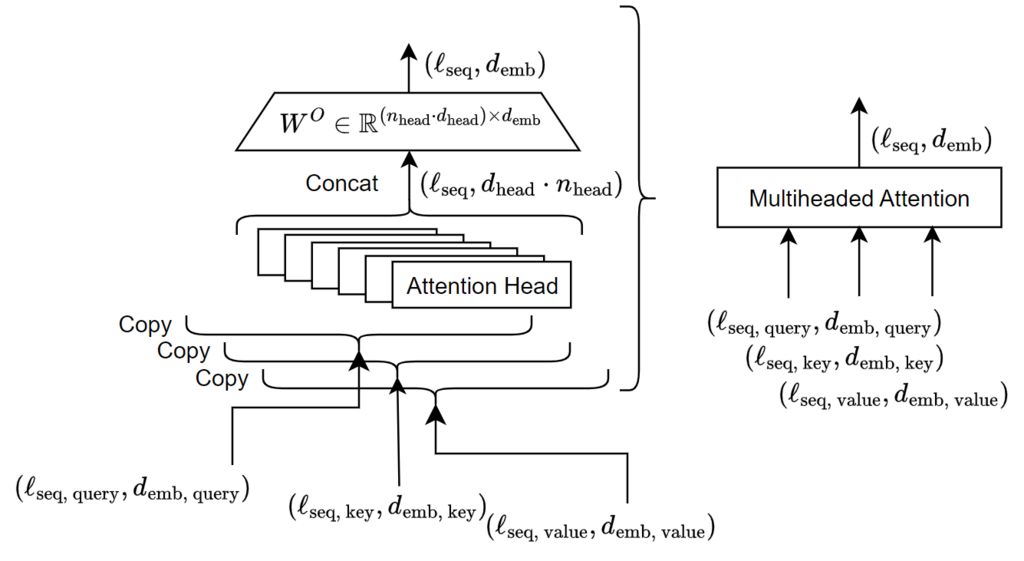
After the multi-head attention layers have gathered all this contextual information, the data is passed through a feed-forward neural network. This is a more standard component of neural networks. Its job is to process the rich, attention-weighted information and perform further computations. Think of it as a processing station that takes the complex relationships identified by the attention heads and transforms them into a format that the next layer of the Transformer can use.
Unlike recurrent neural networks (RNNs) and convolutional neural networks (CNNs), Transformers rely entirely on attention mechanisms, eliminating the need for recurrence and convolutions.
This combination of self-attention, multi-head attention, and feed-forward networks creates a powerful and efficient architecture. It has become the foundation for most modern AI models that deal with language.
Time to check your understanding of how Transformers work.
What were the two primary drawbacks of older sequential models like RNNs that the Transformer architecture was designed to overcome?
What is the key mechanism in a Transformer that allows it to weigh the importance of different words in a sentence relative to each other, regardless of their position?
By understanding these core components, you have a solid foundation for grasping how modern AI models process and understand language with such remarkable ability.