Transformer Models Explained
Introduction to Transformer Models
Handling Language in Sequence
For a long time, teaching computers to understand language felt like teaching a person to read one word at a time. The most successful approach involved models called Recurrent Neural Networks, or RNNs. An RNN would read a sentence sequentially, from the first word to the last.
As it read each word, it would update a kind of internal memory, called a hidden state. This memory was supposed to carry the context from the beginning of the sentence all the way to the end. The idea was that by the time the model reached the last word, its memory would hold the meaning of the entire sentence.
For the sentence, "The cat sat on the mat," an RNN would process "The," then "cat," then "sat," updating its memory at each step.
But this approach had a major flaw. For long sentences, the model would start to forget what it read at the beginning. The crucial context from the early words would get diluted or lost by the time it reached the end. This made it difficult for RNNs to grasp the meaning of complex, lengthy texts. They were also slow, since processing one word required waiting for the previous one to finish.
A Parallel Approach
In 2017, a paper titled "Attention Is All You Need" introduced a new architecture that changed everything: the Transformer. Instead of reading word by word, the Transformer model processes every word in a sentence simultaneously. This parallel processing was a massive breakthrough.
Transformers revolutionized NLP by replacing RNNs with self-attention mechanisms, allowing models to process entire sentences in parallel and capture long-range dependencies efficiently.
By looking at the entire sentence at once, a Transformer can directly compare every word to every other word. This allows it to weigh the importance of different words when interpreting context, solving the long-range dependency problem that plagued RNNs. This parallel nature also makes Transformers much faster to train on modern hardware like GPUs.
The Encoder-Decoder Structure
The original Transformer model was designed for tasks like machine translation, where you convert a sequence of words from one language to another. To do this, it uses a two-part structure: an encoder and a decoder.
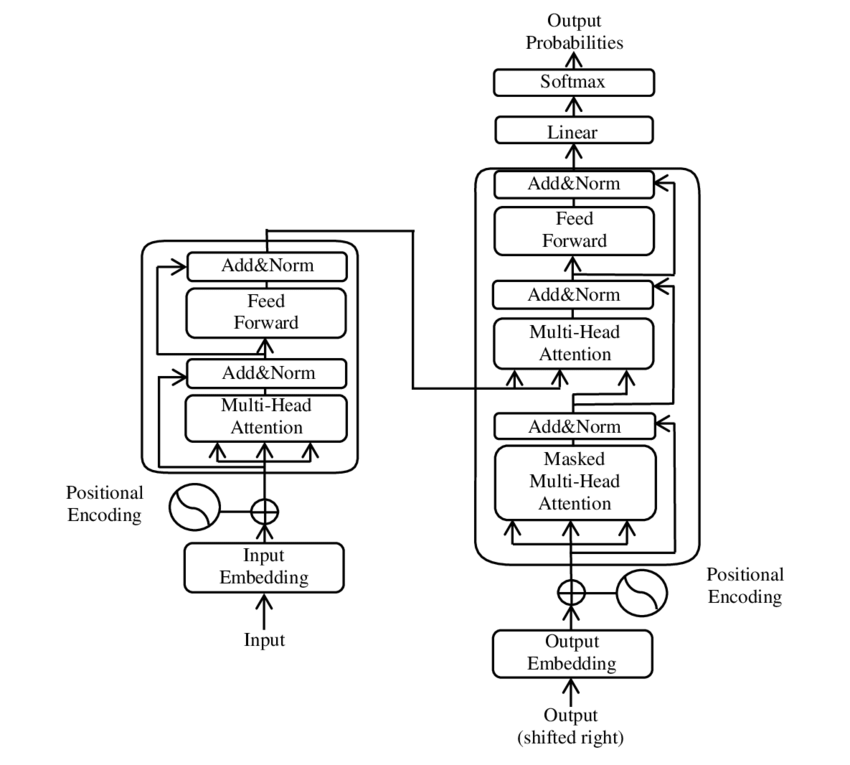
The encoder's job is to read the input sentence (say, in English) and build a rich, numerical representation of its meaning. It's like reading a paragraph and summarizing the key ideas in your head. The encoder is made up of a stack of identical layers that work together to refine this understanding.
The decoder's job is to take that numerical representation and generate the output sentence, one word at a time (for instance, in Spanish). As it generates each new word, it looks back at the encoder's representation and the words it has already produced to decide what should come next.
This powerful encoder-decoder framework became the foundation for many of the most advanced AI models in use today.
What was the major limitation of Recurrent Neural Networks (RNNs) when processing long sentences?
How does the Transformer architecture's approach to processing a sentence differ fundamentally from an RNN's?