Transformer Models Explained
Introduction to Transformer Models
What Are Transformer Models?
Transformer models are a type of neural network architecture that has fundamentally changed how machines understand and generate human language. Before transformers, models processed text sequentially, reading one word at a time, much like we do. This method was slow and often lost track of context in long sentences.
Transformers process all the words in a sentence at once. This parallel approach allows them to grasp the relationships between words, no matter how far apart they are.
This ability to see the bigger picture makes them incredibly powerful for tasks in Natural Language Processing (NLP), from translating languages to writing articles.
A New Way of Processing
To understand why transformers are so effective, let's compare them to older models, like Recurrent Neural Networks (RNNs).
An RNN reads a sentence word by word, from left to right. It tries to remember what came before as it moves along, but its memory is limited. By the time it reaches the end of a long paragraph, it may have forgotten crucial details from the beginning. This is often called the "long-range dependency" problem.
Transformers solve this by abandoning the sequential approach. Instead of a step-by-step process, they look at the entire input text at once. This parallel processing is not only faster but also allows the model to weigh the importance of every word in relation to all other words, capturing context with far greater accuracy.
We propose a new simple network architecture, the Transformer, based solely on attention mechanisms, dispensing with recurrence and convolutions entirely.
Inside the Transformer
At its core, the original transformer model has two main parts: an encoder and a decoder.
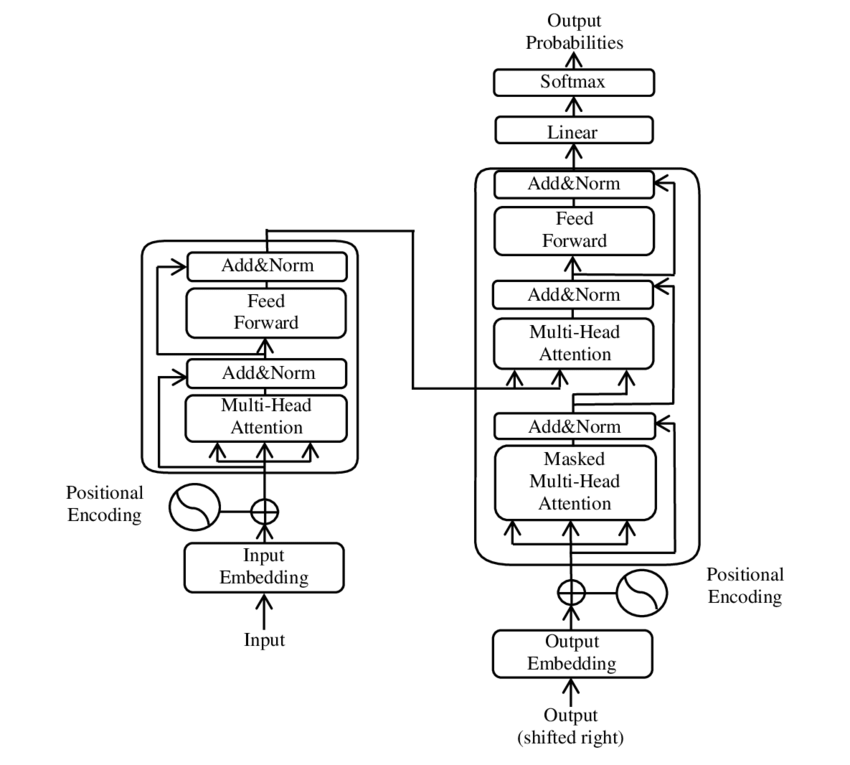
The encoder's job is to read and understand the input text. It processes the entire sentence and creates a numerical representation that captures its meaning and context. Think of it as a deep reader that digests a sentence and summarizes its essence.
The decoder's job is to take that numerical representation and generate an output. For a translation task, it would take the encoder's understanding of an English sentence and generate the equivalent sentence in French.
Together, they form a powerful sequence-to-sequence system. The encoder learns the meaning, and the decoder generates a new sequence based on that meaning.
History and Impact
The transformer architecture was introduced in a 2017 paper by researchers at Google titled "Attention Is All You Need." This paper was a watershed moment in AI. By showing that a model based entirely on attention mechanisms could outperform traditional RNNs, it set a new course for NLP research.

Since then, transformer-based models have become the standard. They are the foundation for most modern Large Language Models (LLMs), including well-known systems like BERT and GPT. Their versatility has enabled breakthroughs in a wide range of applications:
- Machine Translation: Translating text between languages with higher accuracy.
- Text Summarization: Condensing long articles into brief summaries.
- Question Answering: Understanding a question and finding the answer within a block of text.
- Chatbots and Virtual Assistants: Powering more natural and context-aware conversations.
Time for a quick review of the key ideas we've covered.
What is the primary advantage of Transformer models over older architectures like Recurrent Neural Networks (RNNs) for processing long texts?
In the original Transformer architecture, what is the main responsibility of the decoder component?
By moving beyond sequential processing, transformers unlocked a new level of performance and scale, paving the way for the sophisticated AI tools we use today.