Transformer Model Mechanics
Introduction to Neural Networks
The Brain as a Blueprint
Neural networks are inspired by the structure of the human brain. Your brain is made of billions of cells called neurons, which are connected in a vast network. They receive signals, process them, and pass them on to other neurons. An artificial neural network works in a similar way, but with math instead of biology.
The simplest unit is an artificial neuron, sometimes called a perceptron. It takes one or more inputs, each with an associated "weight." These weights are crucial; they represent the importance of each input. A higher weight means that input has more influence on the neuron's output.
The neuron multiplies each input by its weight, sums them all up, adds a bias value (which helps fine-tune the output), and then produces a single output. Think of it like a tiny decision-maker.
Neurons Working Together
A single neuron isn't very powerful. The real magic happens when we connect them into layers. A typical neural network has at least three types of layers:
- Input Layer: This layer receives the initial data. If you're analyzing images, each neuron might correspond to a pixel. For text, it might be a word.
- Hidden Layers: These are the layers between the input and output. There can be one or many hidden layers (which is where the term "deep learning" comes from). This is where most of the computation happens. Neurons in these layers detect patterns in the data.
- Output Layer: This layer produces the final result. If you're classifying emails, the output layer might have two neurons: one for "spam" and one for "not spam."
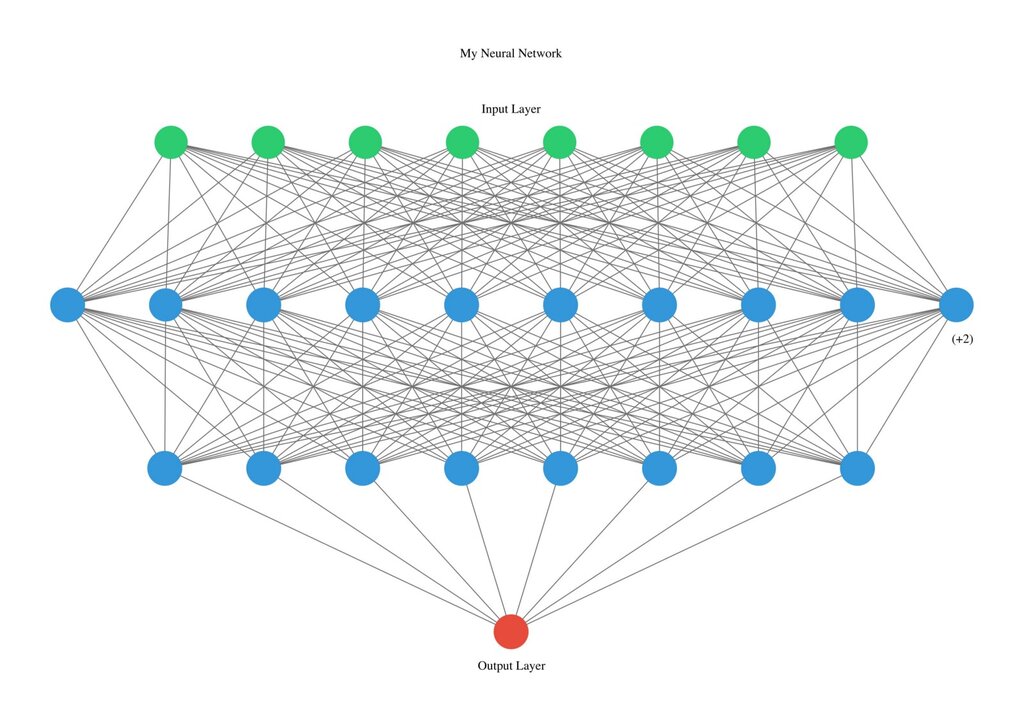
When you feed data into the network, it flows from the input layer, through the hidden layers, to the output layer. This one-way trip is called forward propagation. Each neuron in a layer passes its output to the neurons in the next layer, creating a cascade of calculations until a final prediction is made.
Making Decisions
If neurons only added up weighted inputs, the entire network would just be one big, complex linear equation. It wouldn't be able to learn complex patterns, like the difference between a cat and a dog.
To introduce non-linearity, we use activation functions. After a neuron sums its weighted inputs, the result is passed through an activation function. This function decides what the neuron's final output should be, effectively determining whether the neuron should "fire" and how strongly.
An activation function is a mathematical gate that helps the network learn complex relationships in the data.
A common example is the Sigmoid function, which squishes any input value into a range between 0 and 1. This is useful for representing probabilities in the output layer, like the probability that an email is spam.
Another popular choice is the Rectified Linear Unit (ReLU), which simply outputs the input if it's positive, and 0 otherwise. It's computationally simple and works very well in many cases.
Learning from Mistakes
A neural network starts out dumb. Its initial weights are set randomly, so its first predictions are just guesses. The process of making it smarter is called training.
Training involves showing the network many examples from a dataset where we already know the correct answers. For each example, we let the network make a prediction through forward propagation. Then, we compare the network's prediction to the actual correct answer.
To quantify how wrong the prediction was, we use a loss function (or cost function). The loss function calculates a single number, the "loss," which represents the size of the error. A high loss means a bad prediction; a low loss means a good one. The goal of training is to minimize this loss.
The goal of training is to adjust the network's weights and biases to make the loss as low as possible.
But how do we know which weights to adjust? That's where backpropagation comes in. It's a clever algorithm that works backward from the output layer to the input layer. It calculates how much each individual weight and bias in the network contributed to the total loss.
Once we know who to blame for the error, an optimizer algorithm, like Gradient Descent, steps in. It adjusts each weight in the direction that will decrease the loss. Imagine you're on a mountain in a thick fog and want to get to the lowest point. You'd feel the slope under your feet and take a small step in the steepest downward direction. Gradient Descent does the same thing, but in the mathematical landscape of the loss function.
By repeating this process of forward propagation, loss calculation, backpropagation, and weight updates millions of times with many different examples, the network gradually learns to make more accurate predictions.
In a neural network, what is the primary role of a weight associated with an input?
The process of calculating the network's prediction error and then using that error to adjust the network's weights is known as _________ and _________, respectively.