Transformer Architecture in AI
Introduction to Neural Networks
The Brain's Blueprint
Neural networks are inspired by the human brain. The brain is made of billions of cells called neurons, which connect to each other to process information. An artificial neural network does something similar, but with digital 'neurons' instead of biological ones.
Neuron
noun
The fundamental processing unit of a neural network. It receives one or more inputs, processes them, and passes the result to other neurons.
Think of a single artificial neuron as a tiny decision-maker. It takes in several pieces of information, called inputs. Each input is assigned a 'weight,' which signifies its importance. An input with a higher weight has more influence on the neuron's decision. The neuron adds up all the weighted inputs, adds a value called a 'bias,' and then makes a final decision.
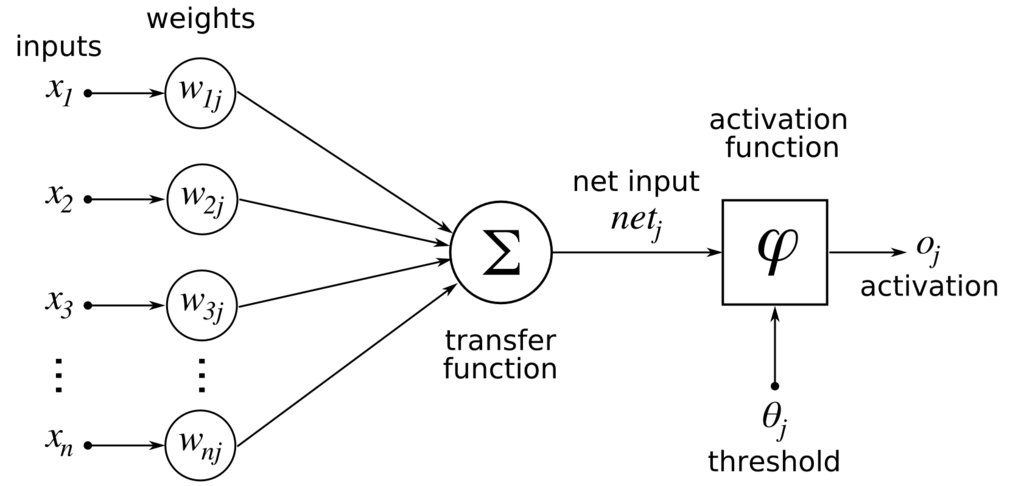
The bias allows the neuron to shift its output up or down, making it more flexible. Without a bias, the neuron's output would always be zero if all inputs were zero, which can be restrictive for learning.
Making a Decision
After the neuron sums its weighted inputs and adds the bias, it doesn't just pass the raw number along. Instead, it runs this sum through an 'activation function.' This is a critical step.
An activation function is a mathematical gate that decides whether a neuron should be 'activated' or not. It introduces non-linearity, allowing the network to learn complex patterns.
Without these functions, a neural network, no matter how many layers it has, would behave just like a simple linear model. The real world is rarely linear, so this step is what gives neural networks their power.
Two common activation functions are the Sigmoid function and the Rectified Linear Unit (ReLU).
- Sigmoid: This function takes any number and squashes it into a range between 0 and 1. It's useful for turning numbers into probabilities.
- ReLU: This function is even simpler. If the input is negative, it outputs 0. If the input is positive, it outputs the same number. It's computationally efficient and is the most popular activation function today.
Assembling the Network
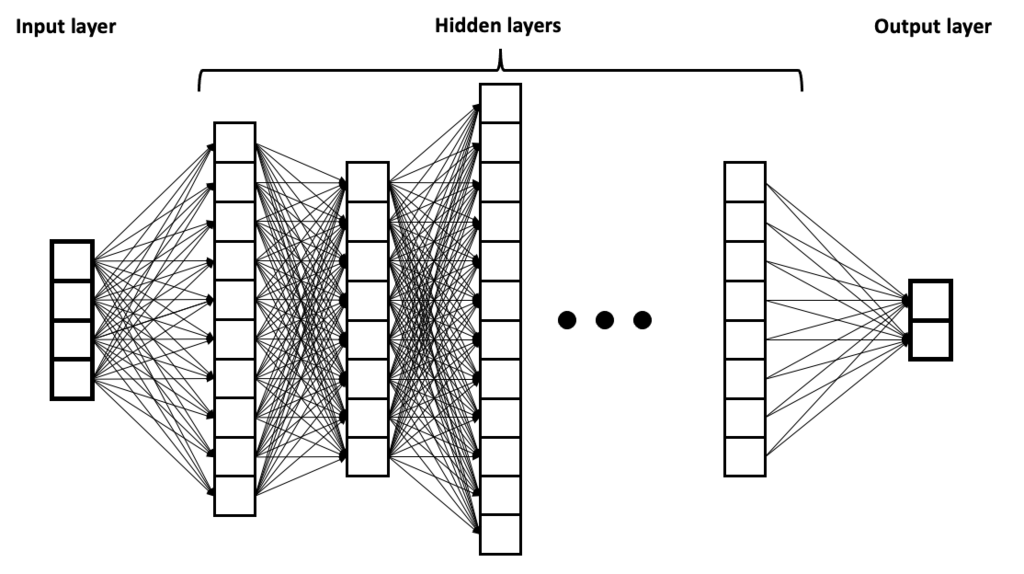
A single neuron isn't very powerful. The magic happens when we stack them together in layers. A typical neural network has three types of layers:
- Input Layer: Receives the initial data, like the pixels of an image or the words in a sentence.
- Hidden Layers: One or more layers of neurons between the input and output. This is where most of the computation happens. The network learns to detect features in these layers.
- Output Layer: Produces the final result, such as identifying an object in an image or predicting a stock price.
When data moves from the input layer, through the hidden layers, to the output layer in one direction, it's called a feedforward neural network. This is the most common and straightforward type of network.
Another important architecture is the Convolutional Neural Network (CNN). CNNs are specially designed for processing grid-like data, such as images. They use a special type of layer, a convolutional layer, to automatically and adaptively learn spatial hierarchies of features from the input. For example, a first layer might learn to detect edges, a second might combine edges to detect shapes, and a third might combine shapes to detect objects.
How a Network Learns
So how does a network figure out the right weights and biases? It learns through a process called training. We show the network thousands or even millions of examples, each with a known correct answer.
The training process involves a few key steps:
- Forward Pass: An input example is fed into the network. The neurons fire, and the data passes through the layers until it reaches the output layer, producing a prediction.
- Calculate Error: The network's prediction is compared to the correct answer. The difference between them is the 'error' or 'loss.' A loss function is used to measure how wrong the prediction was.
- Backward Pass (Backpropagation): This is the clever part. The network works backward from the error, calculating how much each weight and bias contributed to it. It's like assigning blame. An algorithm called gradient descent then makes tiny adjustments to every weight and bias, nudging them in a direction that will reduce the error.
This cycle of forward pass, error calculation, and backward pass is repeated for all examples in the training data, over and over again. Each full pass through the dataset is called an 'epoch.' With each epoch, the network gets slightly better at its task.
Avoiding Bad Habits
A common problem during training is overfitting. This happens when the network doesn't just learn the general patterns in the data, but actually memorizes the training examples, including their noise and quirks. An overfitted model performs great on the data it has seen but fails miserably when shown new, unseen data.
Imagine studying for a test by memorizing the exact answers to the practice questions. You'd ace the practice test, but you'd likely fail the real one if the questions were even slightly different. That's overfitting.
To combat this, we use regularization techniques. These are methods that prevent the network from becoming too complex and memorizing the training data. One popular technique is called dropout. During training, dropout randomly 'drops' or ignores a fraction of the neurons in a layer. This forces the other neurons in the network to learn more robust features, as they can't rely on any single neuron to be present.
By understanding these core components—neurons, layers, backpropagation, and regularization—you have the foundation for exploring the more complex and powerful neural network architectures that drive modern AI.
What is the primary role of an activation function in a neural network?
A data scientist notices their model performs with 99% accuracy on the training data but only 65% accuracy on new, unseen data. What is this problem called?