Transformer Architecture for MAANG ML Interviews
Introduction to Transformers
The Transformer Revolution
Before 2017, most AI models that worked with language, like recurrent neural networks (RNNs), read sentences one word at a time, from left to right. This is similar to how we read, but it has a major drawback: it's slow and can lose track of context in long sentences.
A groundbreaking paper titled “Attention Is All You Need” introduced a new architecture that changed everything: the Transformer. Instead of processing words sequentially, Transformers can look at an entire sentence at once. This parallel processing makes them incredibly fast and powerful, forming the backbone of modern large language models like GPT.
The transformer model, introduced in 2017 by Vaswani et al. in the groundbreaking paper “Attention Is All You Need”, revolutionized Natural Language Processing (NLP).
An Encoder-Decoder Structure
At its core, the original Transformer has two main parts: an encoder and a decoder. Think of it like a human translator. When translating a sentence from English to French, the translator first reads and understands the entire English sentence. This is the encoder's job: to read the input sequence and build a rich, numerical representation of its meaning, capturing the context of every word.
Once the translator understands the English sentence, they start writing the French translation, one word at a time. As they write, they constantly refer back to their understanding of the original sentence. This is the decoder's job. It generates the output sequence, word by word, while paying close attention to the encoded representation of the input.
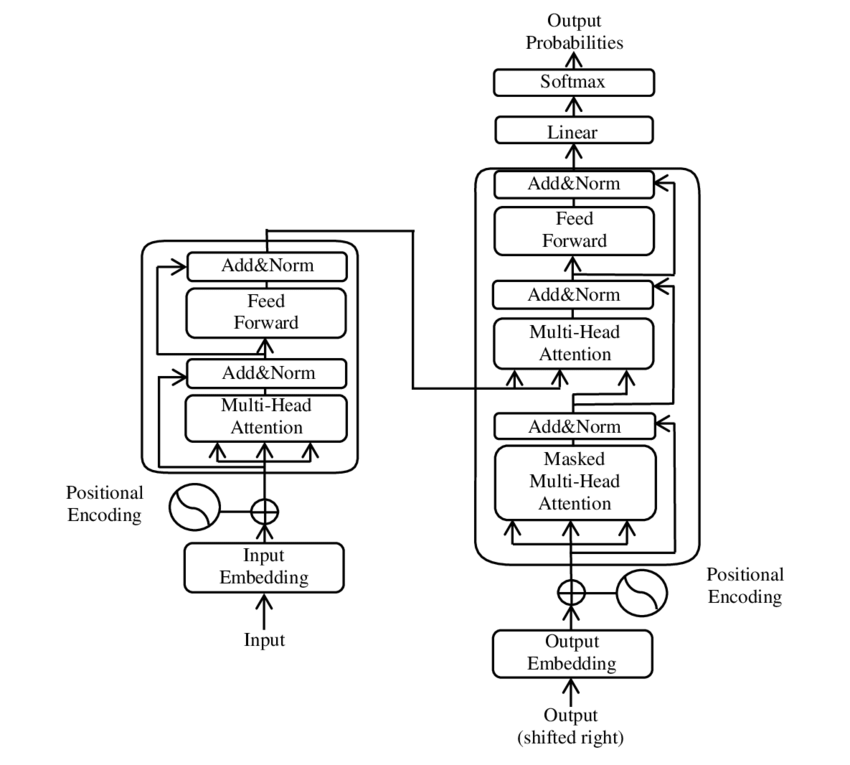
This two-part system is perfect for tasks like machine translation or summarization, where you have an input sequence and need to generate a new output sequence. But what allows the encoder and decoder to understand context so well? The answer lies in a mechanism called attention.
Self-Attention The Secret Sauce
The key innovation of the Transformer is self-attention. It's a mechanism that allows the model to weigh the importance of different words in a sequence when processing a specific word. It helps the model understand relationships between words, even if they are far apart in the sentence.
Consider the sentence: "The animal didn't cross the street because it was too tired." What does "it" refer to? For a human, the answer is obviously "the animal." Self-attention allows the model to make this same connection. When processing the word "it," the model pays more attention to "animal" than to other words like "street" or "cross," building a better understanding of the sentence's meaning.
Self-attention lets the model look at other words in the input for clues that can help create a better representation for the word it's currently processing.
By calculating these attention scores for every word in relation to all other words, the Transformer builds a deeply contextual understanding of the entire sequence.
Knowing the Order of Words
Processing all words at once creates a new problem: the model doesn't inherently know the order of the words. To the model, "The cat chased the dog" and "The dog chased the cat" look like the same collection of words, just in a bag. But word order is crucial for meaning.
To solve this, Transformers use positional encodings. This is extra information added to the input for each word that tells the model its position in the sentence. It’s like adding a unique timestamp or a page number to each word. This encoding is a vector of numbers that the model learns to interpret. This way, the model has both the meaning of the word and its position, allowing it to understand the grammar and structure of the sentence even while processing everything in parallel.
Positional encodings give the Transformer a sense of sequence, which is lost when words are processed in parallel instead of one by one.
Together, the encoder-decoder structure, self-attention, and positional encodings create a powerful and efficient architecture. This design has become the foundation for most state-of-the-art models in AI today, driving progress in everything from language translation to code generation.
Now, let's test your understanding of the Transformer architecture.
What is the primary advantage of the Transformer architecture compared to older models like Recurrent Neural Networks (RNNs)?
In the original Transformer architecture, what is the main function of the encoder?