Transformer Architecture Explained
Introduction to Transformers
A New Way to Process Language
For a long time, teaching computers to understand language was like teaching them to read one word at a time. Models like Recurrent Neural Networks, or RNNs, would process a sentence sequentially, from the first word to the last. This makes sense, as it’s similar to how we might read a sentence aloud.
But this step-by-step process creates a bottleneck. It's slow, and the model can lose track of context from the beginning of a long sentence by the time it reaches the end. Think about trying to remember the first word of a long paragraph after reading the whole thing; the initial details can get fuzzy.
In 2017, a new architecture called the Transformer changed everything. Instead of reading word-by-word, it processes the entire sentence all at once.
This parallel approach allows the model to weigh the importance of every word in relation to all other words in the sentence. It can directly connect the last word of a sentence to the first, without having to “remember” it through all the words in between. This ability to see the bigger picture is what makes Transformers so powerful.
The Encoder-Decoder Duo
The standard Transformer model has two main parts that work together: an encoder and a decoder.
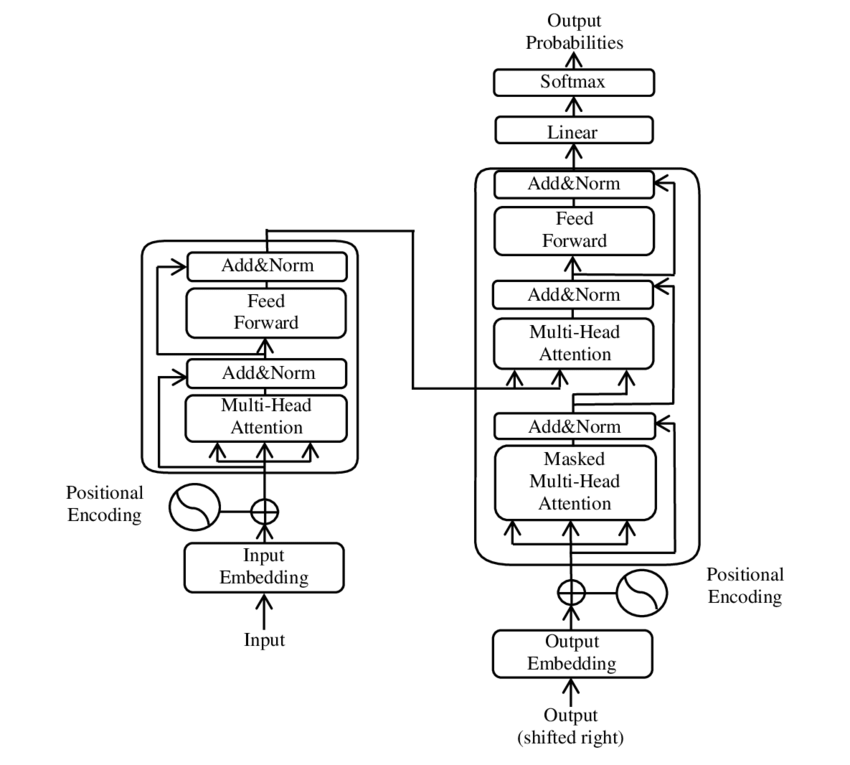
The encoder's job is to read and understand the input sentence. It takes the text and creates a rich numerical representation of it, capturing the meaning and context of each word. You can think of the encoder as a researcher who reads a document and creates a detailed set of notes, highlighting the key concepts and how they relate to each other.
The decoder's job is to take those detailed notes from the encoder and generate the output. For a translation task, it would use the encoder's understanding of the original sentence to write a new sentence in the target language. Following our analogy, the decoder is the writer who uses the researcher's notes to draft a summary or a response.
Both the encoder and decoder are typically made of a stack of identical layers. Stacking these layers allows the model to build up a more and more sophisticated understanding of the language as the data passes through.
Breaking from Tradition
So why was the Transformer such a breakthrough? It all comes down to how it handles sequences compared to older models like RNNs.
RNNs, by their nature, are sequential. They process information in order, and the calculations for one word depend on the results from the previous word. This makes them difficult to speed up with modern hardware, which excels at parallel computations. It also leads to the problem of vanishing gradients, where the influence of early words fades as the network processes longer sequences.
Transformers, on the other hand, do away with this sequential requirement. By using a mechanism called self-attention, the model can look at all the words in the input at the same time. This parallel processing is much faster on modern GPUs and, more importantly, it allows the model to easily capture long-range dependencies—the relationships between words that are far apart in a sentence.
We propose a new simple network architecture, the Transformer, based solely on attention mechanisms, dispensing with recurrence and convolutions entirely.
This fundamental shift from sequential processing to parallel attention is the key innovation that has made Transformers the foundation for most state-of-the-art language models today.
What is a primary limitation of Recurrent Neural Networks (RNNs) for processing long sequences of text?
In the standard Transformer architecture, what is the primary role of the decoder?
This new architecture opened the door for building much larger and more capable AI models than ever before.