Transformer Architecture Explained
Introduction to Transformers
A New Way to Understand Language
For a long time, artificial intelligence struggled with the nuances of human language. Early models, like Recurrent Neural Networks (RNNs), tried to mimic how we read: one word at a time, in order. This sequential approach created a bottleneck. If a sentence was long, the model might forget the beginning by the time it reached the end, losing crucial context. It was also slow, since each word had to be processed before moving to the next.
Other models, like Convolutional Neural Networks (CNNs), which are brilliant at understanding images, were also tried. But language isn't like a fixed grid of pixels. The relationships between words are fluid and complex, making CNNs a less natural fit for most language tasks.
Traditional models either processed language too slowly or couldn't grasp the complex relationships between words in a long sentence.
Enter the Transformer
In 2017, a groundbreaking paper titled "Attention Is All You Need" introduced a new architecture that changed everything: the Transformer. Instead of processing words one by one, it looks at the entire sentence at once. This parallel processing not only makes it much faster but also allows it to capture intricate relationships between words, no matter how far apart they are.
The Transformer is typically built around two main parts: an encoder and a decoder.
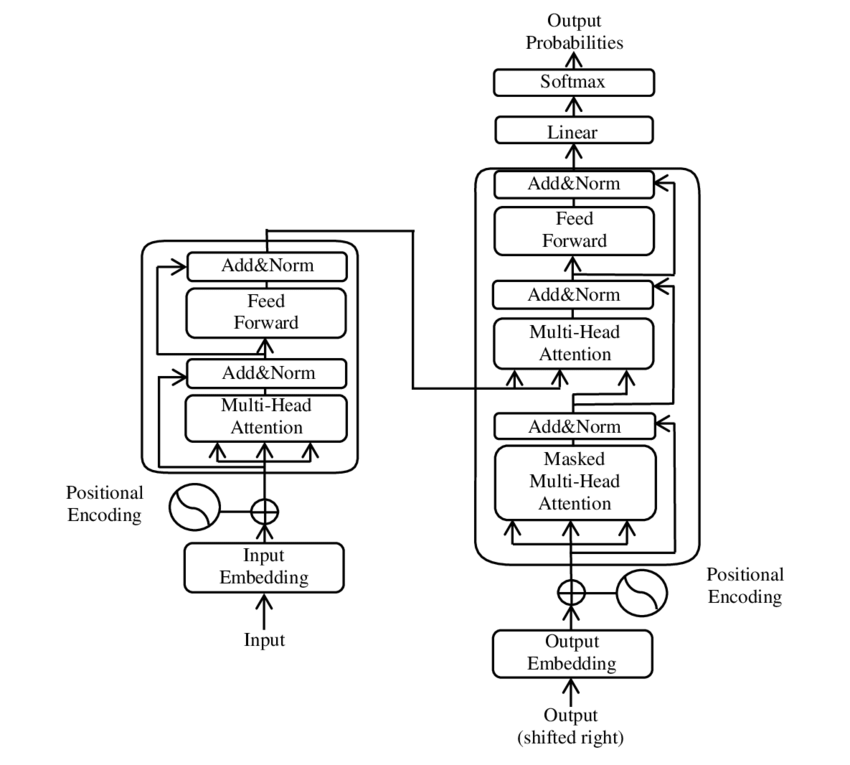
Think of the encoder as the reading part. Its job is to process the entire input sentence and build a rich, numerical representation of its meaning. It's like reading a paragraph and summarizing the key ideas in your head.
The decoder is the writing part. It takes the encoder's summary and, step by step, generates the output. For a translation task, it would produce the translated sentence, one word at a time, while always referring back to the meaning captured by the encoder.
The Secret Sauce
Two key innovations make the Transformer so powerful: the self-attention mechanism and positional encodings.
Self-attention is the core idea. It allows the model to weigh the importance of different words in a sentence as it processes each word. Consider the sentence: "The robot picked up the ball because it was heavy." When the model processes the word "it," self-attention helps it determine that "it" refers to the "ball," not the "robot."
It does this by creating connections between every word in the sentence and calculating an "attention score" that signifies relevance. This solves the long-range dependency problem that plagued RNNs, as the model can directly link words regardless of their distance.
Self-attention, a core concept in Transformers, allows the model to weigh the importance of different words in relation to each other, enhancing context understanding.
There's a catch to processing all words at once, though. The model loses the original word order. To the model, "The dog chased the cat" and "The cat chased the dog" would look the same without context.
This is where positional encodings come in. Before the words are fed into the model, a piece of information representing each word's position is added to it. It's like giving each word a unique timestamp or a seat number, ensuring the model knows the original sequence.
Together, these components allow Transformers to process language with a deep understanding of context and word order, setting a new standard for what's possible in AI.
Now let's check your understanding of these core concepts.
What fundamental problem with Recurrent Neural Networks (RNNs) did the Transformer architecture's parallel processing approach solve?
In the sentence, "The delivery drone dropped off the package, but it was damaged," what does the self-attention mechanism help the model understand?
By moving beyond sequential processing, the Transformer architecture opened the door to the powerful large language models we see today.