Transformer Architecture Explained
Introduction to Transformers
A New Way to Understand Language
For a long time, teaching computers to understand language was a major challenge. Early models tried to process sentences the way a person might read them: one word at a time, in order. This sequential approach made sense, but it had serious limitations.
Imagine trying to understand a long, complex story by only remembering the single word that came just before the one you're reading now. You'd quickly lose the plot.
This is similar to the problem faced by older neural network architectures like Recurrent Neural Networks (RNNs). They were designed to handle sequences, but they often struggled to connect words that were far apart. The meaning of a word at the end of a paragraph might depend heavily on a word used at the very beginning, but by the time the RNN got to the end, it might have 'forgotten' the start.
The Limits of Sequential Processing
RNNs process information in a step-by-step loop. Each word's analysis is influenced by the analysis of the word right before it. This creates two main problems.
First, it's slow. The model can't process the tenth word until it's finished with the ninth. For long documents, this sequential processing becomes a significant bottleneck.
Second, it struggles with long-range dependencies. The influence of earlier words fades as the network processes more of the sequence. In the sentence, "The cat, which chased all the birds that lived in the old oak tree by the river, was finally taking a nap," understanding that "was" refers to "cat" requires linking words that are far apart. RNNs find this difficult.
Other architectures, like Convolutional Neural Networks (CNNs), which are stars in image recognition, were adapted for text. They look at text through small, sliding windows of a few words at a time. While good at spotting local patterns, they also struggle to piece together the meaning of a whole, complex sentence.
The Transformer Arrives
In 2017, a paper titled "Attention Is All You Need" introduced the Transformer architecture. It completely changed the game by getting rid of sequential processing. Instead of looking at words one by one, a Transformer processes every word in the sentence at the same time.
The Transformer architecture is a groundbreaking neural network design that has revolutionized natural language processing by enabling highly parallel, efficient, and accurate modeling of sequences through attention mechanisms rather than recurrence or convolution.
This parallel approach makes Transformers incredibly fast and efficient to train on modern hardware. More importantly, because the model sees the entire sentence at once, it can directly compare every word to every other word. This ability allows it to easily draw connections between distant words, solving the long-range dependency problem that plagued older models.
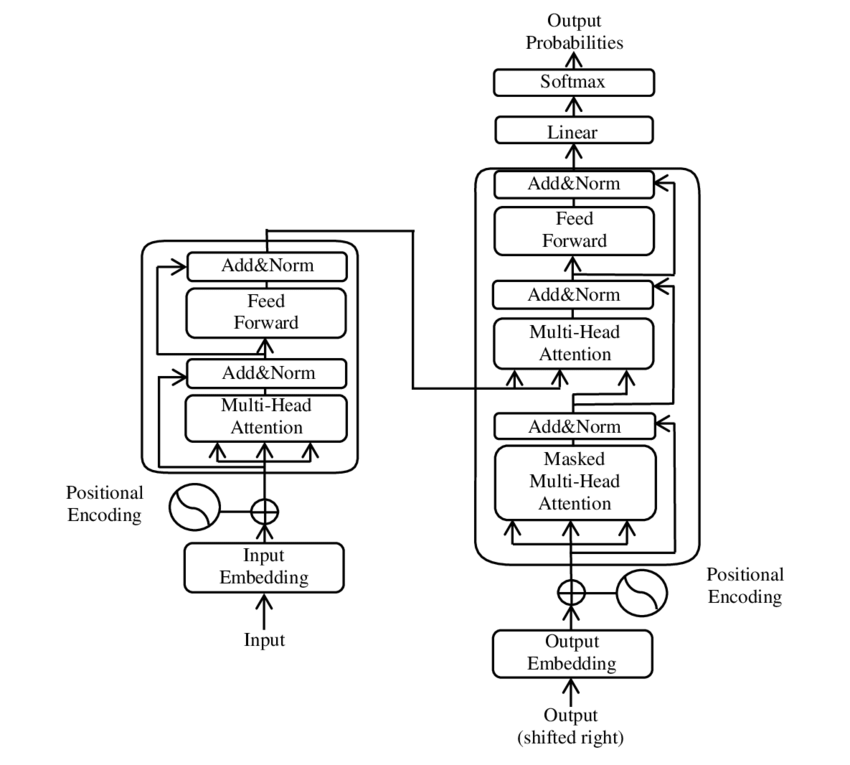
At a high level, the Transformer has two main parts: an encoder and a decoder.
- The Encoder: Its job is to read the input text and build a rich, numerical representation of its meaning. It looks at every word and its relationship to all the other words to understand the context.
- The Decoder: It takes the encoder's understanding of the input and generates the output text, one word at a time. For a translation task, it would generate the translated sentence.
This structure, powered by the ability to process text in parallel, laid the foundation for the massive language models we see today.
Ready to test your understanding of these core ideas?
What is the primary limitation of sequential processing models like Recurrent Neural Networks (RNNs) that the Transformer architecture was designed to solve?
In the sentence, "The girl who adopted five puppies and three kittens from the local shelter, which was featured on the news, is very happy," an RNN might struggle to connect "is" with "girl." What is this specific problem called?
By moving beyond the one-word-at-a-time approach, Transformers unlocked new capabilities in machine understanding of language, setting the stage for more powerful and nuanced AI.