Transformer Architecture Explained
Introduction to Neural Networks
The Brain's Inspiration
Artificial neural networks are inspired by the human brain, but they are much simpler. Think of the basic building block, a neuron (or node), as a tiny decision-maker. It takes in several pieces of information, weighs how important each one is, and then makes a call.
Each input () is a piece of data. Each connection has a weight () that signals its importance. The neuron multiplies each input by its weight and sums them all up. It also adds a bias (), which is like a thumb on the scale, making the neuron more or less likely to fire. The result is a single number.
But the neuron isn't done. This weighted sum, , is then passed through an activation function. This function makes the final decision, producing the neuron's output. Its crucial role is to introduce non-linearity, which allows the network to learn complex patterns instead of just simple, straight-line relationships.
activation function
noun
A function in a neural network that determines the output of a node based on the weighted sum of its inputs.
Two common activation functions are:
- Sigmoid: This function squishes any number into a range between 0 and 1. It's great for when you want an output to represent a probability.
- ReLU (Rectified Linear Unit): This one is even simpler. If the input is positive, it outputs that same number. If it's negative, it outputs 0. It's like an on/off switch that can also convey intensity. Mathematically, it's .
From Neurons to Networks
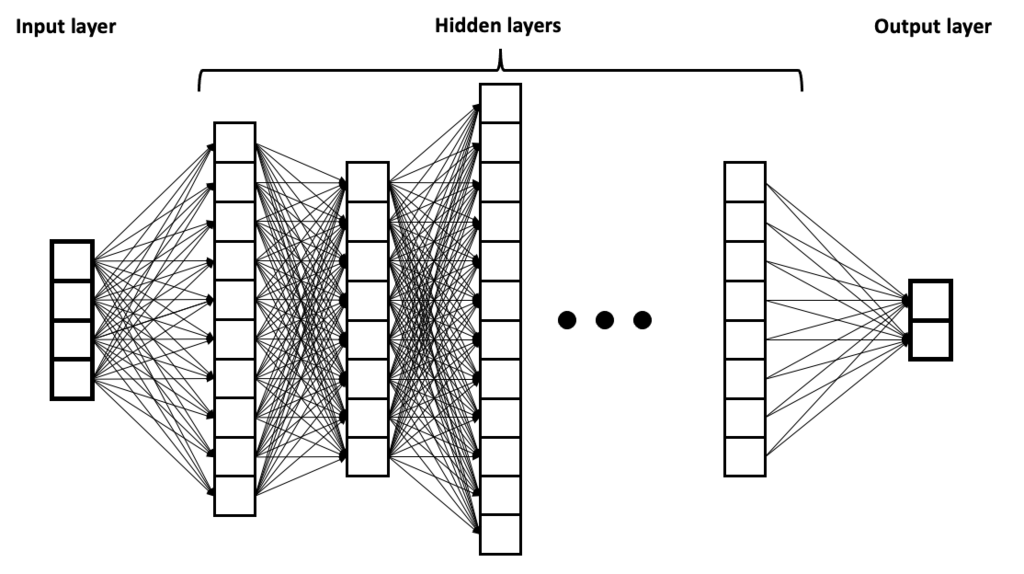
A single neuron can't do much. The magic happens when you connect them in layers. A typical neural network has at least three types of layers.
-
Input Layer: This is the network's front door. It receives the initial data. For an image, this could be the pixel values. For a weather forecast, it might be temperature and humidity.
-
Hidden Layers: These are the layers between the input and output. There can be one or many. This is where most of the learning and computation happens. Each neuron in a hidden layer receives inputs from the previous layer, processes them, and passes the result to the next layer.
-
Output Layer: This is the final layer. It produces the network's prediction. For a network identifying cats in photos, the output layer might have one neuron that outputs a number between 0 (not a cat) and 1 (definitely a cat).
The way these layers are connected defines the network's architecture. The simplest type is a feedforward network, where information flows in one direction, from input to output, without looping back.
Other architectures are designed for specific tasks. Convolutional Neural Networks (CNNs) are masters of visual data, using special filters to detect patterns like edges, textures, and shapes. Recurrent Neural Networks (RNNs) are built for sequences, like text or time-series data, because they have a form of memory that lets them consider previous inputs.
How a Network Learns
So how does a network go from a random collection of neurons to a powerful prediction tool? It learns through a process called training. Imagine you're teaching a child to recognize a cat. You show them a picture, they guess "dog," and you say, "No, that's a cat." They adjust their thinking and try again on the next picture.
Training a neural network is similar. It involves these steps:
-
Forward Pass: You feed the network a piece of data (like an image). The data flows through the layers, and the network makes a prediction.
-
Calculate the Error: You compare the network's prediction to the correct answer. The difference between them is the error, or loss. A high error means a bad prediction.
-
Backpropagation: This is the key to learning. The network sends the error signal backward, from the output layer to the input layer. As it travels back, it figures out how much each neuron's weights and biases contributed to the total error. Think of it as assigning blame.
-
Update Weights: Based on its assigned blame, each neuron slightly adjusts its weights and bias. The goal is to make a better prediction the next time. This adjustment is guided by an algorithm, usually an optimizer like Gradient Descent, which tries to find the set of weights that minimizes the error.
This cycle of forward pass, error calculation, backpropagation, and weight updates is repeated thousands or millions of times with lots of data. With each cycle, the network gets a little bit better at its task.
Backpropagation is the process of working backward from the output to calculate how to adjust the network's internal weights to reduce error.
Staying on Track
A common pitfall in training is overfitting. This happens when the network memorizes the training data instead of learning the general patterns within it. An overfit model might be incredibly accurate on the data it was trained on, but it fails badly when it sees new, unseen data.
It's like a student who memorizes the answers to a specific practice test but doesn't understand the underlying concepts. They'll ace that test but flunk the final exam.
To combat this, we use regularization techniques. These are methods that prevent the network from becoming too complex and memorizing the training data. A popular technique is dropout, where a random fraction of neurons are temporarily ignored during each training cycle. This forces other neurons to step up and learn more robust features, rather than relying on a few specific neurons to do all the work. It's like making a team practice with different players missing, so everyone becomes more versatile.
Now that we've covered the fundamental building blocks, let's test your knowledge.
What is the primary role of an activation function within a neuron?
You are building a model to classify images of handwritten digits (0-9). For the final output layer, which activation function would be most appropriate?