Tower Crane Force Analysis
Introduction to Statics
The Art of Standing Still
Statics is the branch of mechanics that deals with objects at rest. Think of a bridge, a building, or a massive crane lifting a heavy load. None of them are accelerating. They are in a state of balance, or equilibrium. Statics is the study of this balance. It's all about understanding the forces at play and making sure they cancel each other out, so nothing moves unexpectedly.
The core principle of statics is simple: for an object to remain stationary, all the forces acting on it must be perfectly balanced.
Forces as Vectors
A force is just a push or a pull. But to understand it properly, we need to know two things: how strong is the push or pull, and in what direction is it acting? A quantity that has both magnitude (strength) and direction is called a vector.
Imagine you're pushing a heavy box across the floor. Pushing down on it won't move it forward. Pushing it horizontally will. The direction matters just as much as the effort you put in. Because forces are vectors, we can use tools from geometry and trigonometry to work with them.
Often, it's easiest to break a force down into its components. We typically look at the horizontal (x-axis) and vertical (y-axis) parts of the force. A single force pulling at an angle can be thought of as two separate forces working together, one pushing purely horizontally and the other purely vertically.
Using trigonometry, we can find the magnitudes of these components if we know the magnitude of the force and the angle it makes with the horizontal:
Finding Balance
For an object to be in equilibrium, the forces must cancel out completely. By breaking every force down into its x and y components, we can make this idea more concrete. For an object to be still, the sum of all horizontal force components must be zero, and the sum of all vertical force components must be zero.
This applies to a single point, or a particle. But what about a real object, like a lever or a beam? These are called rigid bodies. For a rigid body to be in equilibrium, there's one more condition: it can't be rotating. This means all the turning forces, called moments, must also cancel out.
A moment is the turning effect of a force. Think of using a wrench to tighten a bolt. You apply a force to the handle, which creates a moment that turns the bolt.
The moment created by a force is equal to the force multiplied by the perpendicular distance from the pivot point. For a rigid body to be in equilibrium, the sum of all moments about any point must be zero.
Visualizing Forces
To analyze the forces on an object, engineers use a powerful tool: the free-body diagram. It’s a simplified sketch of the object, isolated from its surroundings, that shows all the external forces acting on it. This helps us see all the pushes and pulls clearly so we can apply the equations of equilibrium.
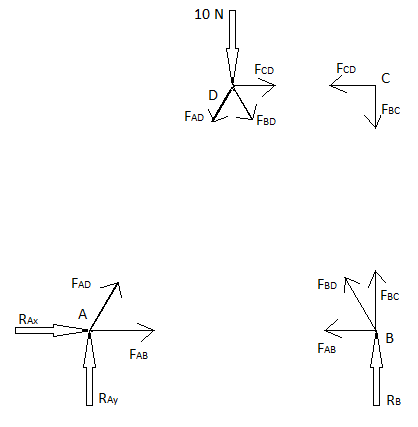
Creating a free-body diagram involves a few steps:
- Draw a simple outline of the object, completely separated from everything else.
- Identify all the forces acting on the object. These could be gravity (weight), pushes, pulls, or reaction forces from supports.
- Draw an arrow for each force, showing where it acts and in which direction it points. Label each force clearly.
Once you have a complete free-body diagram, you can apply the equilibrium equations (\{\sum F_x = 0, \sum F_y = 0, \sum M = 0}) to solve for any unknown forces.
Types of Internal Forces
When an object is subjected to external forces, internal forces develop within it to hold it together. These internal forces are crucial for understanding how a structure might fail. There are four main types you'll encounter in statics.
Tension and Compression These are forces that act along the axis of an object. Tension pulls the object apart, stretching it. Think of the force in a rope during a game of tug-of-war. Compression squeezes the object together. The pillars holding up a building are in compression.
Shear Shear force acts parallel to a surface, trying to slide one part of the object past another. Imagine cutting paper with scissors. The two blades apply shear forces to the paper, causing it to fail along a line.
Bending Moment A bending moment is a turning force that causes an object to bend. When you stand in the middle of a diving board, your weight creates a bending moment that makes the board curve downwards.
Understanding these basic principles of statics is the first step in analyzing and designing almost any structure, from simple shelves to complex skyscrapers.
Statics is the branch of mechanics primarily concerned with which of the following?
For a rigid body to be in static equilibrium, which conditions must be met?