Total Lunar Eclipses on the Natal Moon
Eclipse Astronomy Mechanics
The Shadow's Edge
A Full Moon happens every month, but a Total Lunar Eclipse is a far rarer spectacle. The difference isn't just a matter of alignment; it's about entering a very specific kind of shadow. Earth casts a complex shadow into space, one with two distinct parts.
The dark, concentrated core of the shadow is the , a place of near-total darkness. Surrounding it is the penumbra, a much fainter, more diffuse shadow. During most full moons, the Moon sails just above or below this shadow system entirely. But during a total lunar eclipse, it plunges directly through the umbra. This journey into the deepest part of Earth's shadow is what transforms the bright, silvery full moon into a dim, reddish orb.
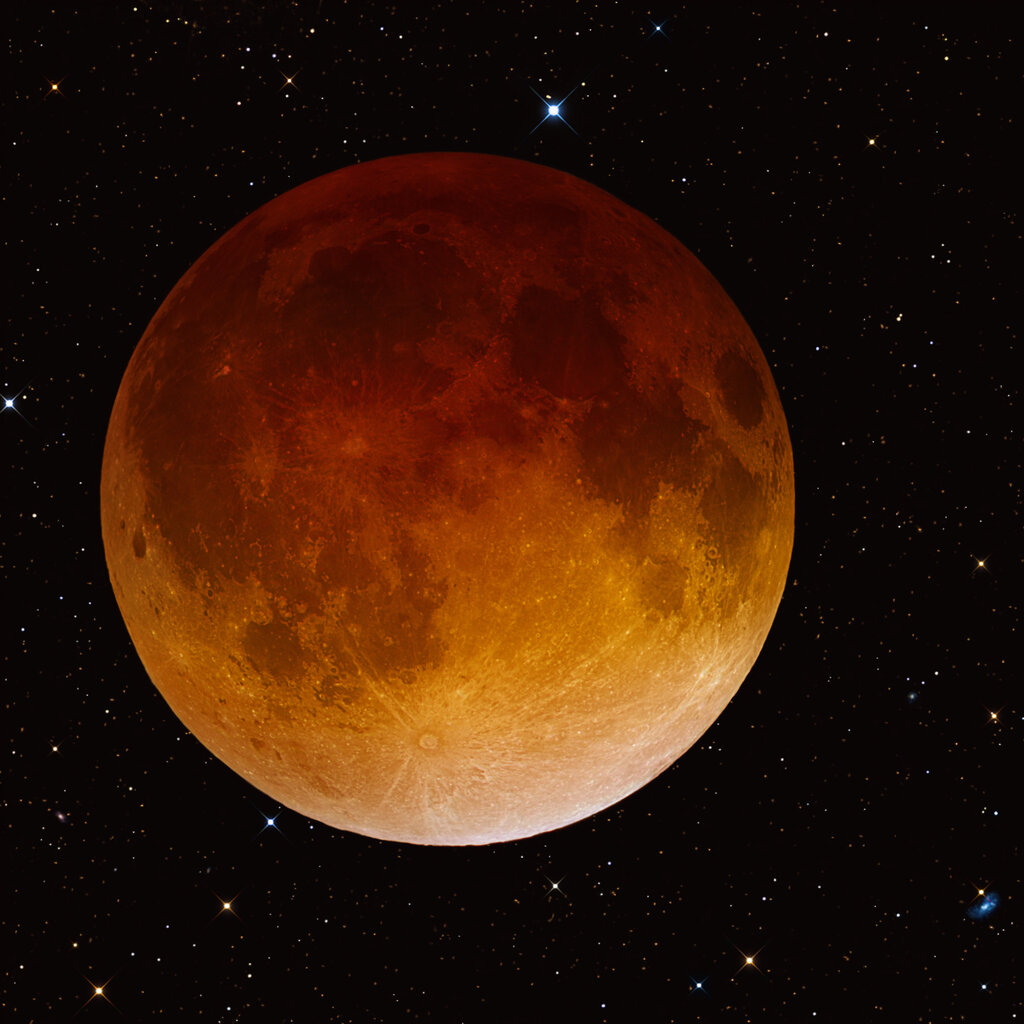
When the Moon only grazes the umbra, we get a partial eclipse. If it only passes through the faint outer shadow, it’s a penumbral eclipse, which is often so subtle it's hard to notice. Only a direct hit through the umbra creates the dramatic visual and energetic shift of a total lunar eclipse.
Cosmic Gatekeepers
If the Sun, Earth, and Moon all orbit on the same plane, we'd have a lunar eclipse every full moon. But we don't. The reason lies in a slight but crucial tilt in the Moon's path. Its orbit is angled about 5 degrees relative to the ecliptic, the plane of Earth's orbit around the Sun.
This means the Moon usually passes above or below Earth's shadow. The cosmic gates only open when a full moon occurs at the exact moment the Moon is crossing the ecliptic plane. These two crossing points are called the —the North Node and the South Node. For an eclipse to happen, the Sun, Earth, and Moon must align near one of these nodes.
This alignment doesn't have to be perfect, but it must be close. This window of opportunity is called the orb of influence. For a total lunar eclipse to occur, a full moon must happen within about 11 degrees and 38 arcminutes of a lunar node. This narrow requirement is why a total lunar eclipse is so much more significant than a standard full moon.
Echoes in Time
Eclipses aren't random events. They belong to large, interconnected families known as (or Saros series). Each series lasts over 1,200 years and contains around 70 eclipses that recur every 18 years, 11 days, and 8 hours. When one eclipse in a series occurs, it shares a similar geometry and zodiacal degree with the one that happened 18 years prior.
Think of a Saros cycle as a long-running story. Each eclipse is a new chapter, revisiting themes from the past but moving the plot forward.
Because of this repetition, an eclipse at a specific degree of the zodiac is connected to past and future eclipses in its family. This gives them a sense of destiny and long-term thematic development. A lunar eclipse happening today is part of a story that began centuries ago and will continue for centuries more, linking our present moment to a vast cosmic timeline.
What is the primary reason a lunar eclipse does not happen during every full moon?
For a total lunar eclipse to occur, the Moon must pass completely through which part of Earth's shadow?
Understanding these mechanics reveals why a total lunar eclipse carries such symbolic weight. It's not just another full moon; it's a precise, rare alignment that pierces the very heart of Earth's shadow, activated by the cosmic gates of the lunar nodes and echoing themes from a story that spans millennia.