Topic Exploration
Introduction to Python
What is Python?
Python is a high-level, general-purpose programming language. That sounds complicated, but the ideas are simple. "High-level" means it's written in a way that's easy for humans to read and write. "General-purpose" means you can use it to build almost anything, from websites to robots.
Created by Guido van Rossum and first released in 1991, Python was designed with a core philosophy: code should be easy to read. This focus on readability means you'll spend less time trying to understand what your code does and more time making it work. It uses simple English keywords and less punctuation than other languages, which makes it feel less intimidating for beginners.
The language's philosophy is often summarized as "The Zen of Python," which includes principles like "Beautiful is better than ugly" and "Simple is better than complex."
Why Learn Python?
Python's simplicity and power have made it incredibly popular across many industries. You can find it everywhere.
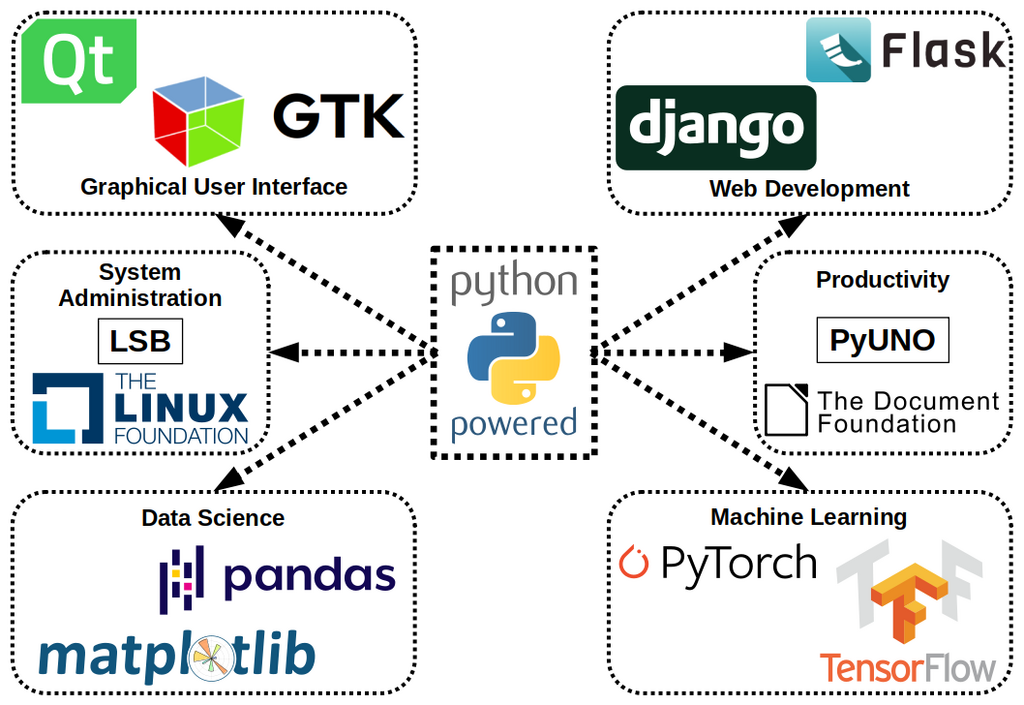
Data scientists use it to analyze trends and build machine learning models. Web developers use it to create the backend of websites and apps. System administrators use it to automate repetitive tasks. Because it's so versatile, learning Python opens up a huge number of career paths. Its large and active community also means you can almost always find help and pre-built code to solve common problems.
Getting Started
To start writing Python, you need two things: the Python interpreter and a place to write your code. The interpreter is a program that reads your Python code and carries out its instructions. You can download it for free from the official Python website, python.org.
While you can write code in any basic text editor, it's much easier to use an Integrated Development Environment, or IDE. An IDE is software that combines a text editor with helpful tools for programmers, like a way to run your code easily and tools to help find mistakes.
IDE
noun
An Integrated Development Environment is a software application that provides comprehensive facilities to computer programmers for software development. An IDE normally consists of at least a source code editor, build automation tools, and a debugger.
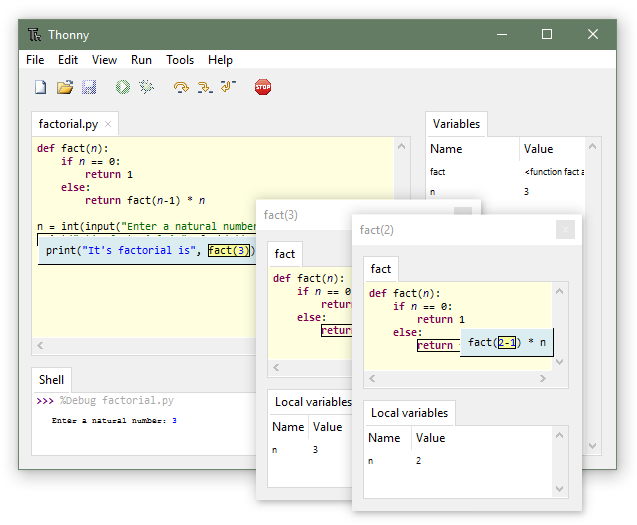
For beginners, a great choice is Thonny. It's a simple IDE designed specifically for learning Python. It comes with Python already built-in, so you only need one installation. Thonny gives you a straightforward interface to write your code in the main editor and see the output in a separate panel called the "Shell".
Your First Python Script
Let's write your first program. It's a tradition in programming to start by making the computer say "Hello, World!". In Thonny, type the following line into the main editor window:
print("Hello, World!")
Now, click the green "Run" button (it looks like a play symbol). Thonny will ask you to save the file first. Save it as hello.py. The .py extension is important because it tells the computer this is a Python file.
Once saved, the script will run. In the Shell at the bottom of the window, you should see the output:
Hello, World!
Congratulations, you've just run your first Python script! You used the print() function, which is a built-in command that tells Python to display text on the screen. Anything you put inside the parentheses and quotes will be printed.
Let's try one more. You can also use Python to work with data. A variable is like a container for storing a piece of information. Let's create a variable called greeting and then print it.
# The equals sign (=) assigns the value on the right
# to the variable on the left.
greeting = "Welcome to Python!"

# Now we print the contents of the variable.
print(greeting)
When you run this code, it will print "Welcome to Python!". You've successfully stored a piece of text in a variable and then used the print() function to display it.
Ready to check your understanding?
What does it mean that Python is a "high-level" language?
What is the primary design philosophy of Python?
You now have a solid foundation. You know what Python is, why it's useful, and how to write and run a simple script. The next step is to learn about the different types of data you can work with.