Tool Engineering Fundamentals
Introduction to Tool Engineering
What Is Tool Engineering?
Think about building a single wooden chair. You could do it with a handsaw, a hammer, and some nails. But what if you needed to build ten thousand chairs, all identical? Your simple hand tools wouldn't be enough. You'd need specialized equipment to cut the wood perfectly every time, hold the pieces in the exact same position for assembly, and ensure every chair is strong and stable.
This is where tool engineering comes in. It's a specialized field focused on designing and creating the tools needed for manufacturing. It’s not about the everyday tools in your toolbox, but the highly specific equipment used to produce goods in large quantities.
Tool engineering is the backbone of mass production. It provides the necessary equipment—from simple guides to complex machinery—that allows companies to make products efficiently, consistently, and affordably.
The scope is broad. It includes everything from cutting tools that shape metal to molds that form plastic parts. It also covers devices that hold workpieces steady during production. The main goal is to solve manufacturing challenges by creating the right tool for the job. A well-engineered tool can dramatically increase production speed, improve the quality of the final product, and reduce overall costs.
Why Tool Design Matters
The design of a manufacturing tool has a direct and significant impact on the product it helps create. A tiny flaw in a tool can lead to thousands of defective products. Imagine the metal die used to stamp car doors. If the die's shape is off by just a fraction of a millimeter, every single door panel it produces will be faulty. This could prevent the door from sealing properly, creating noise for the driver and allowing water to leak into the car.
Good tool design is crucial for several reasons:
| Benefit | Description |
|---|---|
| Efficiency | Well-designed tools allow for faster production cycles. They minimize the time needed to set up, process, and handle materials. |
| Quality & Consistency | Tools ensure that every part is made to the same specification. This uniformity is essential for modern assembly lines where parts must fit together perfectly. |
| Cost-Effectiveness | By increasing speed and reducing errors, good tools cut down on wasted materials and labor. This directly lowers the cost of manufacturing each item. |
| Safety | A key part of tool design is ensuring the safety of the machine operator. Proper design minimizes risks and creates a safer working environment. |
Engineers also work closely with suppliers and internal teams to optimize the design for manufacturability (DFM) and design for assembly (DFA) to reduce production complexity and costs.
A Tour of Tool Types
Manufacturing tools can be grouped into several broad categories based on their function. Here are a few of the most common types you'll encounter in a production environment.
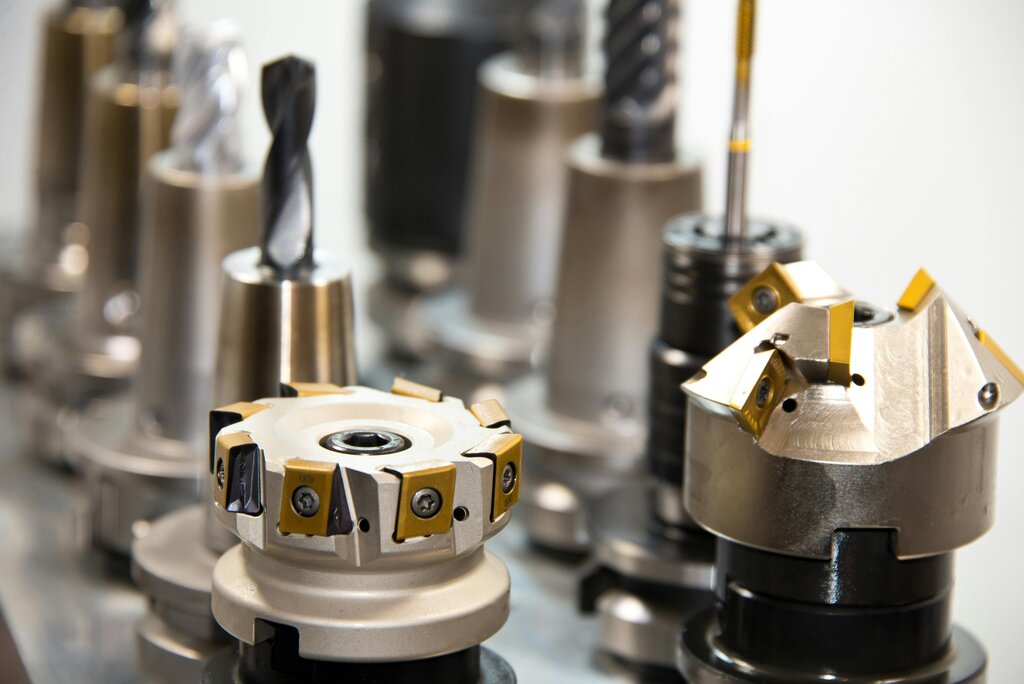
Cutting Tools
noun
Tools designed to remove material from a workpiece to shape it into a desired form. This is done through processes like drilling, milling, or turning.
These tools must be made from materials harder than the workpiece they are cutting. They come in countless shapes and sizes, each tailored for a specific task, from drilling a tiny hole in a circuit board to carving a large metal engine block.
Jigs and Fixtures
noun
Devices used to securely hold a workpiece in a specific position and orientation during a manufacturing process. They are essential for repeatability and accuracy.
While often used together, jigs and fixtures have a key difference. A fixture simply holds the workpiece steady. A jig goes a step further by also guiding the cutting tool. For example, a drill jig not only holds the part but also has a bushing that guides the drill bit to the exact right spot.
Dies and Molds
noun
Tools used to shape materials through processes like stamping, forging, casting, or plastic injection. They typically consist of two halves that form a cavity in the shape of the desired part.
Dies are generally used for shaping sheet metal (stamping) or for forcing hot metal into a shape (forging). Molds are used for liquid materials like molten plastic or metal that solidify within the mold's cavity. The precision of these tools determines the final product's dimensions and surface finish.
These are just a few examples. The field of tool engineering is vast and varied, encompassing a huge range of specialized equipment. At its core, it is the discipline that turns a design concept into a physical product that can be manufactured reliably and efficiently.
Time to check your understanding of these foundational ideas.
Which of the following best describes the primary goal of tool engineering?
A device is needed to hold a wooden block steady while a worker drills a hole. Crucially, the device must also guide the drill bit to the exact same spot on every block. This device is best described as a...
Understanding these fundamentals sets the stage for exploring how these tools are designed and used in specific manufacturing processes.