Time Mass and Speed Relativity
Introduction to Special Relativity
A New Kind of Physics
For a long time, the universe seemed to follow a neat set of rules laid out by Isaac Newton. His laws of motion and gravity were brilliant. They could predict the path of a cannonball or the orbit of a planet with incredible accuracy. For hundreds of years, Newtonian physics was the final word.
But as the 19th century ended, physicists started noticing strange things. Experiments involving light and electricity didn't quite fit Newton's elegant picture. The problems were most obvious when dealing with objects moving at incredibly high speeds, close to the speed of light. The old rules started to break down.
It took a young patent clerk named Albert Einstein to realize that the rules themselves needed to be changed. In 1905, he published his theory of special relativity, which wasn't just a small correction to Newton's work. It was a complete overhaul of our understanding of space and time.
Frames of Reference
To understand Einstein's ideas, we first need to talk about frames of reference. A frame of reference is just a viewpoint, a set of coordinates you use to measure things like position, velocity, and time. If you're standing on the side of a road watching a car drive by, you are in one frame of reference. The driver of the car is in another.
Special relativity deals with a specific kind, called an inertial frame of reference. This is just a fancy way of saying a viewpoint that isn't accelerating. If you're in a car moving at a perfectly steady 60 miles per hour on a straight road, you're in an inertial frame. If the car speeds up, slows down, or turns, you're not. The laws of physics are simplest in inertial frames.
Before Einstein, everyone assumed that if you knew the rules in one inertial frame, you could easily translate them to another. If a ball is thrown at 20 mph from a train moving at 60 mph, someone on the ground would see the ball moving at 80 mph. Simple addition. This is called Galilean relativity, and it works perfectly for trains and balls. But it fails spectacularly with light.
Einstein's Two Postulates
Einstein built his entire theory on two simple-sounding but revolutionary ideas, called postulates.
1. The Principle of Relativity: The laws of physics are the same in all inertial frames of reference.
This first idea is an extension of what Galileo and Newton already thought. It means there's no special,
absolute
adjective
Viewed or existing independently and not in relation to other things; not relative or comparative.
rest frame in the universe. If you're in a windowless room moving at a constant velocity, there is no experiment you could perform to tell if you're moving or standing still. The physics works the same either way. This part wasn't too controversial.
2. The Constancy of the Speed of Light: The speed of light in a vacuum, written as , is the same for all observers in inertial frames, regardless of the motion of the light source.
This is the one that shatters our everyday intuition. Let's go back to the train. If someone on that 60 mph train turns on a flashlight, Newton's rules say an observer on the ground should see the light beam moving at its own speed plus the speed of the train. But they don't.
Experiments showed something bizarre. No matter how fast you're moving toward or away from a light source, you always measure the speed of its light to be exactly the same value: about 299,792,458 meters per second. The speed of the source doesn't add to it. The speed of the observer doesn't subtract from it. It's constant. Always.
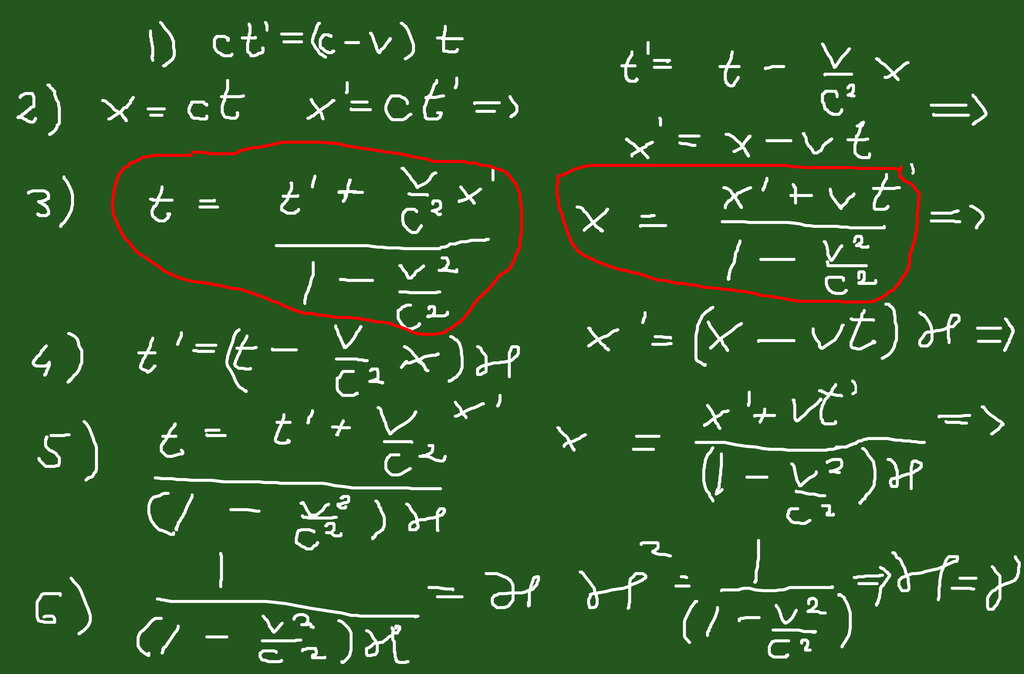
These two postulates, when taken together, have profound consequences. If the speed of light must be the same for everyone, then something else has to give. That something is space and time.
To make the math work, Einstein showed that time must slow down for moving observers, and lengths must contract in the direction of motion. Mass and energy, once seen as separate, were revealed to be two sides of the same coin, linked by the famous equation . Newtonian physics wasn't wrong, it was just an approximation that works well at the slow speeds we experience in daily life. Special relativity provides the more complete picture.
Under what circumstances did the predictions of Newtonian physics begin to fail, leading to the development of special relativity?
According to the postulates of special relativity, if a spaceship traveling at 90% the speed of light fires a laser beam forward, how fast would an observer stationary on Earth measure the laser light's speed to be?