Time Dilation Explained
Introduction to Special Relativity
A Crack in the Foundation
For centuries, the world of physics was built on the solid bedrock of Isaac Newton's laws. His ideas about motion, force, and gravity worked beautifully. They could predict the path of a cannonball or the orbit of a planet with stunning accuracy. This framework, known as classical mechanics, described a predictable, clockwork universe.
In this Newtonian world, velocities are straightforward. Imagine you're on a train moving at 50 kilometers per hour. If you throw a ball forward at 10 km/h, someone standing on the ground sees the ball moving at 60 km/h (50 + 10). If you throw it backward, they see it moving at 40 km/h (50 - 10). Speeds simply add and subtract. It's intuitive.
But by the late 19th century, a different area of physics was stirring up trouble: electromagnetism. James Clerk Maxwell's brilliant equations described how electric and magnetic fields work, and they made a startling prediction. They showed that light is an electromagnetic wave that always travels at a specific, constant speed in a vacuum: about 300,000 kilometers per second. This speed was given the symbol c.
Here was the problem: Maxwell's equations said the speed of light was always c, regardless of who was measuring it or how fast they were moving. This shattered the simple, intuitive logic of the train and the ball.
According to Newton, if you're in a spaceship traveling at half the speed of light and you shine a flashlight forward, a stationary observer should see that light beam traveling at 1.5 times the speed of light. But according to Maxwell, that stationary observer would still measure the light's speed as exactly c. Both couldn't be right. Physics had a major contradiction on its hands.
Einstein's Radical Solution
In 1905, a young patent clerk named Albert Einstein proposed a way out. Instead of trying to patch up the old theories, he suggested that our fundamental ideas about space and time were wrong. He built a new theory, called Special Relativity, on top of two simple but powerful statements, known as postulates.
postulate
noun
A statement that is taken to be true to serve as a starting point for reasoning or arguments.
The first postulate is called the Principle of Relativity.
Postulate 1: The laws of physics are the same for all observers in uniform motion.
This means that if you're in a windowless room on a perfectly smooth-moving train (an "inertial frame of reference"), you can't perform any experiment to tell if you're moving or standing still. The laws of physics work exactly the same in both situations. A ball you toss up will come straight back down, just as it would on the ground. This idea extends what Galileo had figured out centuries earlier to include all the laws of physics, including electromagnetism.
Einstein's second postulate directly addressed the problem with light.
Postulate 2: The speed of light in a vacuum, c, is the same for all observers, regardless of their motion or the motion of the light source.
This was the truly revolutionary step. Einstein essentially said that Maxwell was right. The speed of light isn't relative like the speed of a ball on a train; it's an absolute cosmic speed limit. No matter how fast you chase after a beam of light, it will always race away from you at speed c. No matter how fast you run toward it, it will approach you at speed c.
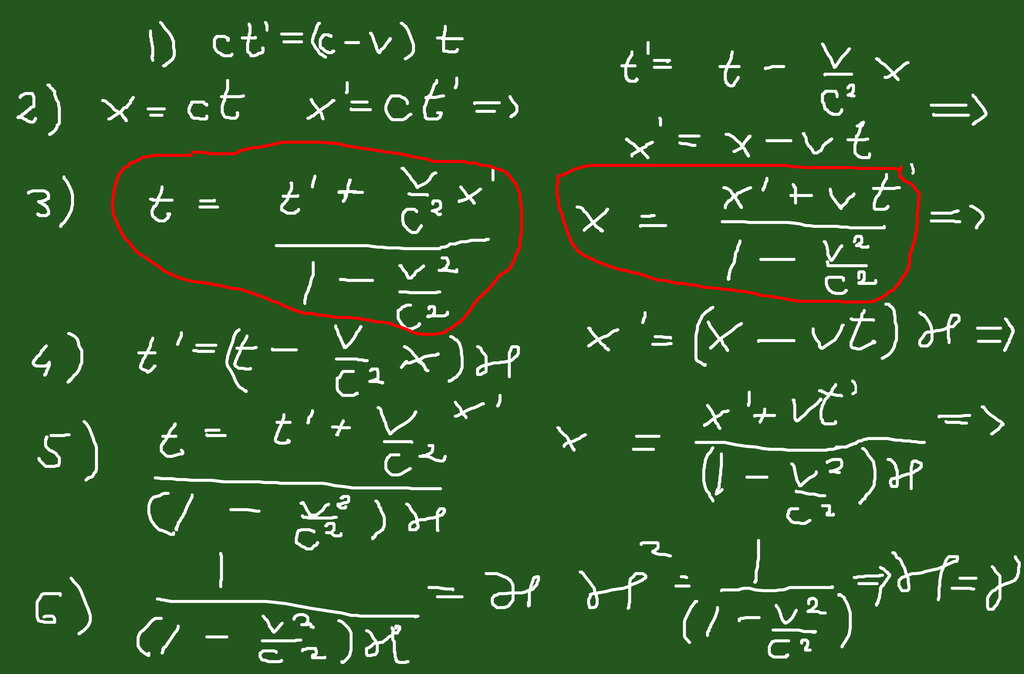
These two postulates seem simple, but their consequences are mind-bending. They force us to abandon the classical idea of absolute space and absolute time. If the speed of light must remain constant for everyone, then something else has to give. As we'll see, what gives are our everyday notions of time and distance.
According to classical Newtonian physics, if you are on a train moving at 100 km/h and you throw a ball forward at 20 km/h, how fast does an observer standing on the ground see the ball moving?
What fundamental conflict in physics did Special Relativity resolve?
These two ideas laid a new foundation for physics, leading to a profound rethinking of the universe.