Three Phase Circuit Analysis Mastery
Three Phase Fundamentals
Generating Power in Threes
Single-phase AC power, with its single rising and falling sine wave, is useful for homes and small devices. But for industrial machinery and power grids, it's inefficient. The power delivered fluctuates, hitting zero twice in every cycle. To solve this, engineers turned to three-phase power.
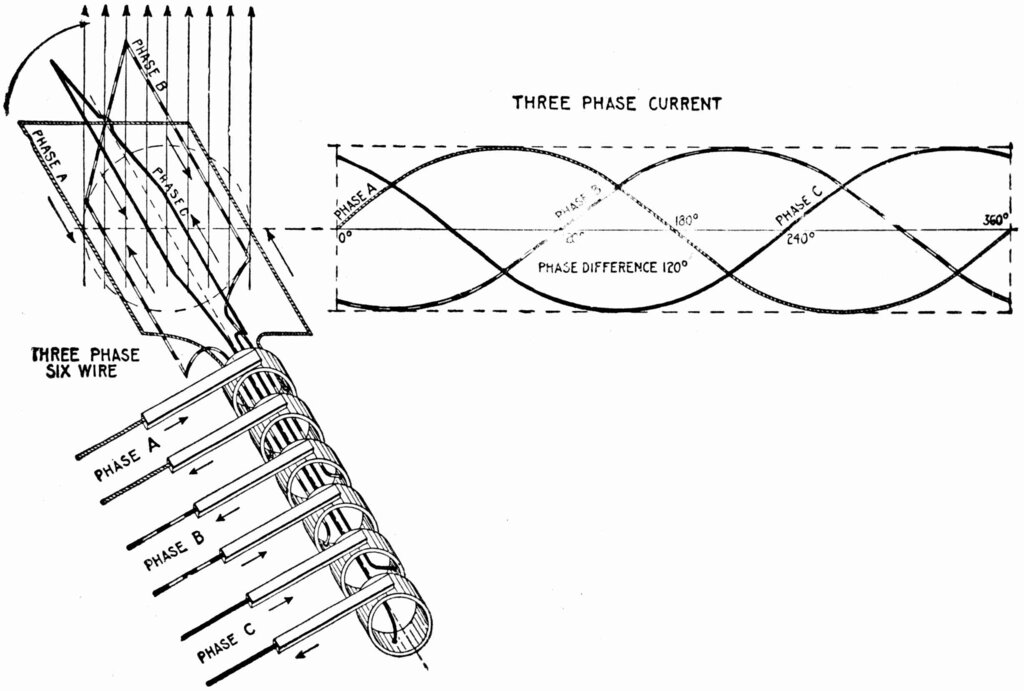
Imagine a generator with three separate coils, physically arranged in a circle and spaced exactly 120 degrees apart. As the generator's magnet rotates, it induces a voltage in each coil. Because the coils are offset, the AC voltage sine waves they produce are also offset. Each wave has the same amplitude and frequency, but they are out of sync—or out of phase—with each other by 120 degrees. These are typically labeled as phase A, phase B, and phase C.
The Math Behind the Waves
We can describe these three voltages with simple trigonometric functions. If we take phase A as our reference, its voltage at any instant in time, , can be represented as:
Since the other two phases are displaced by 120 and 240 degrees respectively, their equations follow a similar pattern, just with the phase shift included:
One of the most elegant properties of a balanced three-phase system is what happens when you add the instantaneous voltages of all three phases together. At any given moment, their sum is always zero.
This zero-sum property is incredibly useful. In a Wye (or Star) connection, it means the neutral wire, which connects to the center point, carries no current under ideal conditions. This allows for more efficient power transmission.
Sequence and Power Flow
The order in which the phase voltages reach their peak values is called the phase sequence. The standard sequence is A-B-C, where phase A is followed by B, then C. This is also called a positive sequence. Reversing the order to A-C-B creates a negative sequence.
This might seem like a minor detail, but it's critical for three-phase motors. The phase sequence determines the direction of the rotating magnetic field inside the motor. If you swap two of the phases, the motor will spin in the opposite direction. This could be catastrophic for equipment like pumps, fans, or conveyors.
The primary advantage of three-phase power is its ability to deliver a constant, non-pulsating stream of power to a load. While the power delivered by each individual phase still follows a sine wave, the sum of the power from all three phases is constant.
Constant power delivery means smoother operation for large motors and more efficient power transmission over the grid.
Furthermore, three-phase systems can transmit more power with less conductor material than a single-phase system at the same voltage. For a given amount of power, a three-phase line requires only 75% of the copper needed for a single-phase line, resulting in significant cost savings for utility companies.
Let's check your understanding of these core concepts.
What is the primary reason for using three-phase AC power over single-phase power for industrial applications?
In a generator producing three-phase power, what is the physical spacing of the three separate coils?
This combination of efficiency and smooth power delivery is why three-phase power is the backbone of industrial and commercial electricity grids worldwide.