Thinking Fast and Slow Explained
Introduction to Dual Systems
Your Two Minds
Your brain has two distinct ways of thinking. Think of it like having an autopilot and a pilot. The autopilot handles all the routine stuff without you even noticing, while the pilot takes the controls when things get complicated or require careful navigation.
These two modes are called System 1 and System 2. They work together constantly to help you navigate the world, but they operate in very different ways. Understanding how they function is the first step to making better decisions.
Meet System 1
System 1 is your autopilot. It's fast, intuitive, and always on. It operates automatically and quickly, with little or no effort and no sense of voluntary control. You can't turn it off.
This is the part of your mind that answers $2+2=?$, turns your head toward a sudden sound, or gets a bad feeling when you see an angry face. It recognizes patterns, makes quick judgments, and handles all the simple, everyday tasks that would be exhausting if you had to think about them consciously. It's an efficient machine, built to jump to conclusions and keep things moving.
System 1 is responsible for things like detecting that one object is more distant than another, completing the phrase "bread and...", and understanding simple sentences.
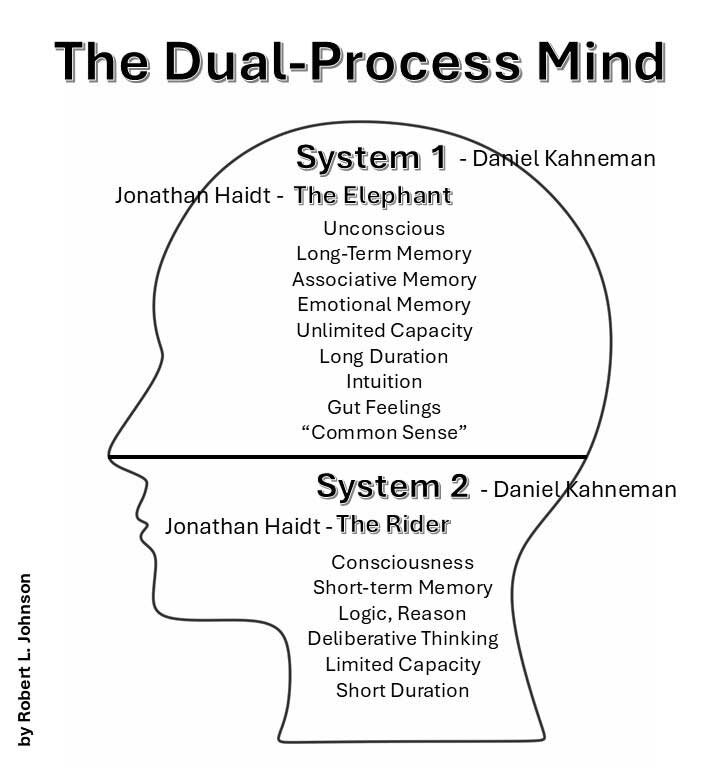
This powerful, automatic system is what guides most of our day-to-day life. But it's not the whole story. When the autopilot encounters turbulence or a situation it doesn't recognize, it calls for help from the pilot.
Waking Up System 2
System 2 is your conscious, reasoning self—the pilot. It's who you think of as "you." This system is slow, deliberate, and requires effort. It's what you use when you're focusing on a complex task, like solving a tricky math problem or choosing between two job offers.
When you are asked to compute , System 2 gets to work. You'll likely feel a sense of mental strain. Your pupils might dilate, and your heart rate might increase slightly. This is the physical sign of System 2 allocating attention to a demanding task.
This system is lazy. It prefers to let System 1 handle things whenever possible. Engaging System 2 is mental work, and our brains are wired to conserve energy. So, it only steps in when necessary: when a problem is too complex for System 1, or when System 1's quick suggestion is flagged as a potential error.
| Characteristic | System 1 | System 2 |
|---|---|---|
| Speed | Fast | Slow |
| Effort | Automatic, effortless | Deliberate, effortful |
| Control | Involuntary | Voluntary |
| Process | Intuitive, emotional | Logical, analytical |
The Handover
The two systems don't work in isolation. They have a dynamic relationship where System 1 is constantly feeding suggestions to System 2: impressions, intuitions, and feelings. For the most part, System 2 accepts these suggestions and acts on them.
For example, if you're walking and see a large puddle, System 1 instantly suggests "walk around it." System 2 quickly endorses this simple, logical idea, and you change your path without much conscious thought. The handover is seamless.
Trouble can arise when System 1 makes a mistake because it relies on simple rules and associations. If the situation is complex, System 1's quick answer might be wrong. It's System 2's job to step in, question the suggestion, and apply logic and deeper analysis. This requires effort, so it doesn't always happen.
System 1 runs the show by default. System 2 is the backup, mobilized only when the stakes are high, when an error is detected, or when the rules of System 1 don't apply.
Ready to test your understanding of these two systems?
Which of the following best describes System 1 thinking?
When you are asked to solve a complex math problem like , which system takes the lead?
Recognizing the interplay between your fast, intuitive mind and your slow, analytical mind is a fundamental skill for improving your thinking.