Thin Orifice Flow Dynamics
Orifice Theoretical Framework
The Ideal Orifice
To measure how fast a fluid is moving through a pipe, we can insert an obstruction and measure the effect it has. The most common tool for this is a thin plate with a precise hole in it, called an orifice plate. By forcing the fluid through this smaller opening, we create a pressure difference that we can relate directly to the flow rate.
To begin, let's model this situation under ideal conditions. We'll assume the fluid is incompressible and has no viscosity. We can use two familiar principles: the continuity equation, which conserves mass, and Bernoulli's principle, which conserves energy.
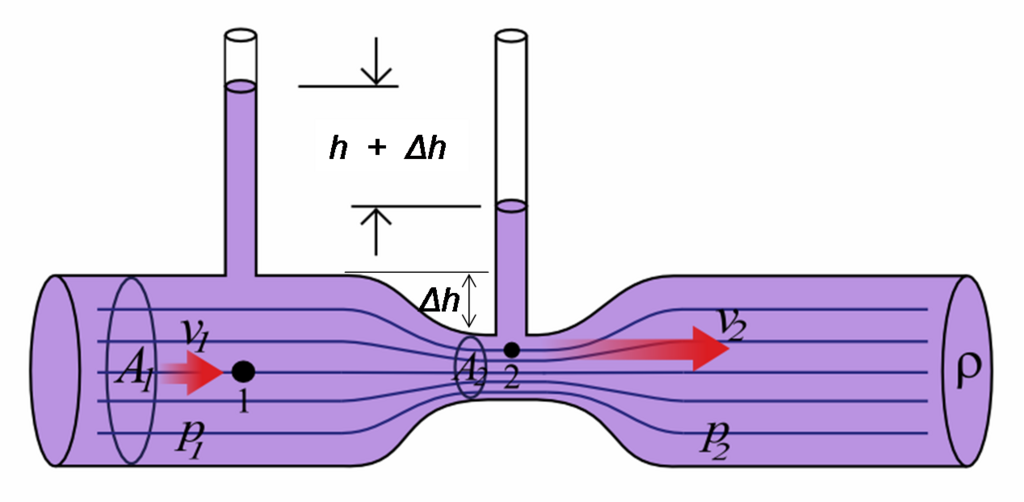
Let's label the conditions upstream of the orifice as point 1 (pressure , velocity , area ) and at the orifice as point 2 (pressure , velocity , area ). For a horizontal pipe, Bernoulli's equation is:
The continuity equation tells us that the mass flow rate is constant:
We can rearrange the continuity equation to express in terms of as . Substituting this into Bernoulli's equation and solving for , we get an expression for the ideal velocity of the fluid as it passes through the orifice:
From this, we can find the ideal mass flow rate, , by multiplying the ideal velocity by the fluid density and the orifice area, .
Reality Check: The Vena Contracta
The ideal model provides a great starting point, but it overlooks a crucial real-world effect. As the fluid approaches the sharp edge of the orifice, it can't make a perfect right-angle turn. The fluid streamlines continue to converge for a short distance downstream of the plate. This point of maximum stream contraction, where the jet has its smallest diameter, is called the vena contracta an d it's where the fluid velocity is highest and pressure is lowest.
Because the effective flow area at the vena contracta is smaller than the physical area of the orifice itself, the actual velocity is higher and the measured pressure drop is different than our ideal calculation predicts. This discrepancy means the actual mass flow rate is always lower than the ideal mass flow rate. To account for this, a correction factor called the discharge coefficient is introduced, but the physics of the vena contracta is the primary reason why it's needed.
Orifice Geometry and Measurement
The design of an orifice meter is highly standardised to ensure repeatable results. A key parameter is the beta ratio (), which is the ratio of the orifice diameter () to the pipe's internal diameter ().
The choice of involves a trade-off. A smaller creates a larger, more easily measured pressure difference, but it also causes a greater permanent pressure loss in the system, which costs energy. Typical values for range from 0.2 to 0.75.
Where you measure the pressure also matters. Different standards specify different locations for the relative to the orifice plate. The most common configurations are:
- Flange Taps: Placed 1 inch (25.4 mm) upstream and 1 inch downstream from the plate faces. This is the most common setup in North America.
- Corner Taps: Drilled directly into the orifice plate carrier flanges, opening into the corner where the plate meets the pipe wall. They are common in Europe.
- D and D/2 Taps: The upstream tap is located one pipe diameter () away from the plate, and the downstream tap is half a pipe diameter () away. This downstream tap is positioned to be near the average location of the vena contracta.
The location of the pressure taps is critical because the pressure changes rapidly near the orifice plate. Using standardised locations ensures that measurements from different meters can be compared reliably.
Finally, the plate itself must be a "thin plate," meaning its thickness at the orifice edge is small compared to the orifice diameter. This ensures the flow doesn't reattach to the inside of the bore, which would alter the flow dynamics and make the vena contracta less predictable. If the plate is too thick, it starts behaving more like a nozzle, for which the fluid dynamics are different.