Thesis Completion for Mobility Data Storytelling
Understanding Human-Centered Design
Putting People First
Have you ever used a product and thought, "Whoever designed this must have never actually used it"? Maybe it was a confusing website, a poorly placed doorknob, or a software feature that made a simple task complicated. This frustration often stems from a design process that forgot the most important element: the human user.
Human-centered design (HCD) flips the traditional script. Instead of building something and then hoping people will like it, HCD starts with the people you're designing for. It's a creative approach to problem-solving that grounds the entire process in the needs, behaviors, and desires of real individuals.
Human-centered design (HCD) is an approach that aligns innovation development with the needs of the people and the settings where those innovations will be used.
The core of HCD isn't just about asking people what they want. Often, people can't articulate their needs clearly, or they might suggest solutions based only on what they already know. Instead, HCD is about deeply understanding their experiences, challenges, and context. This is where empathy comes in.
Empathy
noun
The ability to understand and share the feelings of another person from their perspective.
In design, empathy means watching, listening, and immersing yourself in the user's world. It’s about understanding not just what they do, but why they do it. This deep understanding is the foundation for creating solutions that are not only functional but also meaningful and enjoyable to use.
A Journey of Discovery
Human-centered design isn't a chaotic free-for-all. It follows a structured, iterative process. While different models exist, they generally share a few key stages. Think of it less as a rigid checklist and more as a flexible roadmap that guides you from a problem to a solution.
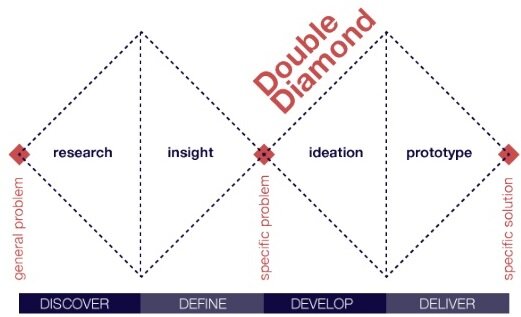
Let's walk through the fundamental stages:
-
Observation: This first phase is all about empathy and understanding. Designers go out into the world to observe and talk to people in their own environment. They conduct interviews, watch how people perform tasks, and try to uncover unspoken needs and frustrations. The goal is to gather raw insights about the user’s experience.
-
Ideation: With a deep understanding of the user, the team begins to brainstorm. This stage is about generating a wide range of ideas, no matter how wild they seem. The focus is on quantity over quality at first. After brainstorming, the team refines these ideas into concrete concepts that directly address the needs uncovered during observation.
-
Prototyping: Ideas are just ideas until you make them tangible. In this stage, designers build quick, low-cost models of their solutions. A prototype can be anything from a simple paper sketch of a mobile app to a physical mock-up of a new product. The goal is to create something users can interact with.
-
Implementation & Testing: The prototype is put in front of real users for feedback. This testing reveals what works, what doesn’t, and what's confusing. Based on this feedback, the team refines the prototype and tests again. This loop of prototyping, testing, and refining continues until the solution effectively meets the users' needs. Finally, the polished solution is ready to be fully built and launched.
Involving users isn't a one-time event. It's a continuous conversation that makes the final product stronger, more intuitive, and more likely to succeed.
The benefits are clear. By involving users from the beginning, you reduce the risk of building the wrong thing. You create products that people genuinely want to use, which leads to higher satisfaction and adoption. It’s a shift from designing for users to designing with them.
What is the fundamental principle of Human-Centered Design (HCD)?
In the context of HCD, what does 'empathy' primarily involve?